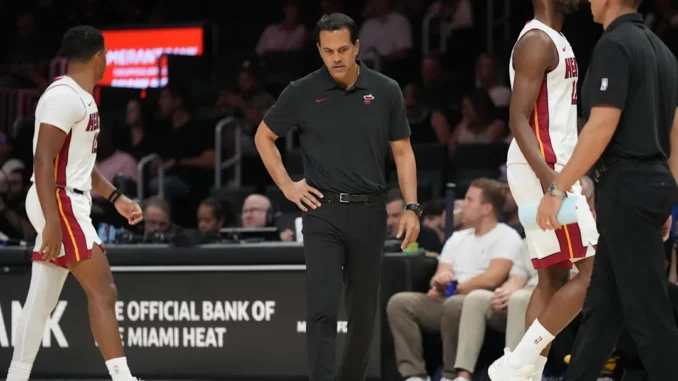
The Ugly Truth the Heat Can’t Run Away From: Vegas Doesn’t Believe in Miami
The Miami Heat enter a new season without the familiar security blanket of recent years. Gone is the absolute certainty of a top-four seed, the unshakeable confidence built on the back of Jimmy Butler’s playoff heroics, and the annual assumption that the vaunted “Heat Culture” will simply bend reality to its will. The ugly truth—and the one the Heat organization must now confront—is that the era of relying on high-floor, high-variance superstar play is over. This shift is brutally quantified by the latest betting lines, where Vegas has delivered a verdict more damning than any media critique: they project the Miami Heat as a middling Eastern Conference team.
The shock of the 37.5 win total placed on Miami by major sportsbooks is not just a numerical slight; it represents a seismic shift in organizational standing. This is a team that was recently projected for 44.5 and 45.5 wins in previous seasons, consistently exceeding expectations in the regular season or making deep playoff runs from a low seed. A drop of seven to eight projected wins is the clear consequence of an offseason defined by subtraction and realignment. Pat Riley’s hard-line stance on roster management, and the subsequent trade of Jimmy Butler to the Golden State Warriors, has forced a reckoning. Miami is no longer feared; they are now questioned.
The Void: Quantifying the Loss of the Playoff Demi-God
The Heat’s recent identity, especially in the postseason, was inextricably linked to Jimmy Butler. He was the ultimate counter-culture figure within a culture-first organization: the player whose personal relentlessness perfectly mirrored the team’s ethos. While his regular-season contributions were often measured (and sometimes injury-limited), his presence guaranteed a championship ceiling the moment the playoffs began.
The trade of Butler, which also saw role players like Josh Richardson exit, created a profound void in two critical areas: star power and late-game execution.
1. The Statistical and Intangible Crater
Butler averaged 20.8 points, 5.7 rebounds, and 5.2 assists over his time in Miami, but those numbers undersell his impact. He was the point-of-attack scorer who bent defenses, the secondary playmaker who alleviated pressure on Bam Adebayo, and the primary closing option. Critically, he provided an offensive rating boost that few players can replicate. Replacing 20 points per game is simple; replacing the gravity and will of a top-15 player is nearly impossible through minimum signings and internal development.
2. The Leadership Vacuum
The win total plunge reflects a statistical model that now sees a team with no clear, elite top-tier scoring wing. The most successful version of the Heat under Erik Spoelstra relied on the tension between Butler’s aggressive style and Spoelstra’s disciplined system. Now, the weight of the organization’s championship aspirations falls squarely onto the shoulders of Bam Adebayo and Tyler Herro. Adebayo is a Defensive Player of the Year-caliber anchor, but his offensive game, while improved, lacks the high-volume, self-creation necessary for a true number one option. Herro, for all his scoring punch, has never functioned as the primary engine of a top-tier offense. The new Heat must find a way to create an identity without the force of nature that defined their recent Finals appearances.
The Eastern Conference Power Shift
Miami’s dip in projected wins is made all the more painful by the simultaneous rise of their Eastern Conference rivals. While the Heat took a step back, the teams surrounding them only got better, making the path to even the Play-In Tournament far more congested and difficult.
The New Standard-Bearers
- Philadelphia 76ers: The acquisition of Paul George to pair with Joel Embiid instantly creates a terrifying two-way duo, boosting Philadelphia back into the conversation for the top two seeds.
- New York Knicks: The acquisition of Karl-Anthony Towns provides the Knicks with a third dynamic scorer next to Jalen Brunson and O.G. Anunoby, upgrading their offense significantly and solidifying their place among the East’s elite.
- Milwaukee Bucks: Even with major roster churn in recent years, the Bucks remain a threat, securing players like Myles Turner and Gary Harris to maximize Giannis Antetokounmpo’s window.
- Atlanta Hawks & Orlando Magic: Even the next tier of competitors—teams Miami must beat to stay relevant—are becoming more imposing. The Hawks and Magic are built on young talent that continues to mature, meaning Miami can’t expect easy wins against developing rosters.
The result is a congested, top-heavy Eastern Conference where the Heat are now positioned, optimistically, in the 7th-10th seed conversation. Vegas is not predicting a complete collapse, but they are predicting mediocrity—a fate that is perhaps even more insulting to the Heat organization than a full tanking scenario.
The New Core and the Development Dilemma
The Heat’s pivot, whether intentional or forced by the Butler trade saga, is now centered on the development of its existing young assets and recent draft picks. This is the new “Culture” challenge: can they transform potential into production, not just marginally, but dramatically?
The Herro and Adebayo Mandate
The success of the 2024-2025 campaign will hinge entirely on the ability of Tyler Herro and Bam Adebayo to elevate their games from elite secondary options to genuine primary stars.
- Tyler Herro: He must become a more efficient volume scorer. The Heat need him to consistently generate 25+ points per game while improving his true shooting percentage. More than that, he must take strides as a primary ball-handler and organizer, a role he has struggled with under extreme pressure.
- Bam Adebayo: While his defense is unimpeachable, his offensive game needs to transcend its current ceiling. He needs to assert himself more aggressively in the paint, demand the ball, and use his enhanced mid-range jumper not just as a tool, but as a weapon. His average of 20-22 points per game must be reliable, not sporadic.
The Youth Brigade
The Vegas win total also serves as a warning about the inherent uncertainty of relying on young players. The Heat have intriguing prospects, but they are still unproven contributors on a team with playoff expectations.
- Jaime Jaquez Jr.: The second-year swingman was a revelation last year, earning a place in the rotation through toughness and polished mid-post play. He must avoid the dreaded sophomore slump and demonstrate that his high-IQ game is sustainable over a grueling 82-game schedule.
- Nikola Jovic and Kel’el Ware: Jovic, a 6’10” forward, and Ware, the promising rookie center, represent the team’s biggest unknown upside. Jovic must solidify a starting spot with consistent three-point shooting and defensive awareness. Ware, the 15th overall pick, is expected to eventually contribute valuable rim protection and vertical spacing. If either or both struggle, the Heat’s depth at key positions (forward/center) becomes thin immediately.
The roster is built on the hope that these players grow exponentially, but hoping for growth is not the same as banking on established production—which is why the oddsmakers are hesitant.
The Pat Riley Pivot: A New Era of Patience
The trade of Jimmy Butler symbolizes more than just the end of a competitive window; it signifies a strategic pivot by Pat Riley. For years, Riley has chased stars and prioritized the present, often operating at the luxury tax line and maximizing his core’s readiness. The decision not to offer Butler the max extension he desired, leading to the trade, suggests an organizational shift towards long-term fiscal health and cap flexibility.
The Heat are now focused on developing talent that can align with Bam Adebayo’s prime and prepare for the next star acquisition. This is a difficult, necessary move, but it guarantees a regular season full of inconsistency and growing pains. Spoelstra, now named the 2028 Olympic coach, has proven he can coach a roster to its absolute peak, yet even he cannot manufacture offensive firepower where none exists.
The genius of Erik Spoelstra and the famous Heat infrastructure is their ability to turn players overlooked by other teams (the undrafted player pipeline) into essential contributors. They will certainly maximize the roster they have, but maximizing a 37.5-win roster still results in a play-in team fighting for its life.
Leave a Reply