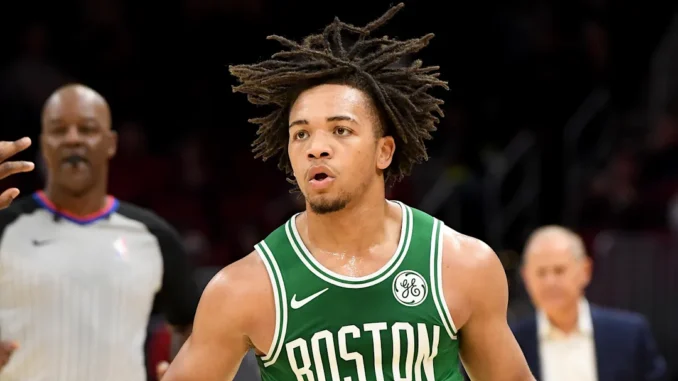
The Transatlantic Transformation: Carsen Edwards’ Ascent to Star Status in Europe
The Boston Celtics, like any successful, star-studded NBA franchise, have a history of discarding promising young projects who later blossom elsewhere. While names like Joe Johnson (drafted 10th in 2001) and Chauncey Billups (drafted 3rd in 1997) are the most famous examples of former Celtics draft picks becoming perennial NBA All-Stars, a more recent, fascinating case highlights the extreme pressure and specificity of talent evaluation in the modern NBA: Carsen Edwards.
The realization that Edwards, once a thrilling but ultimately non-contributing Celtics guard, has found a new life as a bona fide star in Europe underscores a critical, cyclical reality for deep NBA contenders: some highly-skilled players simply require a different platform to succeed. In Boston, Edwards was a spark plug who couldn’t find consistent minutes; overseas, he is a primary offensive engine, validating the talent the Celtics saw when they drafted him.
I. The Initial Project: A Burst of Uncontrolled Energy
Carsen Edwards was drafted by the Celtics with the 33rd pick in the 2019 NBA Draft after a phenomenal collegiate career at Purdue, where he was a pure, high-volume scorer known for his unlimited range and aggressive attack.
The Hype and the Reality
-
The Preseason Flash: Edwards instantly became a fan favorite in Boston following a legendary preseason performance where he famously knocked down eight three-pointers in a single quarter against the Cleveland Cavaliers. This explosion confirmed the Celtics’ rationale: a potential bench scorer who could warp a defense with his shooting gravity.
-
The NBA Wall: The excitement quickly faded when the regular season began. At 6-foot-0, Edwards struggled with the length and athleticism of NBA defenses. His aggressive offensive style, which worked in college, translated into inefficient volume and high turnover rates at the professional level. His scoring instinct clashed with the Celtics’ deep and structured offense, which demanded defensive consistency and precise passing. He spent most of his two seasons in Boston (and a brief stint with the Detroit Pistons) riding the bench or playing in the G League. He appeared in only 68 games for the Celtics, averaging just 9.2 minutes per contest.
The Celtics’ need for him was simple: a microwavable scorer. The reality was complicated: his skillset didn’t scale effectively against top NBA competition, and his defensive deficiencies prevented him from earning Joe Mazzulla’s (and previously Brad Stevens’) trust.
II. The Transatlantic Pivot: Finding the Right System
After his NBA career sputtered out following the 2021-22 season, Edwards took the pivotal step of crossing the Atlantic, a move that often precedes career revival for highly-skilled guards whose game profiles better internationally.
The European Environment
Edwards’ game is perfectly suited for the EuroLeague and other top European leagues. The fundamental differences in the game allow his strengths to be maximized while masking his NBA weaknesses:
-
Reduced Athleticism Gap: The overall defensive athleticism, while still high, is not as overwhelming as the NBA’s, giving smaller guards more room to operate off the dribble.
-
Emphasis on Scoring Guards: Many top European teams, particularly those competing for EuroLeague titles, rely on American guards to be their primary shot creators and high-usage isolation scorers, a role that perfectly fits Edwards’ college pedigree.
Emergence as a Star
Edwards’ development was steady but undeniable. After his first year overseas with Fenerbahçe Beko, he found his footing, truly exploding onto the international stage with Bayern Munich and solidifying his position as one of the best guards outside the NBA with Virtus Bologna.
-
Statistical Dominance: This season, Edwards is showcasing the star power Boston fans once dreamed of. Playing significantly more minutes than his NBA career (around 24.2 minutes per game), he is averaging nearly 17 points per contest in league play and an even more impressive 18.3 points per game in EuroLeague action, putting him among the top scorers in the entire competition.
-
Efficiency: His shooting, once erratic, has settled into solid efficiency, shooting around 42.7% from the field and 36.9% from deep on a high volume of three-point attempts. He is now the offensive engine for a top European club.
III. The Lesson for the Celtics and the NBA
Carsen Edwards’ journey from a non-factor in Boston to a top international star serves as a clear lesson in the tyranny of the NBA context.
-
Role Specialization vs. Star Opportunity: In Boston, Edwards was destined to be a specialist—a five-minute bench scorer. The pressure to win immediately and the presence of high-usage stars like Jayson Tatum and Jaylen Brown meant there was no room for error or patience in developing his overall game. In Europe, he was handed the keys to the offense, allowing him the freedom and volume to grow into a multi-faceted player.
-
The Mid-Level Graveyard: Edwards’ path is common for players who were perhaps too good for the G League but not quite polished enough for an NBA rotation. The Celtics, always operating in “contend now” mode, have consistently leveraged these “young projects” (like Matisse Thybulle and Grant Williams) to acquire proven role players (like Derrick White), a strategy that ultimately led to a championship. While it’s bittersweet to see a former pick thrive elsewhere, Boston’s trade of a draft pick for Thybulle, who became an All-Defense player on the 76ers and Trail Blazers, demonstrates their willingness to prioritize immediate fit over potential development.
Edwards’ success in Europe is the ultimate validation of his offensive talent, a talent that simply needed a system built around him, rather than one built around All-NBA wing players, to achieve star status.
Leave a Reply