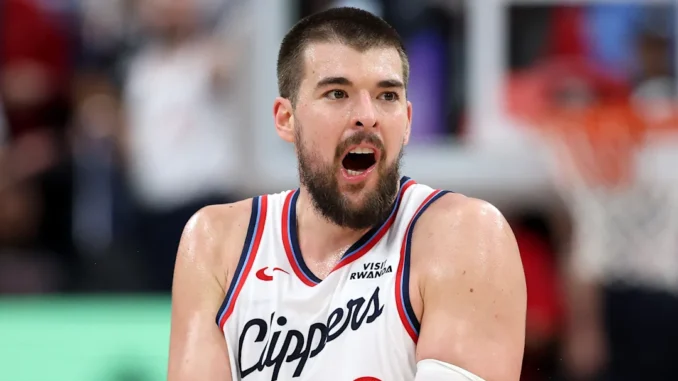
The Second Apron Lock: Why Ivica Zubac to the Celtics is a Near-Impossible CBA Hurdle
The Boston Celtics, eyeing a potential mid-season reinforcement to support their playoff push while Jayson Tatum recovers, have reportedly targeted Los Angeles Clippers center Ivica Zubac. Zubac, an All-Defensive Second Team selection and a high-efficiency anchor, is seen as the perfect frontcourt solution to replace the veteran depth lost in the offseason.
A trade framework is circulating—centered on sending the Celtics’ newly acquired, expiring contract of Anfernee Simons and draft capital to the Clippers for Zubac and possibly another player. On the surface, the deal makes sense for both sides: Boston gets its long-term center, and the rebuilding Clippers gain a high-upside young guard and crucial draft assets.
However, the biggest trade hurdle is not the Clippers’ asking price or the players involved; it is the severe and unforgiving restrictions of the new NBA Collective Bargaining Agreement (CBA), specifically the penalties imposed by the Second Apron. The Boston Celtics’ current financial status makes this trade nearly impossible to execute under the new rules.
The Major Hurdle: The Aggregation Ban
The core problem stems from the most restrictive penalty for teams operating above the Second Apron (projected to be around $207.8 million for the 2025-2026 season):
Teams above the Second Apron cannot aggregate player salaries in a trade.
This means that a Second Apron team cannot combine the salaries of two or more of their own players to match the salary of a single player they are acquiring.
The Zubac Math Problem
-
Zubac’s Salary: Ivica Zubac’s salary for the 2025-2026 season is approximately $18.1 million.
-
Celtics’ Outgoing Assets: The Celtics’ most valuable trade chip is Anfernee Simons, whose contract for the 2025-2026 season is approximately $27.7 million. Simons alone could absorb Zubac’s salary without an issue (as teams below the Second Apron can take back 125% of the outgoing salary).
-
The Celtics’ Apron Status: While the Celtics executed major moves to drop their payroll, they remain a First Apron team with a total salary of approximately $200 million, placing them well within the zone of heightened trade restrictions.
The Real Snag: Trading for Additional Players
The rumored trade framework often includes the Celtics acquiring a second player, like forward Derrick Jones Jr., to help balance the trade or for additional roster depth.
-
If the Celtics acquire Zubac ($18.1M) and Jones Jr. ($10M), they are taking back roughly $28.1 million in salary.
-
To match this, the Celtics would need to send out at least $25.5 million in salary (as a First Apron team can only take back 110% of the outgoing salary).
If the Celtics attempt to send out Simons ($27.7M) for Zubac and Jones Jr. ($28.1M combined), it would be a single-player-for-multiple-players deal, which is allowed under the rules. However, the biggest restriction is likely to come from the Clippers, who are also grappling with the CBA’s apron rules.
The true hurdle is not the Celtics’ ability to make a salary-matching trade, but the philosophical and logistical nightmare of avoiding any aggregation when trying to construct a complex deal that involves draft picks and a third team, which is often required to land a player of Zubac’s caliber.
Other Restrictive Penalties
Even if the trade math works with just Simons for Zubac, the Celtics still face other significant trade hurdles that Brad Stevens must navigate:
| Restriction | Implication for Zubac Trade |
| Salary Matching Limit | A First Apron team like Boston can only take back 110% of the outgoing salary. This tight window reduces the flexibility to add other depth pieces in the deal. |
| Cannot Trade Cash | Second Apron teams cannot send cash in trades. This minor detail is a constant tool used by contenders to sweeten deals or offset minimum contracts. |
| Cannot Use Previous TPEs | Second Apron teams cannot utilize Traded Player Exceptions (TPEs) generated in the previous season. This eliminates a key mechanism Brad Stevens has historically used to absorb players without having to send out matching salary. |
| Limited Draft Pick Mobility | Teams above the Second Apron have their first-round pick seven years out (2033) “frozen,” meaning it cannot be traded. While this penalty doesn’t directly stop the current deal, it severely limits the long-term draft capital Boston can use to sweeten the pot now. |
The Stevens Solution: The Gap-Year Reset
Brad Stevens has already proven his ability to adapt to the CBA by trading away Jrue Holiday and Kristaps Porziņģis in the offseason. That move was explicitly designed to shed massive salary and avoid the punishment of the Second Apron in future years.
Trading for Zubac and locking in his $18 million salary for three more years, while still operating above the First Apron, is a counter-intuitive move that could jeopardize the financial flexibility Stevens worked so hard to establish for the 2027 season (when Tatum returns fully healthy).
Ultimately, while the desire for a championship-caliber center is real, the CBA’s punitive measures serve as a near-insurmountable wall. Unless the Clippers are willing to take Simons and just a single first-round pick for Zubac—a proposition many believe to be too low—the Celtics may be forced to look for a more cost-controlled, lower-salaried player to fill their center void.
Leave a Reply