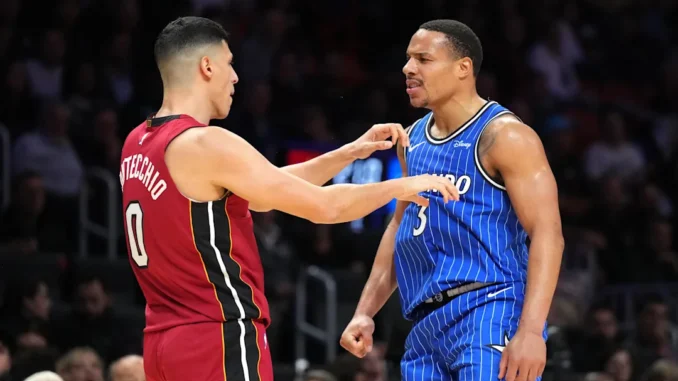
The Miami Heat’s ongoing struggles against the Orlando Magic continued on January 28, 2026, as they fell 133-124 at home in Kaseya Center, dropping to 0-4 against their in-state rivals this season. Norman Powell, Miami’s leading scorer on the year, appeared to hit a wall in this matchup—struggling early with efficiency and defensive assignments before mounting a late rally that proved insufficient to overcome Orlando’s third-quarter explosion.
The bench unit, including contributions from Simone Fontecchio and others, kept the Heat competitive through stretches, particularly in the second quarter surge that built a halftime lead. However, that effort faded as fatigue set in, and the team’s inability to sustain momentum—especially in the pivotal third period—doomed them once again against a surging Magic squad.
Game Recap and Momentum Swings
Orlando entered the contest looking to snap a four-game skid, and they did so emphatically behind Paolo Banchero’s 31-point, 12-rebound double-double and Anthony Black’s career-high 26 points off efficient shooting. The Magic shot 50% from the field, hit 16 threes, and committed only seven turnovers while dishing out 36 assists, showcasing sharp ball movement and transition dominance.
The Heat started slowly, trailing 34-27 after the first quarter as Orlando capitalized on interior scoring and fast breaks. Miami flipped the script in the second, outscoring the visitors 41-25 to take a 68-59 halftime advantage. Bench spark and perimeter shooting fueled the run, with Fontecchio providing instant offense and the unit forcing turnovers that led to easy points.
The third quarter became Miami’s recurring nightmare. Orlando erupted for 40 points while limiting the Heat to just 20, turning a nine-point deficit into an 11-point lead. Defensive lapses allowed easy drives, open threes, and second-chance opportunities, as the Magic grabbed a significant edge in offensive rebounds during the frame. This 20-point swing shifted control decisively.
Miami fought back valiantly in the fourth, narrowing the gap to six points (128-122) with 1:25 remaining on a Powell and-1 play. But Orlando’s composure—led by timely buckets from Banchero, Black, and Desmond Bane (23 points)—preserved the victory. The final margin reflected Orlando’s balance and execution down the stretch.
Norman Powell’s Performance: Hitting the Wall
Powell, who has been a consistent scoring threat for Miami (averaging around 23 points per game in recent stretches), finished with 22 points on 8-of-17 shooting (47.1%), including 2-of-7 from three (28.6%) and a perfect 4-of-4 from the line in 28 minutes. He added two rebounds, one assist, one block, three turnovers, and five fouls, posting a -7 plus-minus.
The night started rough for Powell. He struggled to find rhythm early, missing contested shots and facing aggressive defense from Orlando’s length—particularly guards like Black and Jalen Suggs. Reports noted he was “constantly attacked” defensively, leading to foul trouble and inefficient possessions. His rough start contributed to Miami falling behind in key moments, putting additional pressure on the starters.
Powell showed resilience in the fourth, scoring nine of his points in the period, including a clutch and-1 that cut the deficit to six and sparked a brief rally. That late surge highlighted his scoring ability when finding his groove, but it came too late to erase the earlier damage. Analysts graded him a D+ in postgame evaluations, citing the slow start and defensive struggles as major factors, while noting he’s been battling a back issue throughout the season that may be contributing to inconsistency.
This performance fits a pattern for Powell in recent games against athletic, lengthy teams—he can erupt when hot but hits walls when contested heavily or fatigued. The All-Star break looms as a potential reset, but Miami needs more consistent output from him to climb the standings.
Bench’s Role: Keeping Miami Alive, But Not Enough
Miami’s reserves played a pivotal role in the second-quarter comeback, providing energy, shooting, and defense when the starters needed a breather. Simone Fontecchio led all scorers with a season-high 23 points in just 19 minutes, draining six threes for an efficient spark off the bench. His shooting stretched Orlando’s defense and kept the Heat in striking distance during lulls.
Other bench pieces contributed to the effort: secondary scoring, hustle plays, and perimeter pressure helped force turnovers and build the halftime lead. The unit’s activity contrasted with the starters’ third-quarter flatness, underscoring depth as a strength for Miami despite injuries (Tyler Herro sidelined again with rib issues).
However, the bench couldn’t sustain the momentum into the second half. Fatigue crept in as Orlando’s athleticism wore down rotations, and Miami’s overall 18 turnovers (many leading to transition points) limited second-unit impact. The reserves kept the game close longer than expected, but the third-quarter collapse overwhelmed their contributions.
Key Statistical Breakdown
- Scoring Leaders: Orlando – Banchero 31, Black 26, Bane 23; Miami – Fontecchio 23, Powell 22, Adebayo 21.
- Efficiency: Magic shot 50% FG, 42.1% 3PT (16 made); Heat solid in spurts but hampered by turnovers.
- Rebounding/Defense: Orlando edged key second-chance opportunities; Miami forced 18 turnovers but gave up too many easy looks.
- Third Quarter: Decisive 40-20 Orlando run highlighted Miami’s Achilles’ heel, as Powell himself called it postgame: “It’s our Achilles heel… It sucks, honestly.”
Injuries factored in: Franz Wagner missed his fourth straight for Orlando (ankle), while Miami was without Herro.
Rivalry Implications and Broader Context
The 0-4 mark against Orlando this season—including an NBA Cup loss—highlights a stylistic mismatch. The Magic’s youth, length, and defensive versatility trouble Miami’s more veteran, perimeter-oriented approach. Orlando’s win boosts their 24-22 record and playoff push, while Miami (25-23) slips further in the competitive East.
With the February 5 trade deadline approaching, this loss intensifies scrutiny on roster construction. Ongoing rumors about superstar pursuits (e.g., Giannis Antetokounmpo) persist, but internal fixes—like better third-quarter execution, turnover reduction, and Powell regaining consistency—are urgent.
Powell’s late push showed fight, and the bench’s effort prevented a blowout, but Miami’s inconsistency against divisional foes remains a concern. The Heat start a back-to-back next, needing quick adjustments to avoid further slippage.
In a back-and-forth divisional battle, Orlando’s third-quarter dominance and balanced attack proved too much. Powell hit the wall early, the bench kept hope alive briefly, but ultimately, Miami fell short again—searching for answers as the season intensifies.
Leave a Reply