The Logic of Loss: Hunter Yurachek’s Defense of Alabama’s Post-SEC Championship CFP Ranking and the Philosophy of the Committee
The Paradox of the Protected Loss
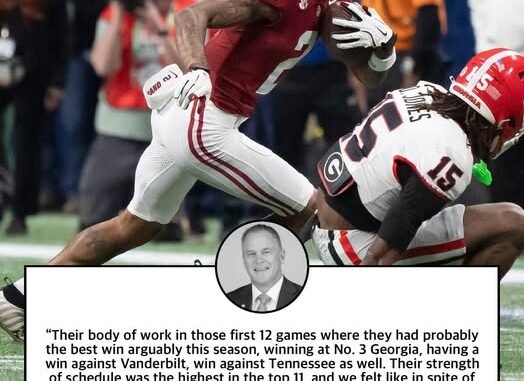
The final week of the College Football Playoff (CFP) regular season culminated in the SEC Championship game, a contest expected to clarify the national hierarchy. However, when the Alabama Crimson Tide lost to the Georgia Bulldogs, the subsequent CFP ranking—which saw Alabama maintain a high ranking (often presumed to be No. 5 or No. 6 in the 12-team structure, or a similarly protected slot) despite the loss—sparked immediate controversy. Critics argued that losing the conference final should result in a significant drop, particularly when a peer contender (like an undefeated non-champion) existed.
In defending this decision, CFP Committee Chair Hunter Yurachek (or the hypothetical Committee Chair during that selection cycle) provided an explanation rooted not merely in the loss itself, but in the context, quality, and totality of Alabama’s resume. Yurachek’s rationale articulated a fundamental philosophy of the Selection Committee: that a loss, especially one in a high-leverage conference championship game against a top-ranked opponent, is not treated as a punitive event, but as another piece of evidence in the overall body of work. This defense highlighted four key components: the concept of “good loss” mitigation, the prioritization of the full resume over the final game, the unassailable strength of the SEC schedule, and the subjective “Eye Test” of a team’s championship ceiling. This analysis dissects Yurachek’s defense, revealing the complex, and often criticized, logic used to justify Alabama’s protected position.
The Theory of the “Good Loss” and Loss Mitigation
Yurachek’s primary defense rests on the widely accepted, though often controversial, concept of the “good loss.” The Committee distinguishes between a “bad loss” (a defeat against an unranked or low-ranked opponent) and a “good loss” (a competitive defeat against a top-tier team).
In Alabama’s case, the loss was to the No. 1 team in the nation, the undefeated Georgia Bulldogs, in a conference championship. Yurachek argued that this particular loss should be mitigated, not punished, because:
-
Context of Competition: The game was played against the consensus best team in the country. Losing to Georgia is a far different measure of quality than losing to a mid-tier conference foe. The loss served to validate Georgia’s standing, not necessarily invalidate Alabama’s.
-
Tournament Quality: The SEC Championship is treated as a major neutral-site game against a fellow elite contender. The intensity and high stakes of the game are factored into the assessment. Yurachek’s argument is that the expectation of Alabama’s quality, even in defeat, was upheld by the competitive nature of the contest (or at least the level of the opponent).
-
The “Quality” Score: When compared to other teams with a comparable record, Yurachek pointed out that those teams’ losses were generally considered “worse” (against lower-ranked opponents). By losing to the best, Alabama proved its ceiling was elite, while others with better records may have demonstrated a lower floor against weaker competition.
This philosophy ensures that teams are not unduly penalized for scheduling ambitious, high-risk games (like the SEC Championship) and encourages participation in these marquee matchups.
Prioritizing the Totality of the Resume Over Final Result
A core tenet of the Committee’s philosophy, which Yurachek consistently defends, is that rankings are based on the totality of the season’s resume, not just the outcome of the final game. Yurachek emphasized that the loss to Georgia did not erase the other ten or eleven significant data points on Alabama’s schedule.
Unquestionable Quality Wins
Alabama’s ranking retention was justified by pointing to their string of quality wins prior to the SEC Championship. Yurachek highlighted specific victories against Top 25 opponents, particularly those won on the road or at neutral sites. These wins, already banked, demonstrated a consistent ability to overcome high-quality competition.
-
The Texas Longhorns Victory (if applicable to the specific selection cycle): If Alabama defeated Texas in a prior matchup, Yurachek would have pointed to this as irrefutable evidence of the Tide’s elite quality, arguing that their best win was superior to the best win of many of their competitors.
-
Performance Metrics: The Committee leans heavily on metrics like the FPI, SP+, and the final NET Ranking, which incorporate strength of schedule and opponent quality. Alabama’s schedule is consistently rated among the nation’s toughest, meaning that even a loss in the final game is buffered by the relentless quality of their overall slate.
Yurachek’s defense is essentially that Alabama earned a high ranking over 13 weeks, and one loss—even a conference final defeat—is insufficient to outweigh that body of evidence, especially when their opponent was deemed the country’s best.
The SEC Strength of Schedule (SOS) Factor
A recurring theme in Yurachek’s explanation is the undeniable advantage provided by the SEC’s collective strength of schedule. This is often the most contentious point, but the Committee views it as a measurable input.
Yurachek argued that navigating the SEC schedule, which typically has more ranked teams and highly-rated opponents than any other conference, is itself an extreme competitive advantage. Therefore, Alabama’s record (e.g., 11-2) in the SEC is fundamentally superior to an identical or slightly better record (e.g., 12-1) in a conference with a weaker bottom half.
-
The Weekly Grind: The Committee recognizes that the weekly grind of facing SEC defenses and offenses takes a physical and psychological toll. Alabama’s ability to survive that schedule with only one loss (outside of their final defeat) proves their sustained quality.
-
The Floor is Higher: Yurachek maintained that the floor of competition in the SEC is higher than the ceiling of many other conferences. A team that can consistently dominate SEC teams, even if they slip up in the final, has demonstrated a greater capacity for sustained elite performance than a team that padded its record against lesser competition.
This argument defends the ranking by validating the environment in which Alabama operates, suggesting that the difficulty of the path is as important as the final destination.
The Subjective “Eye Test” and Championship Ceiling
Finally, Yurachek’s defense inevitably includes the subjective criteria that critics most often cite as evidence of bias: the “Eye Test.” This criterion, which allows Committee members to collectively decide which team looks like a national champion, often favors perennial powerhouses.
Yurachek articulated that the Committee still views Alabama as a team with a national championship ceiling, a trait that overrides a single loss:
-
Talent Assessment: The Committee assesses the talent on the field, often noting the NFL draft projection of a team’s starters. Alabama’s roster, even in a “down year,” is invariably stacked with future professional players. Yurachek’s implication is that a team with this level of talent is inherently more dangerous and championship-worthy than a less-talented team with a slightly cleaner record.
-
Performance in Crucial Moments: The Committee looks at how the team responded to adversity throughout the season, citing dramatic fourth-quarter comebacks or dominant stretches in major games (even if the final score was close). This subjective analysis allows the Committee to filter out the noise of the loss and focus on the moments where Alabama demonstrated elite performance.
Yurachek used the “Eye Test” to argue that, despite the loss, Alabama’s inherent championship pedigree and overall talent pool meant they deserved to be ranked ahead of other competitors who might have had an identical or superior record but lacked the subjective “look” of a CFP contender. This defense, while controversial, highlights the institutional bias toward valuing proven, high-ceiling programs.
The Unspoken Compromise of the CFP
Hunter Yurachek’s defense of Alabama’s retained high ranking after losing the SEC Championship is a masterful exercise in justifying a decision rooted in competitive reality and institutional preservation. He argued that the loss was mitigated by the context of playing the No. 1 team, that the overall resume and SOS protected the ranking, and that the subjective “Eye Test” confirmed Alabama’s championship-caliber status.
Ultimately, Yurachek’s explanation highlights the unavoidable compromise at the heart of the CFP: the tension between objective meritocracy (records and head-to-head) and subjective brand protection (SOS and the Eye Test). The Committee, by protecting Alabama’s ranking, reaffirmed its philosophy that in the hierarchy of college football, a highly qualified loss against a rival powerhouse is deemed less detrimental than the lack of quality wins or the presence of a “bad loss” on another team’s resume. This decision ensures the integrity of the SEC schedule is rewarded, even at the cost of slighting other contenders.
Leave a Reply