The Unprecedented NIL Era: How the New York Knicks Are Navigating a Shifting Basketball Landscape Where College Could Lure Away Pros
In late December 2025, a bizarre and historic development shook the basketball world: James Nnaji, a 21-year-old center whose NBA draft rights are owned by the New York Knicks, enrolled at Baylor University and was granted immediate eligibility—with four full years to play for the Bears. Nnaji, selected 31st overall in the 2023 NBA Draft (initially by the Detroit Pistons, with rights traded multiple times, landing with the Knicks in the Karl-Anthony Towns blockbuster), had never signed an NBA contract. He spent years playing professionally in Europe for clubs like FC Barcelona and appeared in NBA Summer League for both the Hornets and Knicks. Yet, the NCAA cleared him to compete in college basketball, effectively allowing a drafted pro prospect to “stash” himself in the NCAA rather than overseas or in the G League.
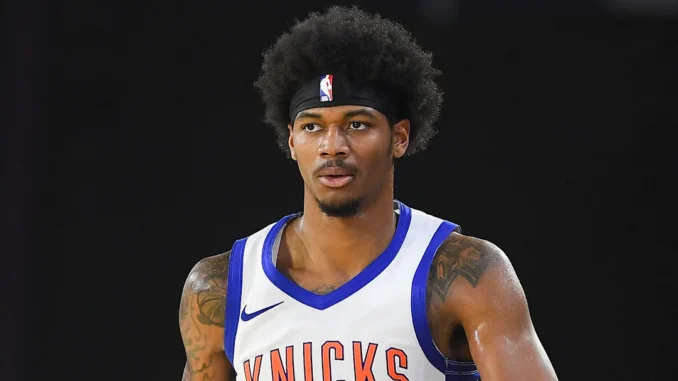
This move isn’t a huge immediate blow to the Knicks—Nnaji hasn’t played a regular-season NBA game and was a long-term project. But as one article aptly titled it, “The Knicks might lose another player to a college team in unprecedented NIL era.” Rumors swirl around another Knicks-affiliated prospect, 19-year-old Dink Pate (currently with the Westchester Knicks in the G League), potentially following suit. Sources suggest Pate has received informal clearance for NCAA eligibility, where NIL deals could far outpace his G League earnings. This isn’t isolated; it’s symptomatic of a seismic shift in basketball’s developmental pipeline, driven by Name, Image, and Likeness (NIL) rules that have turned top college programs into lucrative alternatives to minor-league pro ball.
The Nnaji Case: A Precedent-Setting Anomaly
Nnaji’s path exemplifies the blurring lines between pro and amateur basketball. Born in Nigeria, he turned pro early in Europe, declaring for the 2023 draft at 19. Post-draft, he continued overseas rather than signing stateside. In summer 2025, he terminated his European contract, played Summer League with the Knicks (averaging modest numbers), but opted against committing to the NBA/G League route. Instead, he committed to Baylor on Christmas Eve 2025, eligible mid-season.
Key facts substantiating this as unprecedented:
- No prior modern case of a post-draft NBA pick (without college experience) gaining NCAA eligibility.
- The Knicks retain his rights indefinitely, per reports from The Athletic’s Fred Katz—essentially “loaning” him to Baylor for development.
- NCAA granted four years because Nnaji never triggered eligibility clocks (no prior college, no signed NBA contract; Summer League doesn’t count).
Reactions poured in: UConn coach Dan Hurley called it “crazy” on X. Analysts like CJ Moore noted the “wild world” of NIL enabling this. Critics argue it undermines amateurism—a drafted pro competing against freshmen feels mismatched. Proponents highlight fairness: NIL compensates athletes, and Nnaji’s pro experience was overseas, not NBA/G League regular seasons.
For the Knicks, it’s low-risk/high-reward. If Nnaji dominates at Baylor (addressing their need for rim protection), his stock rises; they can sign him later. Trade leverage improves too—collegiate stats could package him in deals.
The Potential Next Wave: Dink Pate and Beyond
The “another player” hint points to Pate, a 19-year-old guard signed as an undrafted free agent by the Knicks after stints with G League Ignite and Mexico City Capitanes. Playing for Westchester, he’s shown flashes (including historic triple-doubles for his age). But G League pay is modest (~$40k-$100k range for non-two-ways), while top NIL deals at power conferences can reach seven figures.
A trainer’s X post claimed Pate has “backdoor clearance” for NCAA play next season. At 19, he’d have full eligibility. NIL could multiply his earnings, delaying NBA entry until he’s more polished. For Knicks fans, losing Pate stings more—he’s a current roster piece with upside.
Broader trend: Former pros/G Leaguers like Thierry Darlan (ex-Ignite) and Abdullah Ahmed (54 Westchester games) have gained eligibility. Chicago Bulls two-way player Trentyn Flowers drew interest from 12 high-majors. If signed NBA contracts don’t bar eligibility (as long as no regular-season games?), the floodgates open.
Why This Happens Now: NIL’s Transformative Power
NIL, legalized in 2021, exploded post-2024 House v. NCAA settlement, enabling revenue sharing (~$20M+ per school annually starting 2025-26). Top players earn millions: Cooper Flagg reportedly made staggering sums at Duke; incoming BYU freshman AJ Dybantsa inked ~$7M.
Consequences for talent flow:
- Fewer early NBA entries: 2025 draft had only 106 early entrants (lowest since 2015), down from 353 in 2021.
- Pros opting for college: Lucrative NIL > G League/overseas for some. Development + pay + exposure.
- International shift: Scouts once trekked Europe; now, pros come stateside for college.
Evidence: On3 valuations show freshmen like Dybantsa at $4M+. Returning stars (e.g., JT Toppin at Texas Tech ~$4M) cite NIL.
The Insane Precedent: Reshaping Basketball’s Ecosystem
Short-term: Not catastrophic for Knicks. Nnaji was stashed anyway; Pate’s potential departure hurts depth but not contention (Knicks are 22-9 as of late 2025).
Long-term: Revolutionary.
- New Stashing Strategy: NBA teams draft internationals/late bloomers, “loan” to colleges for NIL-funded development. Cheaper than overseas contracts; retains rights.
- G League Threatened: Why grind for low pay when college offers millions + March Madness spotlight?
- Competitive Imbalance: Power conferences dominate recruiting pros. Mid-majors suffer.
- Eligibility Chaos: If drafted/signed pros play college, does it erode “student-athlete” ideal? Lawsuits loom—NCAA avoids strict enforcement post-antitrust losses.
- NBA Draft Impact: Thinner pools; more returns to school. Scouts pivot to college mid-seasons.
- Player Empowerment: Pros “job-hop” back to college for better deals. Leverage against teams.
Critics (e.g., former coaches like Tom Crean) warn of “breaking point.” Dan Hurley: “This s*** is crazy.” Others see evolution—college as viable pro alternative, like baseball’s minors.
For Knicks: Adapt or lose prospects. Leon Rose’s front office, aggressive in trades (Towns deal brought Nnaji), must monitor. If Pate bolts, it signals need for better G League incentives or earlier contracts.
Broader Implications for Basketball
This NIL era redefines pathways:
- Traditional: High school → College → NBA.
- Now: High school → Pro (overseas/G League) → College → NBA (or stay).
- Reverse one-and-done: Drafted, then college.
Potential fixes: NBA-NCAA partnership (minor league expansion)? Stricter eligibility (signed contracts bar college)?
As of December 29, 2025, Nnaji preps for Baylor debut. Pate shines in G League. The Knicks contend. But the precedent is set: In this unprecedented era, college isn’t just preparation—it’s a destination, even for pros.
This shift empowers players financially and developmentally. But it risks turning college hoops into semi-pro chaos, with NBA teams as unwitting farm systems. Not a “huge deal right now,” but indeed, an insane precedent that could redefine basketball for decades.
Leave a Reply