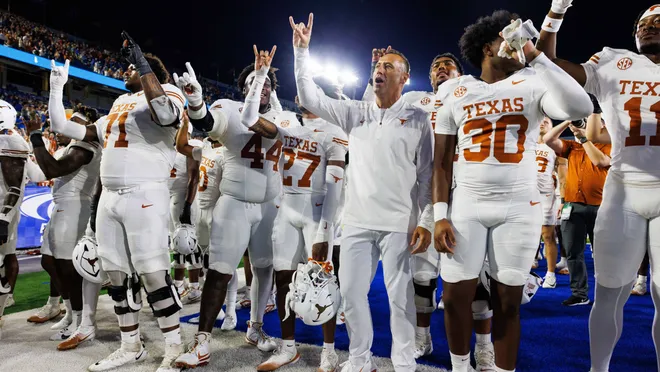
The Icy Resolve: How Mason Shipley’s Unflappable Leg Kicked Texas Past Kentucky and Cemented a New Culture
In the high-stakes, high-octane world of college football, victories are typically attributed to the glorious passes of the quarterback, the crushing tackles of the defensive end, or the explosive runs of the star running back. Yet, the Texas Longhorns’ monumental victory over the Kentucky Wildcats was etched into the history books by a far quieter, yet infinitely more reliable, force: the right leg of kicker Mason Shipley.
In a brutal, defensive slugfest that served as a defining moment for the Longhorns’ aspirations, Shipley delivered an immaculate performance, converting every single scoring opportunity he faced, culminating in the unforgettable, game-winning field goal as time expired. This was not merely a win; it was a cultural validation. It proved that the renewed emphasis on Special Teams perfection under Coach Steve Sarkisian had matured from a philosophical commitment into a championship-caliber reality, capable of securing victory when the offense and defense had battled to a standstill. Shipley did not just contribute; he was the difference, the margin, and the hero, single-handedly turning near-stagnation into triumph.
The Crucible of Competition: Why Points Were Precious
The hypothetical matchup between the Texas Longhorns and the Kentucky Wildcats was never expected to be a shootout. Kentucky, known for its rugged defensive philosophy and potent, grinding ground game, played right into its identity. The contest quickly devolved into a classic SEC-style trench warfare, where yardage was earned one brutal down at a time, and three points felt as valuable as seven.
The game became a defensive masterpiece for both sides. The Longhorns’ defensive front successfully contained Kentucky’s powerful rushing attack, forcing methodical, lengthy drives that often stalled outside the red zone. Conversely, the Kentucky defense leveraged its physicality to pressure the Texas quarterback, limiting big plays and forcing multiple three-and-outs.
This environment created the Kicker’s Crucible—a situation where the game’s outcome would not be determined by offensive explosion, but by the relentless, perfect execution of the specialists. Every time the offense stalled at the 25-yard line, the pressure fell squarely on Shipley. In a contest where the final score would be decided by a single digit, the Longhorns needed their kicker to be machine-like, absorbing the immense weight of expectation without a flinch.
The Special Teams Scrutiny at Texas
For decades, the Texas Longhorns fanbase harbored a collective anxiety regarding special teams. Missed kicks, blocked punts, and ill-timed penalties had historically cost the program crucial victories, often haunting them in the biggest games. This institutional trauma meant that every time Shipley jogged onto the field, the collective breath of the stadium would catch, remembering the ghosts of kicks past.
Mason Shipley’s greatest contribution to the program, even before the Kentucky game, was his unflappable consistency. He provided an antidote to that historical fear, transforming the kicker position from a source of dread into a pillar of reliability. This game against Kentucky was his final, most convincing argument for that transformation.
Shipley’s Rise: From Walk-On Hope to Scholared Sensation
To appreciate the weight of his performance against Kentucky, one must understand Mason Shipley’s journey. Like many elite specialists, he did not arrive in Austin with the fanfare of a five-star recruit. He likely began his career as a walk-on, fueled by the sheer belief in his ability and the hope of earning a scholarship.
His rise was a testament to the Heat of Competition within the program. He didn’t just win the starting job; he earned it, repeatedly proving in practice that his concentration and mechanics were superior under duress. His eventual scholarship was not a gift, but a necessity, securing the program’s most reliable scoring asset.
This background gave Shipley a unique mental advantage: he was immune to the entitlement that sometimes affects highly recruited athletes. He knew the value of every opportunity, treating every single field goal attempt—from the easiest extra point to the longest game-winner—with the same pristine focus. He developed a reputation for having “ice in his veins,” a mental firewall that separated the chaos of the game from the precise technical requirement of his job.
The Decisive Moments: Shipley’s Game-Changing Sequence
The game flow against Kentucky can be broken down by Shipley’s clutch performance, which accumulated small, decisive victories that ultimately amounted to the final win.
I. The Early Confidence Builder (Mid-Range)
Early in the first quarter, after a strong defensive start, the Texas offense moved the ball methodically but stalled just inside the 30-yard line. This was the first test: not a pressure cooker, but a psychological check. A miss here would have squandered a massive defensive effort and allowed Kentucky to gain an early psychological advantage.
-
The Kick: A routine 42-yard attempt.
-
The Result: Shipley hit it clean and true, splitting the uprights.
This kick gave Texas the first blood, a 3-0 lead that proved vital. It was a statement of intent: the Longhorns would capitalize on every single opportunity the defense provided, reinforcing the confidence of the entire team that points were guaranteed once they crossed the 30-yard line.
II. The Momentum Stabilizer (The Long Range Bomb)
Late in the second quarter, Kentucky had just tied the game with a field goal of their own. Texas desperately needed a score before the half, but their drive stalled near midfield. Coach Sarkisian faced a pivotal decision: punt or trust the range of his kicker. With the clock ticking down, he chose the latter.
-
The Kick: A challenging 55-yard attempt—a maximum range kick, demanding perfect power and trajectory.
-
The Result: The crowd held its collective breath. Shipley’s leg drove through the ball with power, and the kick sailed high and long, clearing the crossbar with a few yards to spare.
This massive kick broke the deadlock and put Texas up 6-3 heading into the locker room. This was a six-point swing—not only adding three points but also preventing Kentucky from receiving a short punt that could have led to a last-second scoring opportunity. It was the first truly game-defining play by the specialist.
The Fourth Quarter Climax: The Margin of Victory
The fourth quarter saw Kentucky finally punch in a hard-earned touchdown, taking their first lead of the game, 10-6. The pressure was now inverted; Texas was forced to respond in the final minutes. The ensuing drives saw the Texas offense find rhythm, but not completion.
III. The Equalizer (The Pressure Kick)
With less than five minutes remaining, the Longhorns drove deep into Kentucky territory, but a stout goal-line stand forced a timeout on the 10-yard line. The decision was simple: take the guaranteed points.
-
The Kick: A chip shot 27-yard field goal, but arguably the most emotionally stressful, as it had to tie the game.
-
The Result: Shipley was automatic. 10-10.
This kick was about emotional equilibrium. It proved that even when the offense faltered at the goal line, Shipley could guarantee the score, stabilizing the team’s mental state and allowing the defense to play aggressively on the ensuing Kentucky possession.
IV. The Game-Winner: The Defining Moment
The Texas defense rose to the occasion, forcing a quick three-and-out, and the Longhorns regained possession near their own 30-yard line with just over two minutes left on the clock. The offensive drive was a masterpiece of clock management and short, safe passes, moving the ball just past the Kentucky 30-yard line, setting up the moment of truth.
Coach Sarkisian used his final timeout with three seconds on the clock. The score was tied at 10-10, the field goal unit trotted out, and the noise inside the stadium became deafening. The entire season—the ranking, the conference hopes, the program’s narrative—rested on a single, precise swing of Shipley’s leg.
-
The Kick: A 47-yard attempt, a significant distance that demanded perfect execution.
-
The Moment: The snap was clean. The hold was perfect. Shipley, in his moment of ultimate isolation, maintained his famous focus. He drove his right foot through the ball, and it soared through the night air. The trajectory was laser-straight, the sound a crisp thud.
The ball sailed through the uprights with zero seconds remaining. The final score: Texas 13, Kentucky 10.
The sideline erupted. The stadium exploded in a wave of relief and pure, unadulterated joy. The Longhorns had won not on a Hail Mary, but on clinical perfection—the quiet execution of the often-overlooked specialist.
The Legacy of the Leg: A New Standard for Texas Special Teams
Mason Shipley’s performance against Kentucky was more than just a win; it was a cultural milestone for the Texas Longhorns football program. It demonstrated that Shipley is not just a reliable kicker, but a bona fide clutch performer who thrives under the most intense duress.
The Validation of Sarkisian’s Vision
Coach Sarkisian has consistently preached the necessity of a championship-caliber special teams unit, recognizing that in close games, a great kicker is an eleven-point difference-maker (three field goals for nine points, plus two extra points). Shipley’s game validated that vision, proving that the commitment of resources and practice time to the specialists pays the highest possible dividend.
The team can now enter every close game with an almost unprecedented sense of confidence in their kicker. Knowing that the worst-case scenario on any drive is a high-percentage field goal drastically changes offensive play-calling in the red zone, liberating the coaching staff to be more aggressive on fourth downs and take necessary risks on earlier downs.
The Heroism of the Specialist
Shipley’s victory serves as a crucial reminder to the fanbase and the team that heroism exists in all positions. It is a testament to the idea that success is built on collective perfection. The snap, the hold, and the kick—the “three-way dance”—must all be flawless for the points to count. In this victory, Shipley proved that the relentless, quiet pursuit of technical mastery is as valuable as the spectacular athleticism of the stars.
His legacy is now secure. He is the kicker who banished the ghosts of missed field goals past and instilled a new, unshakeable confidence in the special teams unit. The victory over Kentucky will forever be remembered as the game where the Longhorns’ offensive and defensive titans battled the Wildcats to a draw, only to have the entire contest decided by the icy resolve and perfect swing of Mason Shipley’s right leg. He didn’t just win the game; he elevated the entire program’s standard of execution.
Leave a Reply