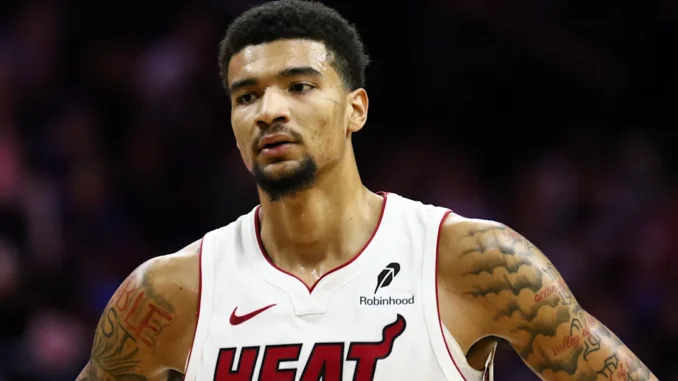
The Giannis Gamble: Why the Heat Must Embrace the Painful Kel’el Ware Reality Check
The Miami Heat’s history is defined by its relentless pursuit of elite talent. From the acquisition of Shaquille O’Neal to the formation of the Big Three with LeBron James, Dwyane Wade, and Chris Bosh, the “Heat Culture” often manifests as a singular, Pat Riley-driven willingness to push all chips to the center of the table for a generational superstar.
With reports swirling that Giannis Antetokounmpo and the Milwaukee Bucks are discussing his future—a conversation that could lead to the two-time MVP demanding a trade—the Heat are once again in the familiar position of circling a seismic star acquisition. This dream, however, comes with a stark, painful reality check centered around the team’s most prized young asset: Kel’el Ware.
For Miami to land a talent of Giannis’s caliber—a player who instantly transforms any contender into a title favorite—they must be willing to sacrifice the future, and that sacrifice begins with the highly promising young center, Kel’el Ware. The cold, hard truth is that the Heat cannot overthink the deal; they must operate under the principle of “Ware or Bust.”
The Rise of Kel’el Ware: A Valuable, But Expendable, Asset
Kel’el Ware, drafted 15th overall by the Heat in 2024, has rapidly developed into a tantalizing prospect. Standing 7-feet tall, he has flashed a unique combination of rim protection, elite rebounding, and burgeoning offensive versatility, including an efficient mid-range game and potential to stretch the floor.
Ware’s Value Proposition:
-
Elite Measurables and Production: Ware has consistently been a double-double threat when given starter minutes, averaging nearly a double-double in limited minutes during his rookie season (9.3 points, 7.4 rebounds, 1.1 blocks in 22.2 minutes per game). His high true shooting percentage (60.3%) demonstrates his efficiency near the basket.
-
A Modern Big Man: Ware possesses the length and athleticism needed in the modern NBA, capable of defending multiple positions and offering vertical spacing on offense. He represents the kind of young, high-upside center that rebuilding teams—like the Bucks would become post-Giannis—covet as a cornerstone.
-
The Bucks’ Rebuilding Necessity: For Milwaukee, a trade for Giannis must yield immediate building blocks. While Tyler Herro offers scoring and name recognition, he doesn’t solve their long-term frontcourt issues. Ware, along with the defensive-minded Jaime Jaquez Jr., gives the Bucks a young, high-ceiling frontcourt to build around, making him essential to the deal’s structure.
However, the reality check for the Heat is simple: Ware’s potential ceiling is irrelevant when compared to Giannis’s established prime.
The Irreconcilable Difference: Potential vs. Prime
Pat Riley’s entire career has been a testament to prioritizing the proven superstar over promising potential. When a two-time MVP, former Defensive Player of the Year, and Finals MVP becomes available—especially one whose game is built on a physical style that complements Miami’s “Culture” and provides a perfect defensive partner for Bam Adebayo—there can be no untouchable players outside of Adebayo himself.
The Giannis Factor: A True Franchise Changer
Giannis Antetokounmpo, at 30 years old, remains arguably the most dominant two-way force in the NBA. Acquiring him instantly solves the Heat’s most glaring issue: the lack of a Tier-1 offensive creator who can consistently generate points in the half-court and carry the team in the playoffs.
-
The Fit with Bam Adebayo: A Giannis-Adebayo frontcourt would be the most dominant defensive pairing in the league, giving Miami two elite anchors capable of defending the paint, switching onto guards, and rebounding at a high level. Offensively, Giannis could operate as the primary initiator, allowing Adebayo to thrive in his secondary playmaking and short-roll role.
-
Elevating the Roster: Giannis turns the Heat’s depth pieces—like Norman Powell, Andrew Wiggins, and Jaime Jaquez Jr. (if he isn’t included in the deal)—into elite, catch-and-shoot supporting cast members. The Heat’s ability to develop players means these role players would likely achieve their highest potential playing alongside a player like Giannis.
The difference in value can be quantified: Giannis is a player whose addition raises a team’s championship odds from $P(\text{Win}) < 0.05$ to $P(\text{Win}) > 0.25$. Ware, even at his All-Star ceiling, is simply a valuable piece. You don’t hedge on a 7-foot, 21-year-old prospect when a Top 15 All-Time player is available.
💰 The Trade Landscape: Why the Heat Need Ware
The Miami Heat are at a disadvantage in a bidding war for Giannis, primarily due to their limited draft capital resulting from previous trades (like the acquisition of Terry Rozier). As of the current moment, they have only two tradable first-round picks and limited ability to create more without getting creative.
Rival bidders like the Oklahoma City Thunder and the San Antonio Spurs can offer packages heavy on draft picks (OKC has a historic collection) or higher-ceiling, blue-chip young stars (The Spurs could offer a package around players like Stephon Castle or Dylan Harper and picks).
Therefore, Miami’s bid cannot rely solely on draft picks; it must rely on high-value, ready-to-develop young players—and that’s where Kel’el Ware and Jaime Jaquez Jr. become the non-negotiable centerpieces.
A Plausible Heat Offer (Ware Included):
-
To Milwaukee Bucks: G Tyler Herro, C Kel’el Ware, F Jaime Jaquez Jr., F Andrew Wiggins, two first-round picks (2026, 2028), and a pick swap.
-
To Miami Heat: F Giannis Antetokounmpo.
As Zach Lowe recently noted, for the Bucks, “The negotiations begin and end with Kel’el Ware.” Without a high-upside centerpiece like Ware, the Bucks would simply not receive enough future value to justify trading a player of Giannis’s magnitude, regardless of how much they value Herro’s scoring.
Embracing the Pain: The Riley Doctrine
This is the ultimate test of Pat Riley’s doctrine and the true cost of “Heat Culture” urgency. The organization has spent years developing Ware, patiently nurturing his unique skillset, and seeing him as a potential long-term partner for Adebayo. The natural inclination of the front office and the fanbase is to view him as “untouchable” or at least, too valuable to lose.
However, the “painful reality check” is recognizing that the immediate, guaranteed championship window opened by Giannis is far more valuable than the uncertain, distant ceiling of a young player. If Ware becomes an All-Star in five years, but the Heat missed out on a Giannis-led championship run in the interim, the decision will be viewed as a historical mistake.
Pat Riley’s philosophy has always been to prioritize banners over building. The moment Giannis signals his availability, Kel’el Ware must instantly transition, in the Heat’s internal valuation, from a promising cornerstone to a necessary trade chip. The dream of a championship is the only thing that matters, and that dream comes with the painful, but required, cost of parting with Kel’el Ware.
Leave a Reply