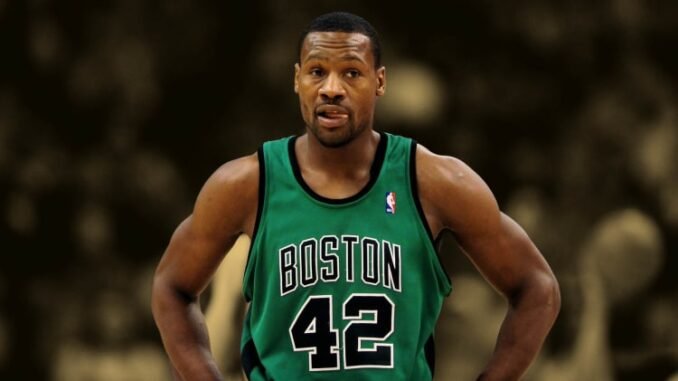
The Boston Education: Tony Allen’s Three “Universities”
For Tony Allen, a young, raw, and intensely competitive player drafted by the Boston Celtics in 2004, the arrival of Kevin Garnett and Ray Allen in the summer of 2007 wasn’t just a roster upgrade; it was a profound, daily masterclass in professional basketball. As he later reflected, being around the three future Hall of Famers—Paul Pierce, Kevin Garnett, and Ray Allen—was less like playing on a team and more like attending an elite, private institution. He famously declared, “We had three universities,” referring to the distinct, invaluable lessons imparted by each member of the legendary Big Three.
This period of immersion shaped Allen from a gifted, but erratic, young guard into “The Grindfather,” a six-time All-Defensive Team selection and one of the most respected, relentless defenders of his era. He learned how to be a champion not just by winning the 2008 title, but by absorbing three fundamentally different approaches to the craft.
🌟 Paul Pierce University: The Competitive Soul
Tony Allen’s relationship with Paul Pierce, “The Truth,” was the longest and most formative. As Allen himself was drafted by the Celtics in 2004, Pierce was already the franchise cornerstone, and he immediately took Allen under his wing. Pierce’s “university” focused on the pure, unadulterated competitive edge and the necessity of separating personal life from the professional battlefield.
-
Lesson 1: The Old-School Competitive Edge: Allen recalled a pivotal lesson Pierce taught him about setting boundaries and establishing a dominant mindset. “I ain’t gonna lie — P the first motherf—ker that showed me I’m not shaking nobody’s hand the day before the game,” Allen shared. In today’s highly social, friendly NBA, this old-school approach to competition was a stark reminder that once the whistle blows, all personal relationships are set aside. Pierce embodied the relentless, trash-talking spirit of the game, teaching Allen how to flip the switch and become a true professional antagonist.
-
Lesson 2: Savvy and Confidence: Pierce was renowned for his ability to score in isolation, often creating shots in late-game situations through craft, pump fakes, and body control. Being around Pierce taught Allen how to carry himself like a winner. As Allen later said, the lesson was “how to act like a winner… not even how to be a winner. That comes later. But it’s how to act like one, how to carry yourself like that’s just what you do.” Pierce instilled in Allen a deep, almost innate self-belief—the “Celtics Championship Confidence” that Allen carried with him to Memphis.
🐺 Kevin Garnett University: Intensity and Confidence
Kevin Garnett, “The Big Ticket,” was the emotional engine and defensive heart of the 2008 Celtics. His “university” was a masterclass in controlled chaos, non-stop intensity, and swagger. Allen noted that KG was the polar opposite of the reserved Ray Allen, making his presence felt through sheer volume and uncompromising commitment.
-
Lesson 1: The Relentless Fire: Garnett’s intensity was legendary. He was famously the first one to arrive at practice and the last to leave. For Allen, a defensive specialist known as “The Grindfather,” Garnett’s work ethic validated his own drive. Garnett showed Allen the level of emotional and physical investment required to be an elite defensive player and a champion. Every possession was treated with urgency, creating an atmosphere of “supreme confidence” and non-stop intensity.
-
Lesson 2: The Mental Aspect of Defense: Garnett was known for his incessant trash talk, a tool he used to get into the heads of his opponents. This wasn’t just for show; it was psychological warfare designed to disrupt the opponent’s focus. Allen picked up on this, using his own defensive flair and intensity to embody a mindset that controlled the game, even when he wasn’t touching the ball. Garnett’s influence taught Allen how to become a psychological, as well as physical, defensive nightmare.
📚 Ray Allen University: Calm Discipline and Professionalism
Ray Allen’s “university” offered the final, most contrasting set of lessons. As the quietest and most reserved of the Big Three, his teachings weren’t about confrontation or swagger; they were about serene dedication and the science of preparation.
-
Lesson 1: Ultimate Professionalism: Ray Allen’s work ethic was meticulous and legendary. He was notorious for his pre-game shooting routine, approaching his craft with the discipline of a scientist. Tony Allen described him as treating his game “like a job that he was very serious about.” Ray’s constant, early-morning shooting sessions showed the young Allen that elite performance is built not on luck or talent, but on obsessive consistency. Ray Allen’s quotes often reflected this belief: “Don’t undermine the work I’ve put in every day.”
-
Lesson 2: The Reserved Lifestyle: Tony Allen noted that Ray Allen was the one who might take you golfing, read a book, and keep to himself—a special, quiet side. This taught Allen the importance of mental fortitude and maintaining a calm, disciplined approach off the court. In the frenetic world of the NBA, Ray Allen was the ultimate portrait of composure, a stark contrast to the emotional volatility of Garnett and the competitive fire of Pierce.
By playing alongside these three “universities,” Tony Allen received a well-rounded education: he learned Pierce’s competitive will, Garnett’s defensive intensity, and Ray Allen’s professional consistency. This potent combination of lessons allowed him to find his identity as one of the best perimeter defenders of the modern era, leveraging his relentless effort (The Grindfather) with a professional, champion’s mindset.
Leave a Reply