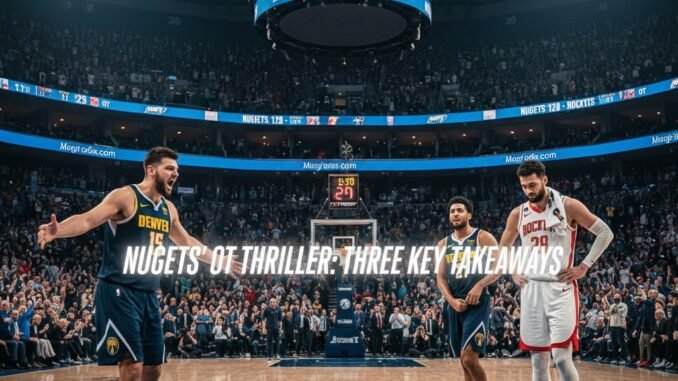
The Art of Winning: Nikola Jokic’s 12th Triple-Double and Jamal Murray’s Clutch Heroics Secure a Monumental OT Victory Over the Houston Rockets
The Denver Nuggets’ 128-125 overtime victory against the Houston Rockets was more than just another notch in the win column; it was a profound, multi-layered testament to the reigning champions’ enduring quality, strategic depth, and superstar resilience. Against a fiercely competitive and rapidly improving Rockets squad, Denver was forced to rely on every ounce of their collective grit, culminating in a performance that will be referenced later in the season as a pivotal moment of resolve. This monumental win, spearheaded by the two-man wrecking crew of Nikola Jokic and Jamal Murray, offered a rich tapestry of tactical lessons, individual breakthroughs, and long-term narratives.
I. The Unstoppable Engine: Jokic and Murray’s Championship Alchemy
In a night of escalating tension and diminishing personnel, the Nuggets’ championship equity was laid bare: it rests entirely upon the symbiotic genius of Nikola Jokic and Jamal Murray. Their combined output—74 points, 25 rebounds, and 16 assists—was not merely statistical padding; it was a sustained, high-leverage scoring and playmaking exhibition that kept the Nuggets’ head above water through every Houston surge.
The Masterclass of Nikola Jokic: A Study in Controlled Dominance
Nikola Jokic’s 12th triple-double of the season (39 points, 15 rebounds, 10 assists) was a clinic in controlled dominance. Facing a dynamic and athletic defense, Jokic employed every weapon in his arsenal, demonstrating why he is currently the most complete and efficient offensive player in the world.
A. Strategic Depth of Scoring
Jokic’s $5-of-9$ shooting from three-point range was a critical dimension of his offense. By converting the three-ball at a $55.6\%$ clip, he stretched the already thin Rockets defense past its breaking point. This forced Alperen Sengun to step out further, creating the necessary space for Murray and other drivers to attack the now-vacant paint.
His work in the post, however, remained the bedrock. He meticulously manipulated matchups, using feathery hook shots, drop steps, and sudden fadeaways to score over multiple defenders. His $13$ points in the fourth quarter and overtime were not just scored; they were manufactured under duress, often breaking tied scores or answering critical Houston buckets.
Key Moment: Late in the fourth quarter, with the score tied at $113$, Jokic caught the ball on the perimeter, calmly sized up Sengun, and without hesitation, drilled a three-pointer. Moments later, he did it again, pushing the lead to six. These were the actions of an MVP actively seizing control of a precarious situation.
B. The Playmaking Ecosystem
While his 10 assists completed the triple-double, the true measure of Jokic’s passing lay in the quality and timing of the passes. He mastered the counter-move to Houston’s defensive adjustments. When the Rockets collapsed on him, he found the outlet to Spencer Jones in the corner for the dagger threes. When the defense stayed home, he utilized the high-low pass to perfection, or delivered the signature cross-court skip pass that disarmed the defense entirely. He is a walking gravity well, and the Nuggets’ entire offensive structure is an elaborate system designed to exploit the space he creates. Even as he fouled out in overtime, the sheer physical and mental toll he imposed on the Rockets defense had already swung the game’s trajectory decisively in Denver’s favor.
The Ice Water of Jamal Murray: Clutch Gene Activated
Jamal Murray’s performance (35 points, 8 assists, 5 rebounds) was the necessary complement to Jokic’s foundational brilliance. Where Jokic provides the steady, overwhelming pressure, Murray provides the explosive, on-ball, clutch finishing. This game was a powerful reminder of his ability to elevate his game in the closing minutes of a tight contest.
A. Aggression and Free Throw Mastery
Murray’s unrelenting aggression in attacking the basket and drawing contact was the single most efficient aspect of the Nuggets’ offense. He generated $15$ free throw attempts, making $14$ of them. In a game decided by three points, his $93.3\%$ conversion rate from the line was a monumental swing factor. His ability to draw fouls on tiring defenders forced the Rockets to play softer defense late, which in turn opened up more driving lanes for him.
B. The Defining Overtime Sequence
With Jokic fouling out with $1:23$ left in the extra period, the onus fell entirely on Murray to close the game. He embraced the role with the confidence of a Finals-tested superstar:
-
Driving Layup: Immediately after Jokic exited, Murray drove to the basket and converted a tough layup over the outstretched arms of the defense, giving the Nuggets a $125-120$ lead.
-
Clutch Free Throws: With Denver nursing a slim lead in the final seconds, Murray drew another foul and stepped to the line. He calmly sank both free throws, extending the lead to three and putting the game out of reach for the Rockets.
Murray’s late-game orchestration—balancing scoring with facilitating—is what separates the Nuggets from other contender duos. When the game slows down and complexity is removed, the sheer talent and nerve of “The Blue Arrow” takes over.
II. The Rise of a Rival: Alperen Sengun’s Statement Game
For the Houston Rockets, this loss was a moral victory, anchored by a truly transcendent performance from their third-year center, Alperen Sengun. His statistical mirroring of Jokic, recording his own triple-double of 33 points, 10 rebounds, and 10 assists, was a seismic declaration of his arrival into the elite tier of NBA big men.
Direct Confrontation with the MVP
The much-anticipated duel between the “Joker” and “Mini-Joker” lived up to the billing. Sengun was fearless, challenging Jokic on both ends of the floor.
A. Passing and Vision
Sengun’s 10 assists were a testament to his unique court vision. He operated the Rockets’ offense from the elbow and the post, delivering clever bounce passes to cutters, finding kick-outs to open shooters, and utilizing a deceptive array of shoulder fakes and look-offs. His orchestration prevented the Nuggets from focusing their defensive scheme solely on him, forcing constant rotations and breakdowns.
B. Poise Under Pressure
Crucially, Sengun showed no hesitation in the biggest moments. He scored $15$ points combined in the fourth quarter and overtime, utilizing quick spins and precise interior footwork to evade the Nuggets’ defenders. His ability to score against the best player in the league, in a hostile road environment, confirms the Rockets’ belief that he is their franchise cornerstone. This performance serves as a massive confidence booster for the entire young Rockets squad, demonstrating that they can compete with, and even outplay, the best players and teams in the Association. The future of the Western Conference will undoubtedly feature many more classic battles between these two brilliant Serbian and Turkish big men.
III. The Depth Test: Resilience and the Unsung Heroes
The victory highlighted an intangible quality often overlooked amidst the superstar stats: team resilience and the vital contributions of the Nuggets’ role players when their backs were against the wall. The team entered the game missing two key rotational pieces in Aaron Gordon and Christian Braun. The situation became dire when defensive specialist Peyton Watson suffered a hamstring injury early, severely limiting Denver’s options on the perimeter.
Spencer Jones: The Corner Pocket Dagger
The necessity of the moment elevated two-way player Spencer Jones into an unlikely hero. Thrust into a $40$-minute role, Jones responded with a career-defining performance that included two of the most important shots of the night.
Jones’s stat line—$8$ points, $3$ rebounds, $3$ blocks, $2$ steals—belies the outsized impact of his timely scoring. His two three-pointers, one in the fourth quarter and one in overtime, were precisely what the Nuggets’ superstar offense needed: gravity-defying shots that relieved pressure and pushed the lead to a more comfortable margin.
-
The $4^{\text{th}}$ quarter three-pointer was the result of the Jokic double-team—a textbook example of the MVP creating a wide-open opportunity for the least expected player.
-
The overtime three-pointer was the psychological blow. It came after a grueling back-and-forth, extending the lead to $127-120$, forcing a Rockets timeout and ultimately deflating the Houston effort.
Jones’s effort—both his perimeter shooting and his active, disruptive defense—was a powerful affirmation of the Nuggets’ organizational ability to develop and integrate talent that can step up on the biggest stage.
Reggie Jackson and Julian Strawther: Steady Hand in the Storm
Despite the focus on the big two, the supporting cast provided stability:
-
Reggie Jackson (13 points, 5 assists) managed the reserve minutes with poise, scoring timely buckets and providing a secondary ball-handling presence to alleviate pressure on Murray.
-
Julian Strawther (10 points, 3 rebounds) provided another crucial three-point threat, hitting $2$ of $3$ shots from deep. His scoring kept the offense diversified and prevented the Rockets from completely walling off the paint.
This collective effort from the supporting cast, in the face of significant injury adversity, ultimately secured the win. It was a win forged in depth, strategy, and sheer will. A team with lesser resolve or fewer systems in place would have buckled under the sustained pressure of an inspired opponent. The Nuggets did not; they adapted, endured, and executed.
IV. Long-Term Strategic Implications
This overtime war serves as a critical strategic bookmark for both franchises heading into the latter half of the season.
For Denver: The Sustainability of the Model
The primary takeaway for the Nuggets is the non-negotiable reliance on their two stars. While this reliance is a strength—they have two of the league’s best high-leverage players—it also highlights a necessary area for improvement: consistency from the deep rotation. They cannot expect Spencer Jones to deliver a dagger performance every night. However, knowing that their two-way players and deep bench can execute under severe pressure, alongside Jokic and Murray, provides the coaching staff with critical confidence for the eventual playoff rotation. This win also provided valuable, high-leverage reps for younger players like Strawther and Jones, accelerating their development.
For Houston: The Validation of the Plan
For the Rockets, the loss is framed entirely as progress. They pushed the defending champions to the absolute limit on the road. The transcendent performance by Sengun validates their core building strategy, and the collective fight shown by Jalen Green, Jabari Smith Jr., and Fred VanVleet confirms that the team’s organizational culture has fundamentally shifted from rebuild to aggressive competitor. This game will serve as a foundational moment for the young Rockets, demonstrating that they have the talent and the fire to be considered a true threat in the coming years.
Leave a Reply