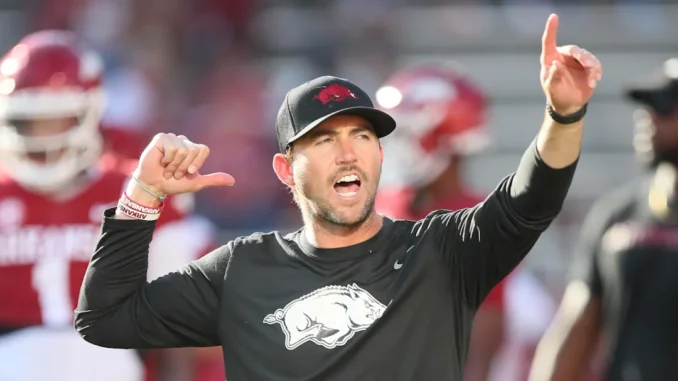
The Acceleration of Offense: Why South Carolina’s Expected Hire of Kendal Briles Signifies a Definitive Shift in Strategic Philosophy
The Search for Offensive Identity
In the intensely competitive landscape of the Southeastern Conference (SEC) football, consistent, high-level offensive production is the non-negotiable prerequisite for championship contention. For the South Carolina Gamecocks, the search for a new offensive coordinator (OC) following a period of inconsistency has become the single most critical decision of the offseason. The expectation that South Carolina is set to hire TCU Offensive Coordinator Kendal Briles is not just a personnel move; it is a seismic event that signals a definitive, aggressive shift in the program’s strategic philosophy toward maximizing tempo, dynamism, and verticality.
This analysis dissects the monumental implications of the expected Briles hire for the Gamecocks. It argues that Briles brings a proven, high-octane offensive system that immediately addresses South Carolina’s most pressing needs: quarterback development, increased pace, and explosive plays. However, it also acknowledges the inherent risks associated with integrating such a dramatic stylistic change into the SEC, particularly the challenges related to offensive line protection and defensive fatigue. The move represents a high-risk, high-reward bet on the acceleration of the offense, a necessary gamble for South Carolina to close the gap on the SEC elite.
The Briles Blueprint: Tempo, Explosiveness, and Verticality
Kendal Briles is widely recognized as one of college football’s foremost architects of the modern Spread-Option and Air Raid hybrid systems. His offenses are defined by three non-negotiable principles: Blazing Tempo, Vertical Passing, and Explosive Plays.
1. The Tempo Advantage
The first and most immediate change South Carolina will experience is the relentless pace. Briles’s offenses traditionally operate at a significantly higher tempo than the vast majority of SEC programs. The philosophy is simple: wear down the opposing defense, limit their ability to substitute, and force mental errors through sheer exhaustion.
-
Strategic Fatigue: By snapping the ball quickly, often within 15 seconds of the previous play, Briles maximizes the number of plays run per game. This puts immense pressure on SEC defensive lines, who are accustomed to rotating and relying on size. Sustaining high-level effort for 85+ plays is extremely difficult, leading to gaps in coverage and missed tackles late in the game—precisely when South Carolina needs to capitalize.
-
Simplifying the Read: The hurry-up offense often forces opposing defensive coordinators to simplify their play calls to avoid confusion, preventing them from running complex blitzes or exotic coverage schemes. This provides a tangible advantage for the quarterback and the offensive line.
2. Vertical Passing and Explosive Plays
Briles’s commitment to running the ball effectively is a setup for his true specialty: the vertical passing attack. His offenses are built on generating “chunk plays”—passes of 20 yards or more that dramatically change field position and score.
-
Run-Action and Play-Action: Briles’s system heavily utilizes play-action passes off the primary running plays (often zone-read or power). By selling the run with the same formation and action, the defense’s linebackers and safeties are forced to crash, creating massive voids behind them for receivers to run deep.
-
The Slot Receiver Weapon: The system often isolates dynamic slot receivers or tight ends in the middle of the field, utilizing speed to create mismatches against slower linebackers or safeties. This reliance on speed over size requires precise execution but generates game-breaking opportunities.
This focus on explosiveness is exactly what South Carolina needs to elevate its offense from methodical to feared.
Addressing South Carolina’s Critical Needs
The expected hiring of Kendal Briles directly addresses two of the Gamecocks’ most glaring deficiencies in recent seasons: inconsistent quarterback play and a failure to generate game-breaking moments.
1. Quarterback Development and Fit
Briles’s system is a perfect fit for a quarterback who is mobile, decisive, and possesses the arm strength to hit vertical routes. Briles has a proven track record of maximizing the potential of quarterbacks in this system, often turning dual-threat athletes into highly productive passers.
-
Clear Decision Trees: While fast, the system is designed to give the quarterback clear, simple reads post-snap. Is the safety down (run)? Is the cornerback covering deep (short pass)? The defined structure allows QBs to play fast and confidently, reducing mental mistakes.
-
Maximizing Mobility: A mobile quarterback is essential for extending plays and utilizing the run-pass option (RPO) game, which is a key component of Briles’s attack. This dual threat keeps defenses honest and limits their ability to focus exclusively on one area of the offense.
2. Recruiting and Talent Acquisition
The most immediate secondary benefit of the hire is the effect on recruiting. Briles’s reputation as an offensive innovator will immediately make South Carolina a much more attractive destination for elite quarterbacks and dynamic wide receivers, the two positions required to thrive in the modern SEC. Top talent wants to play in systems that put up huge numbers and prepare them for the NFL. Briles offers both.
The SEC Challenge: Risks and Defensive Fatigue
While the upside of the Briles hire is immense, the transition is fraught with inherent risk, particularly in the SEC where the speed of play and the physicality of the defensive lines are unmatched.
1. Offensive Line Protection
The primary concern when implementing a high-tempo spread offense in the SEC is the ability of the offensive line to sustain protection without the benefit of extensive substitution time.
-
Physical Wear-and-Tear: Briles’s line will be asked to run 80+ plays a game against the largest, fastest defensive linemen in the country. They will have limited time to recover or receive detailed coaching adjustments on the sideline. This physical challenge is amplified against programs like Georgia and Alabama.
-
The Need for Depth: The system requires not just five starters, but eight to ten reliable offensive linemen who can rotate effectively. South Carolina must recruit and develop this depth immediately to prevent catastrophic second-half failures due to exhaustion and injury.
2. Defensive Attrition and Time of Possession
The philosophical trade-off of a high-tempo offense is the risk it places on its own defense. If the offense executes and scores quickly, the defense gets a much-needed break. If the offense goes three-and-out quickly, the defense is immediately thrown back onto the field with minimal rest.
-
The Quick Stop Problem: Against methodical, heavy run teams in the SEC (like Georgia), a quick three-and-out by the South Carolina offense can lead to the Gamecock defense spending 12-15 minutes of real clock time on the field in a single quarter, leading to fatal late-game fatigue.
-
Turnover Multiplier: Turnovers are magnified in a tempo offense. If Briles’s team commits a turnover, the defense is immediately on the field in poor field position, often without the necessary time to adjust or compose themselves. Briles must prioritize ball security to avoid putting undue stress on the defensive unit.
Strategic Comparison: Closing the Gap on the SEC Elite
The move to hire Briles signifies a choice: South Carolina has decided that the only way to beat the SEC elite is to stop playing their style of football and force them to adapt to a new, faster game.
Programs like Alabama and Georgia are built on defensive excellence, size, and controlling the line of scrimmage. By employing Briles’s system, South Carolina is betting that its relentless tempo and focus on space and speed will negate the size advantage of the conference giants. It’s an attempt to turn the chess match into a high-speed sprint.
-
Forcing Defensive Adaptation: When Georgia or Alabama face South Carolina, they will be forced to simplify their game plans and play faster, which takes them out of their comfort zone of deliberate, crushing defense.
-
The Quarterback Factor: The spread system provides the opportunity to maximize the potential of an elite quarterback. If South Carolina can land an elite transfer or develop a top recruit in Briles’s system, they can immediately compete with the top half of the SEC on offensive firepower alone.
The High-Risk, High-Reward Gamble
The expected hiring of Kendal Briles as the Offensive Coordinator for the South Carolina Gamecocks is a monumental moment that places the program on a fundamentally different trajectory. It is an aggressive, high-risk, high-reward bet that the best way to compete in the hyper-competitive SEC is to accelerate the pace of play, prioritize dynamic athletes, and force opponents to defend the entire field for 80+ snaps per game.
Briles brings a proven, explosive blueprint that immediately raises the floor and ceiling of the Gamecocks’ offense, addresses quarterback development issues, and provides critical recruiting leverage. However, the success of this venture hinges on the rapid accumulation of offensive line depth and the system’s ability to maintain high efficiency to prevent the devastating quick three-and-outs that can exhaust the South Carolina defense. The Gamecocks are signaling that they are tired of playing slow; they are ready to run, and they are ready to compete.
Leave a Reply