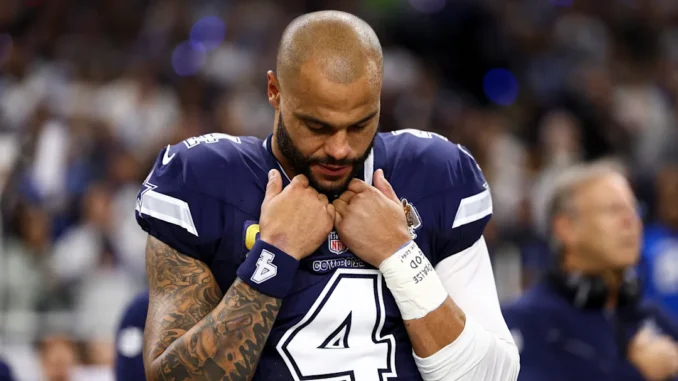
The phrase “margin for error” becomes gospel in the final stretch of the NFL season, and in Week 14 of the 2025 campaign, the Dallas Cowboys proved they had none. Their crucial loss on Thursday Night Football against the Detroit Lions—a game that served as a microcosm of their inconsistent season—was not just a defeat; it was a catastrophic strategic blunder that functioned as a massive, self-inflicted wound. This single result, which mathematically dropped the Cowboys’ playoff probability into the single digits, had the immediate and profound effect of clarifying the entire NFC playoff picture, virtually handing the NFC East crown to their most bitter rivals, the Philadelphia Eagles.
The Cowboys entered Week 14 clinging to the fringes of the Wild Card race, still technically in contention for the division title but facing a schedule that offered no respite. The clash with the Lions was a high-stakes, win-or-go-home type of game for Dallas, a critical junction where momentum, tiebreakers, and playoff destiny were all on the line. What transpired was a high-scoring but ultimately disappointing 44-30 loss. This result did more than just snap a modest three-game winning streak; it effectively removed Dallas from serious contention, providing the Philadelphia Eagles—who were preparing for their own Week 14 matchup against the Los Angeles Chargers—the clearest, least stressful route to the division title and an all-important home playoff game. The Eagles didn’t even have to take the field yet, but their playoff path was already illuminated by the failures of their divisional foe.
The Dallas Debacle: A Fumble of Momentum and Probability
The “Week 14 fumble” referenced in the narrative is less about a single dropped ball and more about the collective fumbling of opportunity and momentum that defined the Cowboys’ performance. In a game they absolutely had to win to keep pace with the 8-4 Eagles, the Cowboys’ defense struggled to contain the Lions’ explosive offense, and their own offense, while productive, failed to capitalize on key drives and sustain consistency.
The psychological impact of this loss cannot be overstated. According to NFL Next Gen Stats, the Cowboys’ probability of making the playoffs plummeted from a challenging, but achievable, figure to a near-miraculous 6-9%. For a team with Super Bowl aspirations at the start of the season, seeing their chances vanish into the statistical abyss with four games still remaining in the regular season is devastating. Had Dallas secured the victory against Detroit, their probability would have climbed significantly, potentially north of 30%, which would have applied immense pressure to the Eagles ahead of their Monday night contest. Instead, the pressure gauge for Philadelphia registered zero.
Further compounding the damage was the injury sustained by star wide receiver CeeDee Lamb, who suffered a concussion during the game. Losing their top receiving threat for an unknown period in the most critical stretch of the season added injury to insult, shifting the narrative from “Dallas fighting for a spot” to “Dallas playing for pride.” The loss thus wasn’t a matter of one turnover but a comprehensive failure to execute under pressure, losing crucial ground in the standings, sacrificing essential tiebreaker advantages, and incurring a potentially season-ending injury to a marquee player. This was the true, multifaceted fumble that changed the NFC dynamic.
The Clearest Path: NFC East Implications for Philadelphia
For the Philadelphia Eagles, the Cowboys’ defeat was the equivalent of a rival forfeiting a key match. The NFC East, one of the most historically contentious divisions in football, suddenly became a foregone conclusion. Heading into the rest of Week 14, the Eagles held an 8-4 record, while the Cowboys dropped to 6-6-1. This two-game advantage in the win column, coupled with the Cowboys having one more game played (the loss to the Lions), created a massive, almost insurmountable divisional lead.
The critical term in this equation is the “magic number.” The Cowboys’ loss immediately dropped the Eagles’ magic number to clinch the NFC East down to three. This means the Eagles only needed a combination of three Eagles wins or Cowboys losses in the final five weeks to secure the division title. If the Eagles defeated the Los Angeles Chargers in their Week 14 Monday Night matchup, that magic number would immediately drop to two.
This clarity provides the Eagles with a profound psychological and strategic advantage. Knowing their rival is effectively out of the divisional hunt allows Philadelphia to shift its focus entirely from defending the division to climbing the NFC seeding ladder. Their remaining schedule, while featuring competitive opponents, can be approached with the confidence that the primary objective—an automatic home playoff game via the division title—is essentially secured.
More specifically, the Eagles now have a very real chance to clinch the division in Week 15. The scenario is simple: if the Eagles defeat the Las Vegas Raiders, and the Cowboys fall to the Minnesota Vikings, the NFC East is theirs. For a team that saw some turbulent moments earlier in the season, this is an incredibly valuable gift, allowing them to rest players, manage injuries, and fine-tune their strategy for the playoffs without the intense pressure of a week-to-week divisional battle. The Cowboys’ loss removed the most dangerous threat to Philadelphia’s immediate postseason ambitions.
The Wild Card Race: Dallas’s Fading Shadow
The Cowboys’ loss did not just affect the NFC East; it delivered a body blow to their chances in the Wild Card race, a competition that is famously unforgiving in the NFC. With their 6-6-1 record, Dallas slipped further down the conference standings, falling to the No. 10 spot, trailing multiple 9-win, 8-win, and even 7-win teams.
The teams currently occupying the Wild Card slots—including the Seattle Seahawks (9-3), Green Bay Packers (8-3-1), and San Francisco 49ers (9-4)—all possess significantly better records and tiebreaker advantages. Moreover, the Detroit Lions, with their 8-5 record following the win over Dallas, are now firmly entrenched in the Wild Card discussion, further pushing the Cowboys down the list. The Carolina Panthers, sitting at 7-6, also jumped ahead of Dallas.
The reality of the NFC Wild Card race is that a team generally needs 10, sometimes 11, wins to secure a spot. For Dallas, achieving 10 wins would require them to go 4-0 in their final four games. Given their inconsistencies, the remaining schedule, and the sudden loss of CeeDee Lamb, this task verges on the impossible. The path is complicated by the need for multiple teams ahead of them—like the Packers, Lions, and Panthers—to suffer unexpected collapses while the Cowboys simultaneously win out. The Week 14 fumble, therefore, transformed the Cowboys’ season outlook from “uphill battle” to “mathematical longshot.” They lost all control over their destiny, and now must rely on a highly improbable confluence of league-wide results just to squeeze into the No. 7 seed.
Eagles’ Seeding Control and the Top of the NFC
While the NFC East title is a huge boon for the Eagles, the greater prize is securing a top seed, which guarantees multiple home playoff games. The Cowboys’ loss also greatly simplified this pursuit for Philadelphia.
Prior to Week 14, the NFC was top-heavy and fiercely competitive, featuring a cluster of elite teams jostling for the coveted No. 1 and No. 2 seeds. The Chicago Bears (9-3) and Los Angeles Rams (9-3) held the top two spots, followed closely by the Eagles (8-4), Seahawks (9-3), and 49ers (9-4). The Cowboys’ demise shifts the focus back to this top tier, allowing the Eagles to concentrate solely on matching the performance of the conference leaders.
By nearly eliminating the Cowboys from the divisional picture, the Eagles can approach their final games with a singular focus on achieving the highest possible win total. If the Eagles can win their remaining games, they are guaranteed a record of 13-4, which would put them in an excellent position to challenge the Bears and Rams for the No. 1 or No. 2 seed. The automatic division title ensures they cannot fall lower than the No. 4 seed, but with the pressure of the Cowboys gone, the 1-seed becomes a realistic target.
The importance of securing a top-two seed cannot be overstated in the NFL playoffs. The No. 1 seed gets the crucial first-round bye, allowing players to rest and recover before the divisional round. The No. 2 seed gets a guaranteed home game against the No. 7 seed. Every additional win the Eagles secure from this point forward not only pads their record but also puts direct pressure on the Bears and Rams, forcing them to win their respective division races and maintain their pace. The Cowboys’ blunder provided the Eagles with the breathing room necessary to focus on this loftier goal, making every remaining game a battle for seeding superiority rather than a tense fight for survival.
A Historical Echo and the Weight of Rivalry
The rivalry between the Dallas Cowboys and the Philadelphia Eagles is one of the most intense and consequential in all of professional sports. Every victory, every loss, and every strategic move is magnified by the other’s response. This Week 14 loss will be remembered as a crucial turning point, a season-defining moment where one rival provided an undeniable assist to the other.
While past seasons might point to specific, tangible fumbles—like Ezekiel Elliott’s costly goal-line fumble against the Eagles in a prior matchup, a play that instantly erased Dallas’s momentum—the Week 14 event is more existential. It was a failure of the team’s entire apparatus to rise to the occasion of a must-win game. They surrendered control, not just of the game, but of their season’s narrative.
The consequences of this loss extend beyond mere statistics. It alters the dynamic of the rivalry in the short term. The Eagles, once again, appear to be the dominant force in the NFC East, having handled their business while their primary challenger faltered when it mattered most. The Cowboys, meanwhile, are left to contemplate what could have been, facing the reality of a lost season defined by inconsistency and an inability to close when the stakes were highest.
The final stretch of the season for Dallas will now be played with the grim realization that their chances are minuscule. For the Eagles, however, the road ahead is clearer, less obstructed, and far more focused. The Cowboys’ Week 14 fumble was a gift to the Eagles, an unexpected Christmas present that ensures Philadelphia will spend January playing meaningful football at home, while Dallas is left to watch the scoreboard, hoping for a miracle that their own performance failed to earn them. The clarity provided by the Cowboys’ defeat means the Eagles can now execute their final maneuvers with confidence, knowing their path to the NFC playoffs is paved and ready for their ascent. The 6% playoff chance for Dallas is the inverse of the near-certainty gifted to Philadelphia.
Leave a Reply