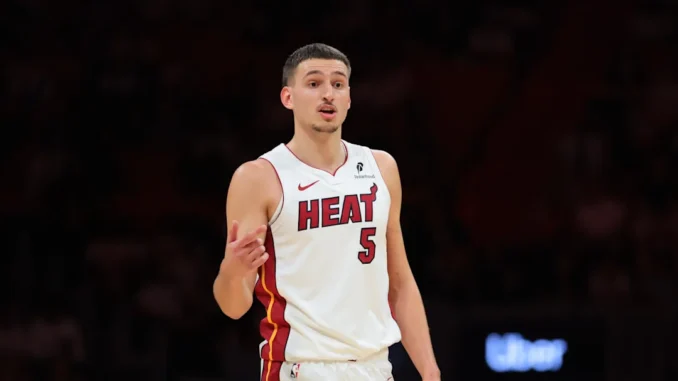
The $62 Million Mistake: Why Nikola Jovic’s Extension is an Absolute Disaster for the Miami Heat
The Miami Heat entered the 2025-26 season with a surprisingly strong foundation, showcasing a high-flying offense and an elite defense. However, despite the positive team results, one offseason decision made by Pat Riley and the front office—a last-minute contract extension—is rapidly turning into an unmitigated disaster that could severely hamper the franchise’s long-term flexibility and trade opportunities: the four-year, $62 million extension for forward Nikola Jovic.
Signed in the final days of the offseason, the deal was a bet on Jovic’s tantalizing, high-upside potential before his rookie deal expired. The organization gambled that by locking him up early, they would secure a key contributor who, if healthy, would grow into a dynamic partner for Bam Adebayo. Instead, the team is facing the brutal reality that Jovic’s regression and inconsistency have made him an immediate liability on the court and a potential financial anchor dragging down the team’s cap sheet.
From Starter to Liability: Jovic’s Sudden and Alarming Regression
Jovic, a former first-round pick, began the 2025-26 season as the starting power forward on opening night, an early sign of the organization’s faith in him. However, his performance quickly deteriorated, exposing significant flaws in his game that are exacerbated by the pressure of his new, hefty contract.
The Statistical Plunge
After a brief flash of hope, including a 29-point outburst in early November, Jovic’s production has plummeted. He has failed to score more than eight points in any game since that outlier performance, and his overall efficiency has tanked.
-
Passivity and Poor Fit: The Heat needed Jovic to be an aggressive rim attacker and a secondary playmaker to complement Adebayo’s interior presence. Instead, he has looked overwhelmingly passive, settling for low-percentage three-point attempts and often looking uncomfortable facilitating. The hoped-for synergy with Adebayo has not materialized.
-
The Turnover Crisis: Jovic’s decision-making has become a glaring weakness. In a recent 10-minute appearance against the Detroit Pistons, he committed five turnovers and was a chilling minus-15 in a close game the Heat ultimately lost. This level of carelessness in limited minutes is unacceptable for a player slated to make over $15 million annually.
-
The ‘2K Create-a-Player’ Effect: When Jovic returned from a recent hip injury—a recurring issue that was a known risk when the extension was signed—he looked completely lost on the court. In his first few games back, he averaged minutes in the low single digits, recording zero points in six minutes against the Mavericks and turning the ball over repeatedly against Detroit. The narrative is clear: even when healthy, Jovic is performing like an unplayable rookie, not a $62 million investment.
The Financial Fiasco: The True Cost of the Extension
The true disaster of Jovic’s extension is not his poor play today, but the enormous financial rigidity it imposes on the Heat’s future.
Salary Cap Albatross
Starting next season, Jovic is set to earn approximately $16.2 million per year, consuming roughly 10% of Miami’s salary cap. For a player who is currently unplayable in crunch time and whose lack of confidence forces Coach Erik Spoelstra to minimize his minutes, this contract is a significant drain on resources.
In the NBA’s hard-cap environment, every dollar counts, especially for a win-now team like the Heat. That $16 million could have been used in myriad ways:
-
A Proven Role Player: Signed to secure an established veteran shooter or a reliable backup center.
-
Trade Asset Flexibility: Left as a less burdensome expiring contract, giving the Heat flexibility at the trade deadline.
-
A Steadier Young Player: Allocated to a different, more consistent young player who could contribute immediately.
Instead, the Heat now have a contract that is difficult to move, especially since Jovic’s extension is so fresh that he is currently ineligible to be traded until later in the season. Even when he becomes tradable, his value is at a nadir. Which team is eager to take on a project—even a talented one—that the Heat, one of the best developmental franchises in the NBA, have struggled to figure out, all while paying him over $16 million per year?
The Giannis Antetokounmpo Conundrum
The greatest, and most critical, fallout from the Jovic extension is its impact on the looming Giannis Antetokounmpo trade opportunity.
The Miami Heat are known to be positioning themselves for a blockbuster trade for a superstar, with Giannis at the top of their list. As established in Pat Riley’s doctrine, acquiring a player of Giannis’s magnitude requires stripping the roster down to its highest-value chips, which often means including young talent.
In a trade scenario, Jovic’s contract was intended to be a valuable asset—a young, high-upside player on a long-term, reasonable deal that would appeal to a rebuilding team like the Bucks. Now, Jovic’s contract is a potential deterrent. His poor performance not only lowers his perceived trade value but his substantial salary forces the Bucks to take on a major commitment to an underperforming player, making the Heat’s trade package significantly less appealing than those offered by rival bidders like the Oklahoma City Thunder or the San Antonio Spurs, who can offer cleaner contracts and more draft capital.
If the Heat ultimately miss out on a superstar because the Bucks found Jovic’s contract too risky, this last-minute extension will be remembered as the organization’s most consequential and damaging mistake of the decade.
What Can the Heat Do Now? Spoelstra’s Difficult Choices
Coach Erik Spoelstra is now left with the unenviable task of managing Jovic’s situation while maintaining a winning record.
-
Bench Jovic Indefinitely: This seems the most likely current scenario. Jovic is the odd man out in a deep rotation, and once injured players like Jaime Jaquez Jr. return, Jovic will likely fall out of the rotation entirely. While sitting him may hurt his confidence, playing him through his struggles has proven detrimental to the team’s ability to win.
-
Play Him Through the Slump: Some argue Jovic needs rhythm and consistent minutes to regain his form. However, Spoelstra is a pragmatist; he cannot afford to sacrifice wins in a tight Eastern Conference race to nurse a single player’s confidence. As Spoelstra himself commented, “I don’t buy that [confidence] narrative… He needs to get in better rhythm. He needs to put in some work, he’ll be just fine.” This is a call for Jovic to fix his game, not a promise of more minutes.
-
Trade Him (Eventually): While he is currently ineligible, the Heat will eventually have to confront his trade value. The key will be pairing him with valuable assets—likely picks or another player—to simply offload the contract to a team willing to take a high-risk gamble on a talent that has been derailed by injuries and inconsistency.
The Nikola Jovic extension was the ultimate “Heat Culture” gamble on potential—a last-minute, aggressive move to secure a piece of the future. But in the present, it is a $62 million problem that is undermining the team’s current depth and threatening to compromise their ability to secure the next superstar. The extension, which was supposed to secure the future, now looks like the anchor preventing the Heat from reaching their destiny.
Leave a Reply