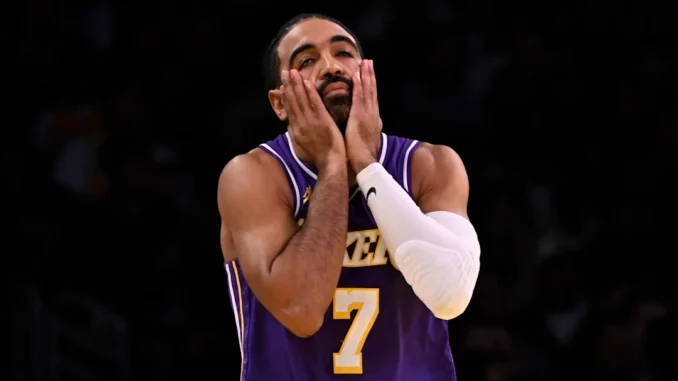
The $33 Million Dilemma: Gabe Vincent Becomes the Lakers’ Most Likely Trade Chip
The Los Angeles Lakers are gearing up to be aggressive ahead of the NBA trade deadline, and one player has quickly emerged as the face of their roster complications: guard Gabe Vincent.
Signed in the 2023 offseason to a three-year, $33 million contract using the Mid-Level Exception, Vincent was expected to be a crucial 3-and-D perimeter defender and a secondary playmaker.1 However, a combination of injuries and glaring inefficiency when healthy has turned his contract into a pivotal decision point for the Lakers’ front office.
Heading toward the trade deadline, the Lakers officially have a “Gabe Vincent problem” on their hands, defined by his poor production contrasted with his critical, trade-matching salary.
1. The On-Court and Injury Problem
Vincent’s tenure in Los Angeles has been disastrously defined by his inability to stay on the court or perform consistently when he is there.
-
Injury History: After missing most of his first season in L.A. due to a severe knee injury, Vincent was hit with a significant left ankle sprain early in the 2025-2026 season (suffered on October 26th), sidelining him for several weeks.2 While he has recently been cleared to return, the pattern of injury has severely hampered his continuity.
-
Production Woes: In the games he has played this season, Vincent’s performance has been significantly below expectations. He is averaging just 5.1 points, 1.7 assists, and 1.0 rebounds on inefficient shooting percentages (around 3$35\%$ overall and 4$37\%$ from three-point range in recent games).5 These numbers are far from the gritty, high-impact contributions he delivered during the Miami Heat’s 2023 Finals run.
-
Defensive Rating: Critically, the Lakers’ defensive efficiency rating has been reported to be abysmal with Vincent on the floor, negating the very reason he was signed: perimeter defense.
2. The Contractual Dilemma: Trade Asset vs. Roster Fit
The most valuable aspect of Vincent’s situation for the Lakers is his $11.5 million salary for the current 2025-26 season, which is fully guaranteed through the 2026 season.
-
Expiring Salary Value: His guaranteed salary structure makes him the most logical mid-tier contract to move. While Rui Hachimura’s shooting is considered too valuable and Jarred Vanderbilt’s contract runs longer, Vincent’s deal is the easiest to package for salary matching purposes without sacrificing a core piece.
-
“Negative Value” Asset: The main problem is his trade value. Several NBA analysts and scouts view Vincent’s contract as a “negative asset” due to his injury history and lack of production. Any trade involving Vincent would likely require the Lakers to sweeten the pot (with a draft pick or a young player like Dalton Knecht) or send him to a rebuilding team willing to absorb his contract as expiring money for future cap space.
3. The Trade Strategy: Upgrading the Frontcourt
With LeBron James and Luka Dončić leading the offense, the Lakers are desperately searching for size, rim protection, and defensive versatility. Vincent’s contract is the key to unlocking this goal.
-
The Robert Williams III Blueprint: One of the most frequently floated trade rumors involves sending Gabe Vincent, Dalton Knecht, and a future second-round pick to a rebuilding team like the Portland Trail Blazers in exchange for a rim protector like Robert Williams III.6 Williams’ expiring $13.3 million deal matches cleanly with Vincent’s salary, giving the Lakers the defensive anchor they need without sacrificing Austin Reaves or major draft capital.
-
Pursuing Other Targets: Vincent’s $11.5 million salary could also be packaged with other assets to pursue defensive wings like Herb Jones (Pelicans) or frontcourt help like Daniel Gafford (Mavericks), provided the Lakers are willing to attach a first-round pick for a major upgrade.
In essence, the Lakers signed Gabe Vincent to be a reliable two-way guard, but he has instead become a high-priced, underperforming player whose greatest contribution now is the salary slot he occupies. Rob Pelinka’s task is now to leverage that salary, which is set to expire next season, to acquire the immediate frontcourt defense needed to make a legitimate title run.
Leave a Reply