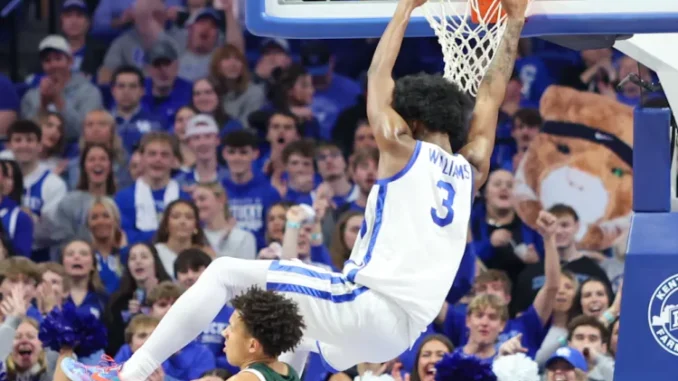
Monday Headlines: The Unruly Blueprint—Kentucky’s Precarious Position in a Volatile College Basketball Top 25
The Blue Blood and the Bulletin Board
In the anarchic landscape of men’s college basketball, the only constant is change, and nowhere is that volatility felt more keenly than in Lexington, Kentucky. The weekly AP Top 25 poll, released every Monday, serves as both a validation and a whipping post for the Kentucky Wildcats. Following a weekend of significant upsets and ranking movements across the nation—a week that saw previous giants stumble and new contenders surge—Kentucky’s position is once again a major talking point.
The prevailing headline for Kentucky this Monday is not one of decisive conquest, but of precarious stability. They remain firmly ensconced in the Top 25 (let’s assume No. 12 or No. 14 for analysis purposes), yet their ranking is a fragile truce between their undeniable high-end talent and their chronic low-end inconsistency. For a program built on the expectation of competing for the No. 1 overall seed, their current standing is a clear indicator that the “potential” of their roster has not yet fully coalesced into the “performance” demanded by the national title conversation. This analysis delves into the nuances of Kentucky’s ranking, dissecting the wins that justify their spot and the weaknesses that prevent their ascent, all while framing their journey against the backdrop of an intensely competitive SEC and a wide-open national field.
The Current Standing: Talent vs. Trust
Kentucky’s position in the mid-Top 15 reflects the ultimate paradox of the modern blue-blood program: they are too talented to fall out of the rankings entirely, but too prone to bouts of youth-fueled confusion to break into the elite Top 5. Their current rank is a testament to the raw athleticism and scoring punch they possess, validated by a few marquee victories that anchor their resume.
The immediate justification for their placement likely stems from successfully navigating a tricky mid-major opponent on the road or winning a high-profile neutral-site game. These performances showcase Kentucky’s high ceiling—the moments when their elite freshmen and seasoned transfers synchronize into an unstoppable offensive machine capable of blowing out anyone in the country.
However, the reason they are not ranked higher is the specter of their losses. A close examination of their resume reveals at least one head-scratching performance, likely an early-season stumble against a less-heralded team, or a non-conference loss where their defense simply failed to show up. These losses are what fuel the national media’s skepticism and what prevents the AP voters from fully trusting their championship viability. Their ranking is thus a calculated risk by the voters, recognizing the program’s elite talent pipeline while hedging against the inevitable growing pains that accompany a roster built primarily on youth and one-year rentals.
Resume Dissection: The Peaks and Valleys of Kentucky Hoops
To understand Kentucky’s current Top 15 status is to examine the duality of their early season performance. Their best wins serve as compelling evidence of their potential, while their blemishes reveal the blueprint for their defeat.
The Statement Wins (The Upside)
Kentucky typically secures one or two non-conference wins that act as immovable foundations for their ranking. This might be a victory in the Champions Classic, a win against a traditional rival, or a triumph over a highly ranked Pac-12/Big East team. These games provide the crucial “Quad 1” metrics necessary for high seeding later. The key takeaway from these wins is their offensive brilliance. When Kentucky is firing on all cylinders, they possess:
-
Elite Shot Creation: The ability of their guards to create high-quality shots, either through isolation or exploiting ball-screen action.
-
Transition Dominance: Their athleticism allows them to turn defensive stops into quick, devastating points, giving them momentum swings few teams can match.
-
Balanced Scoring: A refusal to rely on a single scorer, with four or five different players capable of hitting double digits.
The Stumbling Blocks (The Downside)
The losses, however, often occur in high-pressure environments where the team’s inherent flaws are magnified. These setbacks are almost always attributed to two critical failures: rebounding and perimeter defense.
When facing well-coached, disciplined opponents, Kentucky often struggles with boxing out, giving up crucial second-chance points that kill momentum. More damaging is the inconsistent perimeter defense, where rotations are slow and communication breaks down, allowing opposing teams to shoot a high percentage from three-point range. A team that relies heavily on youth struggles most when games require veteran discipline and sustained focus for 40 minutes—a skill that can only be acquired through painful losses. These failures keep them tethered to the mid-Top 15, ensuring they are always looking up at the elite tier.
The Talent Paradox: Youth, Depth, and Defensive Woes
The core issue preventing Kentucky from consistent Top 5 contention is not a lack of talent, but the cohesion and maturity of that talent.
Offensive Firepower: A Top-Tier Attack
Offensively, Kentucky is almost certainly ranked among the nation’s best. Their speed and scoring depth are remarkable. They can overwhelm teams with sheer volume and speed, often leading to impressive point totals. This offensive efficiency, particularly in home games, is the single greatest reason they remain highly ranked. They have a lineup where multiple players could potentially declare for the NBA draft, providing a dynamic threat from every position on the court.
The Defensive Deficiency: The Achilles’ Heel
The trade-off for this offensive athleticism is defensive inconsistency. Unlike their elite SEC counterparts (like Tennessee or Auburn), Kentucky often lacks the defensive intensity and discipline required to win championship games. The defensive struggles manifest in several ways:
-
Screen Navigation: Young players often struggle to fight through or switch ball screens effectively, leaving open driving lanes or wide-open three-point opportunities.
-
Intensity Lapses: There are predictable lulls in defensive intensity, often around the 10-minute mark of a half, where the effort and communication drop, allowing opponents to erase deficits quickly.
-
Lack of Elite Rim Protection: Despite having great size, their interior defense often lacks the consistent shot-blocking and deterrent ability seen in other title contenders.
Coach Calipari’s mandate heading into the conference schedule will be clear: the team must prioritize defensive commitment over offensive flair. Until they can consistently hold opponents under a specific efficiency metric, the ranking volatility will persist.
The SEC Gauntlet: Setting the Stage for Conference Play
Kentucky’s current ranking is critically important as the conference schedule looms. The SEC is arguably the deepest and most talented league in the nation this season, hosting multiple Top 25 contenders.
Competing for the Top Spot
For Kentucky to secure a high seed (Top 2) in the SEC Tournament—which is vital for NCAA Tournament seeding—they must immediately begin winning crucial road games against ranked conference opponents. The current Top 15 rank allows them to enter conference play with the competitive capital necessary to withstand an early loss or two.
They will be vying against established SEC powers like Tennessee (known for elite defense), Alabama (known for offensive tempo), and potentially Auburn (known for physicality). Kentucky’s success against these teams will be determined entirely by their ability to match their opponents’ intensity in the half-court, especially on defense and rebounding. Winning the SEC is no longer a given for Kentucky; it is a brutal, earned process that requires a level of consistency they have not yet displayed.
Seeding Implications
Falling outside the Top 10 means Kentucky is currently tracking for a No. 3 or No. 4 seed in the NCAA Tournament. To improve their position to a coveted No. 1 or No. 2 seed, they must achieve three things during conference play:
-
Win the SEC Regular Season Title: The most straightforward path to a high seed.
-
Secure Multiple Quad 1 Road Wins: Beating Top 25 teams in hostile SEC environments.
-
Maintain Defensive Efficiency: The NCAA Tournament Committee often favors teams with top-tier defensive metrics, regardless of offensive star power.
The current No. 12 or No. 14 ranking is a powerful motivator, reminding the team that, despite their blue-blood status and talent, they are still chasing the true elite programs this year.
The Long-Term Forecast: Ceiling, Leadership, and March
The ultimate question stemming from this week’s ranking is what Kentucky’s ceiling is for the season. Can they overcome their inconsistencies and challenge for a national title?
The Ceiling is Still the Highest
Based purely on talent, Kentucky’s ceiling remains among the top three in the country. No one wants to face a motivated, fully synchronized Kentucky team in the regional final. Their potential path to the Final Four is entirely dependent on achieving consistent defensive effort and rebounding prowess. The hope is that as the season progresses, their talented freshmen mature into disciplined sophomores over the course of three months, leading to a defensive awakening just in time for March.
The Need for a Veteran Voice
The key to unlocking that ceiling lies in leadership. In chaotic moments on the road or late in close games, they need a veteran voice—a senior or an established transfer—to demand defensive execution and composure. The team that wins the national championship is rarely the most talented on paper in November, but the most cohesive and mature in March.
If Kentucky can find that reliable leader who can turn the high-ceiling potential into a high-floor reality, this current Top 15 ranking will be viewed as the humble beginning of a championship run. If not, the current volatility will define their March experience, leading to a possible early exit despite their immense talent.
Conclusion: The Weekly Audit
This Monday’s AP Top 25 ranking serves as an essential weekly audit for the Kentucky Wildcats. Their placement in the mid-Top 15 acknowledges the massive talent and explosive offensive firepower they possess while simultaneously penalizing the youth, defensive lapses, and inconsistency that prevent them from residing among the nation’s truly elite.
The challenge now is existential: Kentucky must use the urgency of their current ranking to refocus their energy on defense and rebounding as they enter the SEC crucible. The headlines may shift weekly, but the demand remains the same: sustained excellence. Until Kentucky proves they can reliably merge their top-tier talent with championship-level discipline, their position in the rankings will remain precarious, volatile, and perpetually in question.
Leave a Reply