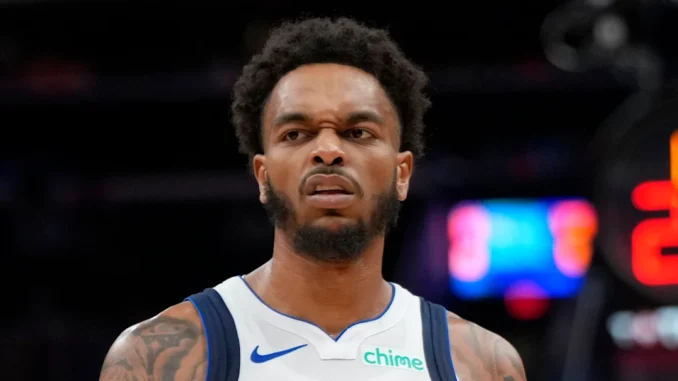
Mavericks Already Have a Brewing P.J. Washington Problem on Their Hands
The Dallas Mavericks’ frontcourt looked like a strength on paper entering the 2025-26 season: Anthony Davis as the anchor, rookie sensation Cooper Flagg bringing generational talent, and P.J. Washington providing versatile two-way play after a standout playoff run in 2024. Washington, acquired mid-2024 trade deadline and quickly becoming a fan favorite, earned a four-year, approximately $89-90 million extension in September 2025 that kicks in for 2026-27. At the time, it felt like a reward for his contributions and a commitment to continuity around Flagg.
But midway through a disappointing 13-23 campaign, a problem is brewing with Washington—one that’s less about his individual performance and more about positional overlap, financial commitment, and long-term roster fit. Analysts and insiders are increasingly questioning whether paying Washington $20+ million annually (starting at around $19.8 million in 2026-27, escalating to $24.6 million) makes sense if he’s relegated to a backup role behind the ascending Flagg. Both players operate primarily as power forwards with similar skill sets: athletic finishing, rebounding, perimeter shooting, and switchable defense. As Flagg dominates usage and minutes, Washington’s role—and value—could diminish, creating a luxury the cap-strapped Mavericks may not afford.
Washington’s Strong Play Masks the Underlying Issue
To be clear, Washington hasn’t suddenly become a liability on the court. Through early January 2026, the 27-year-old is posting solid numbers reminiscent of his Dallas tenure: around 14 points, 7-8 rebounds, 2 assists, with efficient scoring and defensive versatility. In recent games, he’s contributed double-digit points and strong rebounding, including standout efforts in wins. His three-point shooting hovers in the mid-30s to high-30s range on decent volume, and his ability to guard multiple positions remains a plus.
Washington’s impact was evident in the 2024 playoffs, where his scoring and defense helped propel Dallas deep. Since arriving, he’s averaged career highs in several categories, justifying the extension at the time. Fans love his toughness, leadership, and “no-nonsense” style—he’s a culture fit in a locker room navigating post-Luka Dončić turbulence.
Yet, the “problem” isn’t Washington’s fault. It’s structural.
The Flagg Factor: Overlap and Timeline Mismatch
Cooper Flagg, the No. 1 overall pick in 2025, has lived up to the hype. At 19, he’s averaging nearly 19 points per game, leading rookies in key metrics, earning consecutive Rookie of the Month awards, and showcasing elite two-way potential. Flagg plays power forward predominantly, with the size (6’9″), athleticism, and skill to dominate inside while stretching the floor and defending wings.
This creates redundancy with Washington. Both thrive in similar roles: secondary scoring, transition play, rebounding, and perimeter defense. Early lineup experiments have featured them together, but spacing issues arise when paired with Davis or Daniel Gafford. Dallas has tried double-big looks (Davis-Gafford) and shifted Flagg to small forward or even point-forward duties, but Washington’s minutes have fluctuated.
As Flagg’s usage climbs—projected to be the franchise cornerstone by 2026-27—Washington risks sliding to the bench. One Mavs Moneyball analysis crystallized the dilemma: “PJ would be the best backup you want on a perfect team around Cooper Flagg, but is paying a backup $22,000,000+ a season to be a backup before Flagg’s prime worth it?”
Exactly. Washington’s extension locks him in through 2029-30, overlapping prime Flagg years. By 2026-27, Dallas projects heavy luxury tax penalties, especially with Kyrie Irving’s deal, Davis’s massive salary (if retained), and other commitments. Paying premium for a high-end sixth man strains flexibility in a second-apron world.
Contract Complications: Untouchable This Season, Trade Chip Next?
The extension’s timing added irony. Signed in September 2025, it triggered a six-month trade restriction, making Washington ineligible for deals until March 2026—at minimum, post-trade deadline (February 5, 2026). He’s stuck in Dallas for the remainder of this season, forcing the front office to navigate the fit issue internally.
Come offseason 2026, however, Washington becomes a prime trade candidate. His contract—descending then ascending, but reasonable for a starter—combined with proven production makes him “one of the Mavs’ most sought-after players,” per insiders. Contenders needing a 3-and-D forward would line up, potentially netting Dallas picks or young talent to accelerate the Flagg rebuild.
The Mavericks invested heavily to acquire him (effectively two first-round equivalents in the 2024 trade), only to extend him amid uncertainty. Now, with the roster pivoting fully to youth post-Dončić trade and Nico Harrison’s firing, Washington’s veteran presence is valuable short-term but potentially expendable long-term.
Broader Roster Context: Depth or Redundancy?
Dallas’ frontcourt glut exacerbates the issue. Davis (injury-prone but dominant when healthy), Gafford (team-friendly extension, hot trade market), Dereck Lively II (young upside, injury concerns), and Naji Marshall add layers. Recent experiments—like starting Flagg at point guard with double-big Davis-Gafford—highlight creativity born of necessity, but Washington’s role gets squeezed.
Injuries have compounded matters: Washington’s recent ankle sprain limited him, Flagg has hit a “rookie wall,” Davis misses chunks of games, and Irving remains sidelined until late January. The team’s 13-23 record reflects inconsistency, with frontcourt logjams contributing to uneven lineups.
Head coach Jason Kidd has praised Washington’s professionalism, but minutes allocation tells the story. As Flagg commands more touches, Washington’s usage dips, raising questions about contentment and efficiency.
Potential Solutions and Trade Outlook
Short-term: Dallas must maximize co-existence. Play Washington at small forward more? Small-ball with him at center? Data suggests staggered minutes preserve his impact without overlapping Flagg’s dominance.
Long-term: Monitor the market. If Washington excels as a starter this season, his value peaks—ideal for a 2026 trade fetching assets (protected firsts, young wings) to pair with Flagg, Max Christie, and future picks (Dallas owns its 2026 first).
Retaining him isn’t impossible—he’s young (27), improving, and a winner. A core of Flagg, Irving (when healthy), Christie, Lively, and Washington could contend by 2027-28. But financial realities loom: Second-apron restrictions limit signings, aggregations, and flexibility.
Fan reactions are split. Many want to keep the “fan favorite” forever; others see the overlap as unsustainable. Social media debates rage: “Protect PJ at all costs” vs. “Trade him for picks while value is high.”
The Inevitable Crossroads
The P.J. Washington “problem” is a good one in isolation—a productive player on a fair deal. But in Dallas’ context—rebuilding around a teenage superstar amid cap constraints and trade rumors swirling around Davis, Thompson, and others—it foreshadows tough decisions.
By summer 2026, the Mavericks face a choice: Commit to Washington as a core piece alongside Flagg, or capitalize on his market to build depth elsewhere. For now, the issue brews quietly, but it’s one that could define the franchise’s trajectory in the post-Dončić, Flagg-led era.
In a season full of upheaval, Washington’s situation exemplifies the growing pains of transition: Talent abounds, but fit and finances will force change.
Leave a Reply