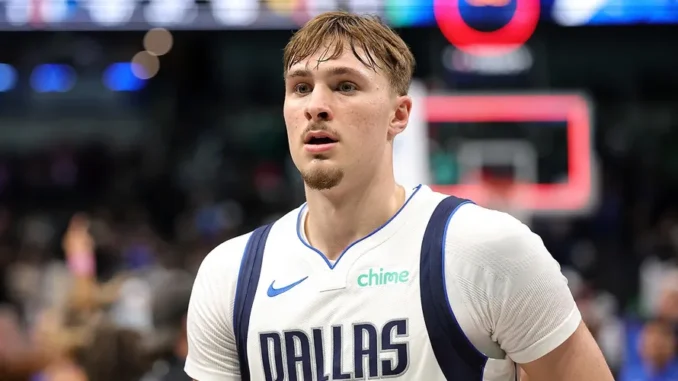
It’s the Most I’ve Lost, I Think Ever”: Cooper Flagg Confronts The Brutal Reality of NBA Losing
Dallas Mavericks rookie sensation Cooper Flagg—the highly-touted No. 1 overall pick—is grappling with a harsh and unfamiliar adjustment to professional basketball, one that transcends stat lines and skill development: the relentless, soul-crushing experience of losing. Following the Mavericks’ disappointing 2-6 start to the 2025-26 season, Flagg offered a sobering and incredibly honest assessment of the early-season struggles, revealing that the constant defeats have shaken him on a fundamental level.
In a quote that perfectly encapsulated the jarring transition from a career defined by dominance to one marred by defeat, Flagg stated:
“For me, it’s the most I’ve lost since… you know, I think ever. We have to adapt to playing a lot more games, and I definitely have to get used to that. But I wouldn’t say anyone’s happy. Guys are obviously trying to stay level-headed and know that we’ve got a lot more games to go, and it’s still really earl1y.”
This statement, coming from an 18-year-old who has been a basketball prodigy since his early teens, lays bare the single biggest psychological hurdle for virtually every top draft pick: trading individual success for organizational instability and the inevitable frequency of NBA losses.
The Prodigy’s Pedigree: A Career of Winning
To truly understand the weight of Flagg’s quote, one must look at his historical context. Cooper Flagg is not just a highly-ranked high school player; he is a statistical anomaly in terms of winning.
| Level of Competition | Teams/Programs | Typical Loss Record |
| High School | Montverde Academy (FL) | Typically 1-3 losses per season. |
| AAU/Elite Circuits | Maine United/USA Basketball | Championship-winning frequency, near-perfect records. |
| College | Duke Blue Devils | Rarely exceeds 10 losses in a season. |
Throughout his amateur career, Flagg was accustomed to being the central figure on teams that did not just win, but were often overwhelming favorites that steamrolled their competition. At powerhouse Montverde Academy and during his single season at Duke, the narrative was constant: dominance, championships, and a few losses sprinkled in, easily forgotten by the next game.
Now, a few weeks into his NBA career with the Dallas Mavericks, Flagg found himself on a team that, at the time of the quote, had already logged six losses in eight games. This single stretch of professional basketball had already surpassed the total number of losses he might have accumulated over his entire high school or college career. This seismic shift from near-perfection to frequent defeat is a mental shockwave that tests the very competitive DNA of every rookie superstar.
The Mavericks’ Tumultuous Environment
Flagg’s adjustment is complicated by the chaotic environment he was drafted into. The Dallas Mavericks were a playoff team that, by sheer luck (a 1.8% chance in the draft lottery), landed the No. 1 pick. The expectation, despite the controversial Dončić trade, was that a core of Kyrie Irving, Anthony Davis, and Flagg would contend for a playoff spot.
However, the team has been besieged by issues:
-
Star Injuries: The continuous injury woes of Anthony Davis and extended absence of Kyrie Irving have left the rookie with an unstable supporting cast, forcing him to take on responsibilities far beyond what a typical No. 1 pick faces.
-
Front Office Chaos: The team’s struggles directly contributed to the recent firing of General Manager Nico Harrison, creating a sense of organizational instability that weighs heavily on the players.
-
The Luka Shadow: Every loss is magnified by the knowledge that the player the team traded away to reset the franchise, Luka Dončić, is thriving on a contender. The air of failure and regret permeates the locker room and the arena, making losses feel heavier than they would otherwise.
Flagg, thrust into a leadership role as the designated “savior” of the post-Dončić era, is absorbing the full force of this collective frustration.
The Shift from High School to NBA Losing
The challenge of losing in the NBA is not just about the number of losses; it’s about the nature of those losses and the lack of time for recovery.
| Factor | Amateur (High School/College) | Professional (NBA) |
| Frequency of Games | Typically 1-2 games per week. | 3-4 games per week (82 games total). |
| Ability to Recover | Days/weeks to shake off a loss in practice. | Must “clear it and move on” in less than 24 hours. |
| Quality of Opponent | Occasional top-tier opponent. | Every opponent is elite talent, well-coached. |
| Rookie Responsibility | Immediate dominance expected. | Learning process amidst high-pressure expectations. |
Flagg is learning that in the NBA, a “bad game” or a “bad week” can result in three or four losses. As he noted, in high school and college, a single bad performance was often masked by a dominant team victory. In the NBA, a slight dip in performance from a star—even an 18-year-old rookie—can be the difference between a win and a loss. The competitive margin is simply too thin to coast, and the calendar is too unforgiving to dwell.
The Long-Term Test of Character
Flagg’s candid admission, while perhaps “depressing” to fans, is viewed by many scouts and analysts as a sign of his incredible competitive fire. The greats in the league—the Michael Jordans, Kobe Bryants, and LeBron Jameses—were all maniacal competitors who hated losing more than they loved winning.
Flagg is now facing the first major test of his character: Can he translate that deep-seated hatred of losing into productive, sustained work and leadership, rather than succumbing to frustration?
Veteran players and the coaching staff will be crucial in guiding him through this period. They will emphasize that this difficult stretch is foundational to his career, teaching him resilience and the professional habits required to win consistently in the NBA. He has already shown flashes of brilliance—including a 26-point career high in a recent loss—proving he has the talent.
However, the real test of his journey, and indeed the Mavericks’ future, will be whether he can maintain his confidence, trust his work ethic, and adapt to the reality that every NBA victory is earned, and every loss is painful, transforming his shock over “the most I’ve lost” into the drive to reverse the team’s fortunes. The path of a franchise savior is rarely easy, and for Cooper Flagg, the education in professional losing has just begun.
Leave a Reply