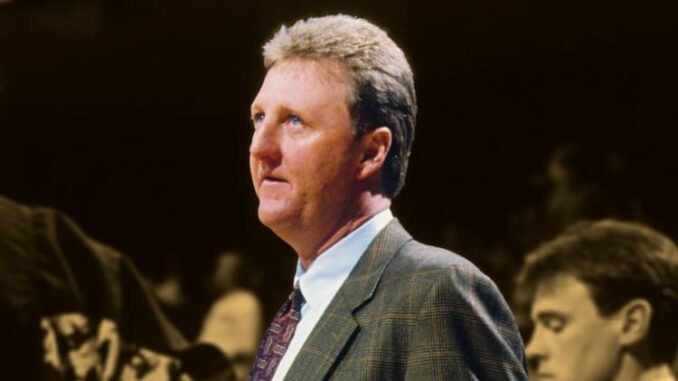
Larry Bird’s Mastery of Building Confidence: The Fred Hoiberg Story and Its Lasting Impact on the Indiana Pacers
In the late 1990s, the Indiana Pacers were a team on the cusp of greatness, but they needed a spark to push them over the edge. Enter Larry Bird, the legendary Boston Celtics forward turned rookie head coach. With no prior coaching experience, Bird took the reins in 1997 and transformed the Pacers into a powerhouse, earning NBA Coach of the Year in his debut season and leading them to the NBA Finals in 2000. One of the hallmarks of Bird’s brief but brilliant coaching tenure was his unparalleled ability to instill confidence in his players—stars and role players alike. He understood that basketball at its highest level wasn’t just about talent or strategy; it was about belief. And no story captures this better than the one shared by Fred Hoiberg, a sharp-shooting guard who played under Bird during those formative years.

Fred Hoiberg, drafted by the Pacers in 1995, was a classic role player: a reliable three-point specialist who averaged modest numbers but provided crucial spacing and clutch shooting off the bench. In interviews reflecting on his time in Indiana, Hoiberg recounted a pivotal moment that exemplified Bird’s coaching philosophy. During a game, Hoiberg rose up for a three-pointer. “As soon as it released from my hand,” Hoiberg recalled, “Larry Bird yelled, ‘Money!'” The ball swished through the net, of course. It wasn’t just a lucky call—it was Bird’s way of preemptively affirming his player’s ability, removing any doubt before the outcome was even decided. In that single word—”Money”—Bird conveyed absolute trust. He saw the shot as good the moment it left Hoiberg’s fingertips, boosting the young guard’s confidence in real time.
This anecdote isn’t isolated trash talk or hype; it’s a window into Bird’s deeper approach. As a player, Bird was infamous for his psychological edge—predicting shots, trash-talking opponents into submission, and backing it up with ice-cold execution. As a coach, he flipped that intensity inward, using it to elevate his team. He made sure every player, no matter how big or small their role, felt like a superstar in their domain. Hoiberg, often coming off the bench for spot-up opportunities, wasn’t Reggie Miller or Rik Smits, but Bird treated his contributions with the same conviction he might have given a game-winner.
Bird’s method was deceptively simple: empower through belief. Former Pacers like Chris Mullin praised Bird for keeping things “real simple, real fundamental—be on time, play unselfish, and play hard.” But beneath that bluntness was a profound understanding of pressure. In high-stakes moments, when games tightened, Bird grew calmer, reminding players of their preparation: “You’re open; hit the shot. I saw you make 12 of them yesterday.” This wasn’t empty motivation; it was rooted in observation and trust. Bird watched practices intently, knowing exactly what each player was capable of, and he vocalized that faith loudly and often.
The impact on the Pacers was transformative. Coming off the rigid, detail-oriented style of previous coach Larry Brown—who players reportedly loathed for being a “control freak”—Bird’s player-friendly approach was a breath of fresh air. Players bought in immediately. Mark Jackson, the veteran point guard, credited Bird with putting players “in the best position to make the most money,” by maximizing their strengths. Antonio Davis and others noted how the team was elated when Bird replaced Brown, confident that “Larry Legend” would foster a winning culture. Even in the face of intimidation from Michael Jordan’s Chicago Bulls, Bird demanded fearlessness. He once gave his team an ultimatum after sensing hesitation against MJ: knock him down if you get the chance, or don’t expect to win. Though they fell short in the 1998 Eastern Conference Finals (going seven games), the Pacers pushed the dynasty harder than most, a testament to the confidence Bird instilled.
Bird’s emphasis on roles was key. He didn’t try to turn bench players into stars; he made them stars within their roles. Big men like Dale Davis and Rik Smits anchored the paint with physicality. Shooters like Hoiberg and Travis Best provided spacing. Veterans like Mullin and Jackson brought leadership. And Reggie Miller thrived as the closer. Bird’s calm demeanor on the sideline—sitting quietly, subtly calling sets—contrasted with more animated coaches, but it worked because players knew he believed in them unconditionally. As Mullin put it, “The game gets tight, he gets more comfortable.” This created a locker room of accountability and reliance, where distractions were minimized, and the focus was purely on basketball.
The results spoke volumes. In Bird’s three seasons (1997-2000), the Pacers posted a 147-67 regular-season record, reached the Eastern Conference Finals every year, and made the Finals in 2000, falling to the Shaq-Kobe Lakers. Bird’s 1997-98 team set a franchise record with 58 wins (tied later), and he became one of the few to win both MVP and Coach of the Year. His players responded: Smits made his first All-Star team under Bird; Miller elevated his game further; role players like Hoiberg contributed without ego.
Hoiberg’s story resonates because it humanizes Bird’s genius. As a former player who trash-talked his way to three championships, Bird knew confidence wasn’t innate—it was built. He called shots “money” not for show, but because he genuinely saw the purity in his players’ mechanics. This extended beyond the court. Bird challenged players in shooting contests, daring them to beat him (and occasionally losing to the likes of Jonathan Bender). He fostered unity gestures, like the team’s famous head-shaving in the 1998 playoffs, which surprised even veterans and galvanized them.
Bird’s Pacers era was short—he stepped down in 2000, honoring a pre-hire promise to coach only three years due to health concerns—but its legacy endures. He later returned as president of basketball operations, building more contenders. Players from that era, including Hoiberg (who went on to a successful coaching career himself), often cite Bird as a pivotal influence. Hoiberg, now head coach at Nebraska, draws from those lessons: trust your players, simplify the game, and affirm their abilities relentlessly.
In an NBA increasingly dominated by analytics and schemes, Bird’s approach feels timeless. He proved that great coaching isn’t always about X’s and O’s; sometimes it’s about a single yell from the bench—”Money!”—that reminds a player they’re capable of greatness. Bird didn’t just coach the Pacers; he made them believe they belonged among the elite. And in doing so, he cemented his status not only as a playing legend but as one of the most impactful coaches in the game’s history.
Bird’s philosophy extended to handling adversity. Facing the Bulls’ dynasty, he refused to let fear creep in. His teams played with a swagger born of belief. Role players like Hoiberg weren’t afterthoughts; they were essential, and Bird ensured they knew it. This egalitarian confidence-building created a cohesive unit where superstars deferred and bench players stepped up.
Reflecting on his time, Hoiberg’s anecdote stands out because it was personal. Bird, the stoic Hoosier, rarely effusive, chose that moment to vocalize faith. It wasn’t scripted; it was instinctive, drawn from his own playing days where he called his own shots with unshakeable certainty.
Ultimately, Larry Bird’s Pacers tenure teaches a profound lesson: true leadership in basketball—or any team endeavor—is about making everyone feel indispensable in their role. Big or small, every contribution matters, and when a coach like Bird affirms that with unwavering belief, magic happens. The Pacers didn’t win a title under him, but they competed at the highest level, leaving an indelible mark. And stories like Hoiberg’s ensure that mark endures, inspiring generations of players and coaches to shoot with confidence, knowing someone believes it’s “money” from the moment it leaves their hand.
Leave a Reply