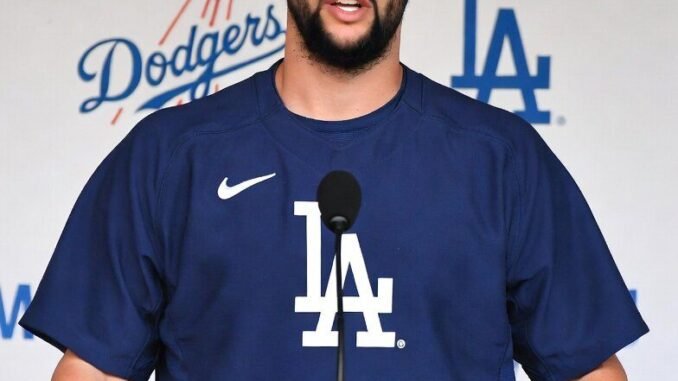
Clayton Kershaw Fires Back at Critics, Compares Dodgers’ Dominance to NY Yankees’ Dynasty
The Los Angeles Dodgers recently achieved a feat not seen in a quarter-century: becoming back-to-back World Series champions after defeating the Toronto Blue Jays in a thrilling seven-game 2025 Fall Classic. Yet, even as the parade confetti settles, the “villain” narrative has intensified. Critics point to the team’s record-shattering payroll and aggressive free-agent acquisitions—most notably Shohei Ohtani and Yoshinobu Yamamoto—as evidence that the Dodgers are “buying” titles and ruining the competitive balance of the sport.
Newly retired Dodgers legend Clayton Kershaw isn’t having it. In a recent appearance on the Literally! with Rob Lowe podcast, the three-time World Series champion and future Hall of Famer fired back at the detractors, offering a perspective that leans into the polarizing nature of greatness.
Embracing the Villain Role
Kershaw, who officially hung up his cleats following the 2025 title run, addressed the perception that the Dodgers’ dominance is bad for baseball. He argued that the sport actually thrives when there is a clear “juggernaut” for fans to either idolize or despise.
“I think that was the way the Yankees were,” Kershaw told Lowe. “When I was growing up, the Yankees were the best team, in the World Series and winning all those. But I think that’s good for baseball. I really do. Having a team that you either love… or you hate because they keep winning, that’s good for baseball. You don’t want to be indifferent.”
Kershaw’s comparison to the New York Yankees dynasty of the late 1990s and early 2000s is apt. Much like those Derek Jeter-led teams, the current Dodgers have become a cultural phenomenon. Kershaw noted that the 2025 postseason saw record-high viewership, fueled significantly by the team’s massive international fanbases in Japan and Canada.
“Buying” Wins vs. Building Culture
A core criticism of the 2024 and 2025 championships is the reliance on big-ticket free agents. Critics argue that the “Dodger Way” has been replaced by the “Dodger Checkbook.” However, Kershaw pointed out that several teams with massive payrolls—the Mets and Yankees included—have failed to secure titles despite similar investments.
For Kershaw, the difference lies in the clubhouse culture. He credited the organization’s ability to integrate superstars like Ohtani into a cohesive unit that can weather injuries. In 2025, the Dodgers rotation was decimated by injuries to Tyler Glasnow and Gavin Stone, yet the team found ways to win.
-
Payroll vs. Production: While the Dodgers spend heavily, they also lead the league in player development “value,” with players like Will Smith and Max Muncy (reclamation project) serving as the heartbeat of the team alongside the superstars.
-
The Destination Factor: Kershaw emphasized that the Dodgers have become a “status symbol” destination. Players aren’t just coming for the money; they are coming for the rings and the institutional stability.
The Three-Peat Challenge
With Kershaw stepping away, the Dodgers are now looking toward the 2026 season with a historic goal: the first three-peat since the 1998–2000 Yankees. The team has already bolstered its roster for the attempt, adding star closer Edwin Díaz on a multi-year deal and anticipating the return of Shohei Ohtani to the pitching mound.
The retired lefty’s “stern message” to the haters serves as a rallying cry for a fanbase that has embraced its status at the top of the mountain. As Kershaw puts it, if the rest of the league is upset about the Dodgers’ dominance, the solution isn’t for the Dodgers to stop winning—it’s for the other teams to catch up.
Impact of the Retirement
Kershaw’s retirement marks the end of an era. Over 18 seasons, he became the face of the franchise, navigating the transition from the McCourt era to the current Guggenheim dominance. His final gift to the city was a 12th-inning relief appearance in the 2025 postseason that helped clinch a crucial win against Toronto—a fitting “legendary” capstone to a career that defined a generation of Dodgers baseball.
Leave a Reply