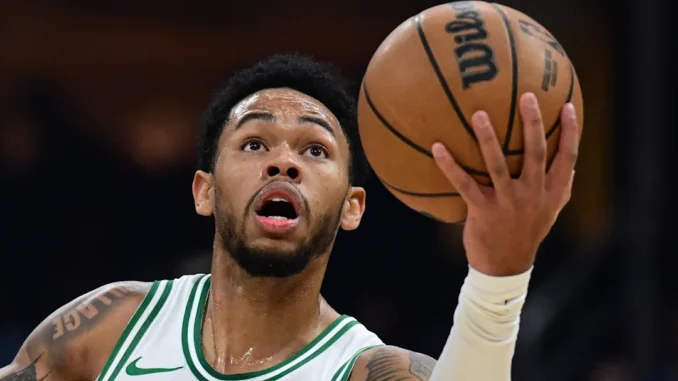
The Boston Celtics’ Direction With Anfernee Simons: A Decision Looming in January
The Boston Celtics entered the 2025-26 NBA season in uncharted territory. Following Jayson Tatum’s devastating Achilles rupture during the 2024 playoffs, the franchise shifted gears from defending their championship to a “bridge year” focused on financial flexibility and long-term sustainability. A key move in that direction was trading veteran guard Jrue Holiday to the Portland Trail Blazers in July 2025, acquiring Anfernee Simons in return—a straight player-for-player swap after initial reports of additional draft picks fell through due to Holiday’s medical concerns.
Simons, then 26, arrived in Boston as a dynamic scoring guard on an expiring $27.7 million contract. The acquisition was widely viewed as a salary-dump maneuver for the Celtics, shedding Holiday’s deal while positioning Simons as a potential trade chip to further reduce luxury tax burdens and avoid the punitive repeater tax. Yet, as the season has unfolded, Simons has become an integral part of a surprisingly competitive Celtics squad. As of late December 2025, Boston sits at 18-11, third in the Eastern Conference, forcing president of basketball operations Brad Stevens to reassess the team’s direction. According to recent reports, the final call on Simons—trade him or keep him—will likely come in January, as the February 5, 2026, trade deadline approaches.
This 2,000-word exploration delves into Simons’ journey with the Celtics, his on-court impact, the financial and strategic considerations at play, potential trade scenarios, and what the decision could mean for Boston’s present and future.
The Trade That Brought Simons to Boston
The swap of Holiday for Simons was one of the offseason’s most scrutinized deals. Holiday, a cornerstone of Boston’s 2024 title run with his elite defense and clutch play, was moved to lighten the payroll amid Tatum’s absence. Portland, in rebuild mode, sought Holiday’s veteran leadership for their young core, including Scoot Henderson and Shaedon Sharpe.
For Boston, Simons represented instant offense off the bench. In Portland, he had evolved into a high-volume scorer, averaging 19.3 points in 2024-25 with elite three-point shooting. His athleticism and shot-creation were seen as assets for a Tatum-less roster leaning on Jaylen Brown, Derrick White, and Payton Pritchard. Early preseason flashes—like a 21-point outburst against Cleveland on 6-of-9 threes—hinted at his potential to thrive in Joe Mazzulla’s motion offense.
However, from day one, Simons was labeled a trade candidate. His defensive limitations—a persistent issue in Portland—clashed with Mazzulla’s emphasis on switchability and tenacity. Moreover, his expiring deal made him the perfect salary-matching tool for upgrades or tax relief. Reports emerged that Boston quietly explored flipping him before the season even started, discussing frameworks with teams like Brooklyn and Milwaukee, though nothing materialized.
Simons’ Performance in Green
Despite the trade buzz, Simons has carved out a meaningful role. Through 29 games (all off the bench), he’s averaging 13.0 points, 2.3 assists, and 2.1 rebounds in about 24 minutes per game. His shooting splits—43.1% from the field and 36.9% from three—reflect streaky but impactful scoring. He’s third in the league in bench points, providing microwave bursts that have bailed out Boston during Tatum’s absence.
Highlights include back-to-back 23-point games in November and a key nine-point third quarter in a comeback win over Indiana just before Christmas. Mazzulla has praised his sacrifice and depth contribution, noting how Simons’ aggression creates space for others. Teammates like Brown have echoed this, urging more playmaking opportunities for him.
That said, cracks exist. Simons ranks in the bottom 10th percentile among guards in defensive estimated plus-minus, often targeted in mismatches. His usage has dipped compared to Portland, and recent slumps—averaging 11.2 points over his last five on 38.9% shooting—have seen minutes ceded to rising wings like Hugo González. ESPN’s Tim Bontemps has questioned his playoff fit, suggesting a limited role even if retained.
Overall, Simons has been a net positive, helping Boston exceed low expectations. Their 18-11 record without Tatum speaks to depth, with Simons as a key cog.
The Financial Imperative
Boston’s decisions hinge on money. After years as repeat tax payers, the Celtics faced second-apron restrictions. Trading Holiday and others (like Kristaps Porziņģis) got them below the second apron but still above the luxury tax line by about $12 million early in the season.
Simons’ $27.7 million expiring contract is the largest movable piece. Dealing him could drop Boston under the tax entirely, resetting the repeater clock and creating flexibility for future extensions (e.g., around Brown and a returning Tatum). Ownership has no strict mandate to duck the tax, per Stevens, but sources indicate willingness to pay “some level” this year—provided the team competes.
Insider Jake Fischer of The Stein Line reported in late December that Boston “could very well elect to keep Simons,” a shift from earlier flip expectations. Their strong start has prioritized winning over pure cost-cutting. Yet Fischer added that a deal moving Simons for a rotational upgrade while lowering the tax bill would “check all the boxes.”
Trade Scenarios and Potential Partners
If Boston trades Simons, the goal is dual: improve the roster (particularly frontcourt depth, with makeshift starters like Josh Minott and Neemias Queta) and save money.
Proposed deals include:
- Multi-team constructs with Utah and Phoenix, landing versatile defenders like Kyle Anderson and Nick Richards while shedding ~$15.8 million.
- Straight-up for Brooklyn’s Nic Claxton, a 6-foot-11 rim protector, saving $2-5 million.
- Targets like Ivica Zubac (Clippers) or Ayo Dosunmu (Bulls) for big-man help or guard depth.
Rebuilding teams like Utah or Washington could absorb Simons for picks, but Boston prefers upgrades. They’ve resisted attaching first-rounders to sweeten pots.
Portland fans have noted irony: the Blazers traded Simons partly due to his defensive fit and contract demands, issues now plaguing Boston.
Why January Matters
Reports pinpoint January as the decision month. By then, Boston will have ~20 more games to evaluate:
- Sustained competitiveness (top-4 East seed?).
- Simons’ consistency and defensive growth.
- Tatum’s rehab progress (potential mid-to-late season return).
- Market for Simons—his value hasn’t skyrocketed (13 PPG off bench), but flashes could attract suitors.
If Boston surges, keeping Simons preserves depth for a playoff push, with his expiring deal turning into summer cap space. Trading him mid-slump risks weakening a contender.
Conversely, fading into Play-In territory reignites tax concerns, making Simons expendable for relief or minor assets.
Long-Term Implications
Retaining Simons through the deadline signals ambition: this “bridge year” could yield a deep playoff run, especially with Tatum back. His offense complements White and Pritchard, forming a potent bench.
Trading him aligns with sustainability—avoiding tax penalties to chase stars later or extend youth.
Either way, Simons’ Celtics tenure has been revealing. Acquired as a placeholder, he’s proven valuable yet imperfect. As Fischer noted, nothing’s decided until January, but the outcome will define Boston’s identity: contenders now or builders for tomorrow?
In a season of surprises, Anfernee Simons embodies the Celtics’ crossroads. His direction—stay or go—will clarify theirs.
Leave a Reply