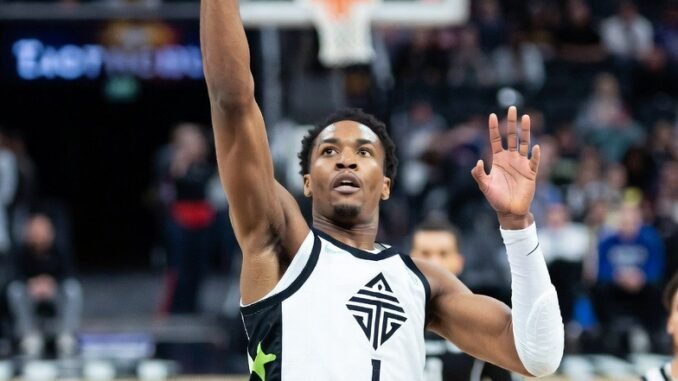
Anfernee Simons Drains Five Threes in Dominant Win: A Statement Performance That Silences Doubts
On January 3, 2026, the Boston Celtics closed out their five-game West Coast road trip with a resounding 146-115 thrashing of the LA Clippers at the Intuit Dome. Jaylen Brown stole headlines with a 50-point masterpiece, Derrick White poured in 29, and Jordan Walsh posted a double-double off the bench. Yet, quietly but emphatically, Anfernee Simons delivered one of the most efficient scoring outbursts of his young Celtics tenure: 15 points on 5-of-8 shooting—all five makes coming from beyond the arc—in just 19 minutes off the bench.
The performance wasn’t merely a hot shooting night; it was a declaration. Simons, acquired in the blockbuster summer trade that sent Jrue Holiday to Portland, has spent the early part of the 2025-26 season navigating questions about fit, role, and consistency alongside Boston’s star-studded backcourt. Saturday’s flawless 5-for-8 from deep—his best three-point output since November 9—served as a reminder of the elite scoring gravity he brings, especially as a sixth man. Over his last six games, Simons has now made multiple threes in every contest, averaging 13.5 points on scorching perimeter efficiency while providing the exact spacing and instant offense the Celtics envisioned when they pulled the trigger on the trade.
The Trade Revisited: From Portland Prodigy to Boston Bench Weapon
When Brad Stevens shipped Jrue Holiday, a beloved champion and defensive anchor, to the Trail Blazers for Simons and draft compensation in July 2025, the move drew polarized reactions. Celtics fans mourned losing a locker-room leader and clutch performer. Portland fans celebrated landing a veteran mentor for their young core. National pundits largely viewed it as Boston prioritizing financial flexibility and youth over short-term certainty.
Simons, then 26, arrived with a reputation as one of the league’s most electric young scorers. In Portland, he had blossomed into a 20+ point-per-game guard, highlighted by a 2021-22 campaign where he averaged 22.0 points and shot 40.5% from three on high volume post-CJ McCollum trade. His blend of pull-up creation, deep range, and explosive finishing made him a modern microwave scorer. Yet concerns lingered: defensive limitations, occasional inefficiency, and how he would adapt to a reduced role behind Derrick White, Payton Pritchard, and a ball-dominant Jaylen Brown (with Jayson Tatum sidelined).
Early returns were mixed. Simons started the season coming off the bench, averaging modest minutes while adjusting to Joe Mazzulla’s motion-heavy system. Through November, he shot respectably but rarely dominated—flashes of brilliance interspersed with quieter nights. The November 9 game in Orlando marked his previous three-point peak (5-for-8), but consistency eluded him as Boston experimented with lineups amid injuries and roster integration.
The Clippers Game: Perfect Efficiency in Limited Minutes
Against the Clippers, everything clicked. Simons entered in his customary sixth-man role and immediately stretched the floor. His first triple came early in the first quarter off a White kick-out, splashing cleanly to push Boston’s lead. By halftime, he already had three makes, exploiting closeouts from a Clippers defense preoccupied with Brown’s onslaught.
In the third quarter, with Boston pulling away, Simons caught fire. A transition pull-up from 28 feet swished. A catch-and-shoot corner three off a Brown drive followed. Each make forced rotations, collapsing LA’s defense and creating driving lanes for Brown and White. His fifth triple—a step-back over Kris Dunn late in the third—elicited roars from the Celtics’ traveling contingent and prompted Mazzulla to keep him in closing minutes longer than usual.
The numbers tell only part of the story: 15 points, 5-8 FG, 5-8 3Pt, 0-0 FT, 3 rebounds, 4 assists, +22 plus-minus in 19 minutes. Zero turnovers. No forced shots. Pure, impactful offense. For a player whose calling card has always been scoring efficiency, it was vintage Simons—reminding observers why Portland once built around him and why Boston coveted his shooting gravity.
Impact on the Celtics’ Offense: Spacing That Unlocks Everything
Boston’s 146 points weren’t an accident. They shot 24-of-51 (47.1%) from three, assisted on 34 of 52 made field goals, and generated 1.587 points per possession—a franchise record for efficiency. Simons’ perfect perimeter shooting played a pivotal role in stretching the Clippers’ drop coverage (particularly with Ivica Zubac returning from injury and moving slowly).
Defenders couldn’t sag off Simons without paying dearly, which opened driving lanes for Brown (50 points on 26 shots) and White (29 on 19 shots). His four assists—mostly swing passes leading to open threes—further amplified ball movement. In a game where the Celtics overwhelmed LA with spacing and pace, Simons embodied the archetype Stevens targeted: a high-volume, high-efficiency shooter who punishes inattention.
Over the last six games, the trend is clear. Simons has knocked down 19 of his last 43 three-point attempts (44.2%), averaging 3.2 made threes per contest. His usage has remained modest (around 20%), but his true shooting percentage during the streak hovers near 65%—elite even among bench scorers. More importantly, Boston’s net rating with Simons on the floor has spiked, underscoring his positive impact beyond box-score counting.
Silencing the Doubters: Role Acceptance and Growth
One persistent critique of Simons entering Boston was role reduction. In Portland, he often operated as the primary or secondary creator. In Boston, he’s firmly the third or fourth option on most nights. Early frustration surfaced subtly—occasional forced shots, visible disappointment after subbing out. Yet credit Mazzulla and the veteran leadership: Simons has embraced the sixth-man identity with increasing enthusiasm.
Postgame against the Clippers, he spoke candidly: “I’m just trying to come in and provide that spark. Whether it’s threes, drives, or playmaking—whatever the team needs in my minutes.” His body language has shifted—no pouting after early hooks, more vocal encouragement from the bench. The five straight games with multiple threes reflect growing comfort within Mazzulla’s system, where off-ball movement and quick decisions are rewarded.
Defensively, improvement is evident too. While never an elite stopper, Simons has competed harder on the perimeter, using his quickness to stay in front of guards. Against LA, he drew a charge on James Harden and contested multiple shots without fouling. Small wins, but meaningful for a Celtics team that prides itself on collective defense.
Broader Implications for Boston’s Season
With Jayson Tatum sidelined indefinitely (Achilles management), the Celtics have leaned heavily on depth. The 4-1 road trip—culminating in the Clippers rout—propelled them to 21-12, third in the East. Performances like Simons’ illustrate why Stevens bet on youth and shooting over veteran stability.
Looking ahead, Simons’ bench role appears cemented. Payton Pritchard’s playmaking and defense make him the preferred starter alongside White and Brown. Yet Simons’ scoring punch off the pine mirrors the Lou Williams/Terrence Ross archetype—capable of 20+ point bursts that swing games. As Tatum nears return, Simons’ spacing will become even more valuable, pulling bigs away from the rim and creating driving angles for the stars.
Trade deadline chatter has quieted. Early whispers of flipping Simons for veteran help have faded as his fit crystallizes. At 26, on a reasonable contract, he represents a long-term asset—potentially the long-term backcourt partner for White if Pritchard’s extension talks stall.
Personal Growth and the Road Ahead
Simons’ journey—from overlooked 2018 first-rounder in Portland to centerpiece to now thriving reserve in Boston—reflects maturity. He’s spoken openly about studying film of JJ Redick and Malik Monk, learning how elite bench scorers impact winning. His work with Mazzulla’s staff on catch-and-shoot mechanics has paid dividends; Saturday’s five makes were almost exclusively off movement or quick swings.
The streak of multiple threes in six straight games isn’t coincidence—it’s adaptation. Averaging 13.5 points in 22.3 minutes during that span, Simons has found rhythm without forcing volume. If sustained, he projects as a leading Sixth Man of the Year candidate, especially on a contender.
For a player who once carried Portland’s offense through dark seasons, accepting a complementary role on a championship-caliber team represents growth. Saturday’s flawless three-point barrage wasn’t just 15 points—it was validation. Validation for Stevens’ vision. Validation for Mazzulla’s trust. Validation for Simons himself.
As the Celtics return home to face tougher Eastern foes, expect more nights like this. Anfernee Simons has arrived in Boston—not as the star he was in Portland, but as the deadly shooter and sparkplug this roster needs. Five threes in 19 minutes against the Clippers? Just the latest proof that the trade is paying dividends, one splash at a time.
Leave a Reply