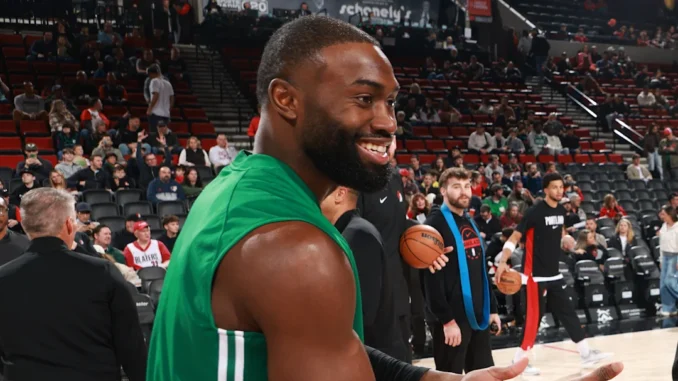
NBA Just Made Two Huge Realizations About Jaylen Brown: He’s a Bona Fide Superstar and a Legitimate MVP Candidate
Introduction: A Star Ascends in Tatum’s Absence
As 2025 draws to a close on December 31, the NBA landscape has shifted dramatically for the Boston Celtics. With Jayson Tatum sidelined for the season recovering from a torn Achilles suffered in the 2025 playoffs, many pundits predicted a steep decline for the defending champions. Instead, Jaylen Brown has seized the moment, elevating his game to unprecedented heights and forcing the league to confront two massive realizations: First, Brown is not just a high-end No. 2 option—he’s a legitimate No. 1 capable of carrying a contender. Second, his explosive December performance has thrust him squarely into the MVP conversation, proving he’s among the league’s elite two-way players.
Brown’s 2025-26 campaign has been a revelation. Entering his tenth season at age 29, the former Finals MVP has averaged career highs across the board, including around 29-30 points per game while leading a revamped Celtics roster to a strong position in the Eastern Conference standings (third place with a winning record despite roster turnover). His December dominance—averaging an NBA-best 32.7 points per game, earning multiple Player of the Week honors, and tying Larry Bird’s franchise record with nine consecutive 30-point games—has crystallized these truths for the entire league.
Realization One: Jaylen Brown Thrives as the Undisputed Alpha
For years, narratives dogged Brown: Could he truly lead without Tatum? Was he overpaid on his supermax extension? Trade rumors swirled, with skeptics arguing he wasn’t built for the primary role. The 2025-26 season has obliterated those doubts.
Without Tatum, and after offseason trades that sent Jrue Holiday, Kristaps Porzingis, and others elsewhere to manage salary cap constraints, Boston leaned on Brown as the focal point. The results? A competitive team hovering near the top of the East, fueled by Brown’s scoring prowess, improved playmaking, and defensive tenacity.
Brown has led the NBA in two-point attempts per game (around 15-16), shooting efficiently (over 54%) in a style reminiscent of pre-championship Michael Jordan—attacking the rim relentlessly while mastering the midrange. He’s not just volume-scoring; he’s efficient, drawing fouls at an elite rate (nine free-throw attempts per game in December, ranking among the league’s top), and creating for teammates with career-best assists.
His streak of 30-plus-point games—nine straight, matching Bird’s longstanding Celtics record—underscored his ability to dominate night after night. Games against tough opponents like the Pacers (multiple 30-31 point outings in wins) and others showcased his clutch gene, echoing his 2024 Finals MVP performance.
Teammates and coaches rave about his leadership. Payton Pritchard publicly stated Brown “should be in the MVP conversation,” highlighting his nightly impact. Joe Mazzulla has praised Brown’s maturation, noting how he’s elevated the offense (Boston boasting top-tier ratings in December) while anchoring the defense.
The league’s realization? Brown was always capable; Tatum’s presence merely masked his alpha potential. Now, with the spotlight solely on him, he’s proving haters wrong—again. Reddit threads and analyst discussions echo this: Brown’s career arc is defined by defying expectations, from draft skepticism to supermax criticism to championship doubts.
Realization Two: Brown Is a Serious MVP Threat and All-NBA Lock
The second huge realization stems directly from Brown’s awards and voting feedback: The NBA is acknowledging his superstar status through honors, even as fan-driven processes lag.
On December 29, 2025, Brown earned Eastern Conference Player of the Week for the second time in December (his sixth career weekly honor), averaging 32.7 points, 6.3 rebounds, 3.3 assists, and 1.7 steals in a 2-1 week. This came amid his historic scoring run, positioning him as a frontrunner for Player of the Month.
Yet, the first All-Star fan voting returns revealed a disconnect: Brown ranked sixth (or even lower in some reports) among East forwards/guards, trailing more marketable names despite superior on-court production. Brown’s response—”I agree PR contest”—went viral, highlighting how All-Star selection often prioritizes popularity over performance.
This juxtaposition forced the league’s reckoning: Brown’s play demands recognition beyond fan votes (which count 50%; media and players make up the rest). Analysts project him for All-NBA First Team, a career first, based on his two-way dominance. He’s leading a depleted contender, scoring at elite levels, and impacting winning—classic MVP criteria.
Comparisons abound: His midrange mastery and rim attacks draw Jordan parallels (pre-1991 titles). His slow-burn progression mirrors Jimmy Butler’s late-blooming All-NBA runs. And in a guard/wing-heavy MVP race (with names like Shai Gilgeous-Alexander, Luka Dončić, and Nikola Jokić), Brown’s defense sets him apart—no top contender relies on him more.
His bold claim during a livestream—”Nobody doing it better than me right now”—ignited debate but reflected confidence earned through results. Pritchard’s endorsement and Mazzulla’s breakdowns reinforce: Brown is top-10, perhaps top-5, in the league.
December Dominance: The Catalyst for League-Wide Awakening
Brown’s December encapsulated these realizations. Leading the NBA in scoring (32.7 PPG), he tied Bird’s record before a potential 10th straight 30-point game against Utah on New Year’s Eve eve.
Efficiency shone: High drive volumes with elite finishing, pull-up jumpers accounting for massive points, and free-throw generation rivaling Giannis or Doncic. Boston’s offense hummed at elite levels, with a +11 net rating second only to Oklahoma City.
Defensively, Brown remained a pest—steals, blocks, versatile assignments—proving he’s not sacrificing one end for the other.
Losses, like to Portland, highlighted reliance on him, but wins (multiple over Indiana) showed his carry job. His triple-doubles, near-misses, and stat-stuffing forced scouts and execs to reassess: This isn’t a flash; it’s sustained excellence.
Broader Impact: Roster Adjustments and Future Outlook
Boston’s revamp—adding Anfernee Simons, relying on Derrick White, Payton Pritchard, Neemias Queta, Jordan Walsh, and rookies—succeeds because of Brown. Youngsters like Walsh thrive off his gravity; veterans like White complement his scoring.
Without Brown, predictions of 35-40 wins might hold; with him, playoff contention feels realistic. If Tatum returns mid-to-late season, a Brown-led foundation could propel a deep run.
Off-court, Brown’s intellect and activism (7uice Foundation, MIT camps) add layers, but on-court, he’s redefining his legacy.
Challenges and Counterpoints
Skeptics note: Shooting variance (3-point dips some nights), rebounding inconsistencies, or cold streaks could temper hype. All-Star snub risks persist if “PR” lags. Yet, data counters: Elite efficiency inside, winning impact, and historical comps silence most doubt.
Conclusion: A New Era for Brown and the Celtics
As 2025 ends, the NBA can’t ignore it anymore: Jaylen Brown is a superstar leader and MVP-caliber force. His response to adversity—elevating without Tatum—has rewritten narratives. The Player of the Week nods and voting discourse are symptoms; the realizations are profound.
Brown’s journey—from third pick to doubted co-star to Finals hero to solo carrier—embodies resilience. In 2026, expect All-NBA honors, All-Star starts (via media/player votes), and perhaps MVP buzz carrying into playoffs.
For Boston, it’s a bridge year turned opportunity. For the league, it’s a wake-up: Jaylen Brown has arrived—fully.
Leave a Reply