Eagles’ Defensive Responsibility That Will Shape Outcome Against Bills
As the Philadelphia Eagles (10-5) head into a high-stakes Week 17 clash against the Buffalo Bills (11-4) at Highmark Stadium on December 28, 2025, the game’s outcome may hinge on one critical defensive task: containing dual-threat quarterback Josh Allen and the NFL’s top rushing attack led by running back James Cook. Vic Fangio’s unit, bolstered by the return of All-Pro defensive tackle Jalen Carter, faces its toughest test yet—a Bills offense averaging 158.9 rushing yards per game while featuring Allen’s elite arm and legs.
The Eagles’ defense has been a revelation in 2025, ranking among the league’s best in points allowed (around 19.3 per game in recent stretches) and passing yards surrendered (7th at 192.3 ypg). Over the last eight games, they’ve held opponents to just 15.5 points and 286.5 total yards per contest. However, vulnerabilities against mobile quarterbacks and downhill rushing attacks have emerged as potential Achilles’ heels—issues that Buffalo exploits masterfully.
Containing Josh Allen: The Ultimate Dual-Threat Challenge
Allen, the reigning MVP frontrunner, has torched defenses with 3,406 passing yards, 25 touchdowns, and a 103.3 passer rating through 15 games, while rushing for 552 yards and 12 scores—leading all QBs in both categories. His ability to extend plays, evade pressure, and gash teams on scrambles or designed runs makes him a nightmare for any coordinator.
Fangio, known for his two-high safety shells and disciplined zone coverages, has historically struggled against elite mobile QBs. Past schemes under Fangio allowed Allen big games, with extended plays thriving when rush lanes collapse. The Eagles have shown similar issues in 2025, yielding big runs to scramblers. Fangio himself noted the need to “rush as a unit” without opening seams, emphasizing containment over individual heroics.
Key to success: The front four—Carter, Jordan Davis, Milton Williams, and Moro Ojomo—must generate interior pressure while maintaining lane integrity. Carter’s explosive return disrupts timing, potentially forcing quicker throws. Edge rushers like Nolan Smith and Jalyx Hunt can’t overpursue, allowing Allen to escape outside.
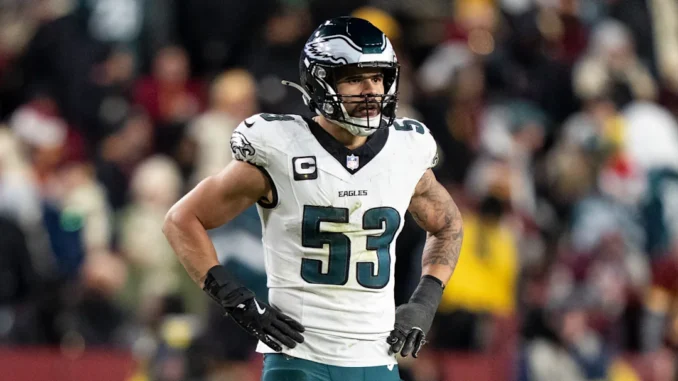
Linebackers Zack Baun and Nakobe Dean (if healthy) serve as spies or cleanup crew. Baun’s Pro Bowl season—fluid in coverage, rangy downhill—positions him as the “foundational” player against Buffalo’s multiplicity. His route recognition and closing speed can mirror Allen on broken plays, limiting yards after contact.
In the secondary, corners Quinyon Mitchell and Cooper DeJean, plus safeties Reed Blankenship and C.J. Gardner-Johnson, must plaster receivers while keeping eyes on Allen. Fangio’s disguises can confuse pre-snap reads, but post-snap discipline is paramount—Allen thrives when defenses lose integrity.
Stopping the Run: James Cook and Buffalo’s Ground Dominance
While Allen grabs headlines, Cook is the engine: league-leading 1,532 rushing yards, 12 touchdowns, and a 5.3 ypc average. Buffalo ranks first in rushing yards per game and has gashed defenses with tempo and physicality.
The Eagles rank 21st against the run (123.5 ypg allowed), struggling with downhill attacks despite overall dominance. Recent opponents exploited gaps, and Buffalo’s scheme—gap/power runs behind a solid line—tests light boxes common in Fangio’s two-high looks.
Carter’s reinstatement is massive: His run-stopping prowess (career highs in tackles for loss) clogs lanes alongside Davis and Williams. Filling gaps and shedding blocks prevents cutback lanes that Cook exploits.
Baun and Dean must trigger quickly without overcommitting to play-action fakes—Buffalo’s RPO-heavy attack punishes hesitation.
Fangio’s Scheme: Strengths and Potential Pitfalls
Fangio’s influence has transformed the Eagles into a bend-don’t-break unit, limiting explosives with split-safety coverages. Against Buffalo, this forces patience: dink-and-dunk drives rather than big plays.
Yet, the scheme’s light boxes invite runs, and mobile QBs like Allen probe fringes. If the Eagles win third downs (opponents convert just 37% lately) and force turnovers (strength this year), they dictate terms.
Why This Shapes the Outcome
Buffalo’s offense thrives on balance—Cook softens defenses, opening play-action for Allen’s deep shots or scrambles. If the Eagles contain the run (under 120 yards) and limit Allen’s legs (under 50 rushing yards), they force predictable passing into a stingy secondary.
Failure here cascades: Extended drives tire the defense, short fields for Buffalo’s offense, and momentum swings in frigid Orchard Park.
Analysts view this as a Super Bowl preview. The Eagles’ pass rush (37 sacks) and turnover creation can neutralize threats, but lapses against the run or scrambles could prove fatal.
With Carter back and Fangio scheming, the Eagles have tools. Execution—lane discipline, gap soundness, and tackling in space—decides if they slow Buffalo enough for their offense (led by Saquon Barkley exploiting Bills’ weak run D) to steal a road win.
This defensive battle isn’t just key—it’s the fulcrum on which the game tilts.
Leave a Reply