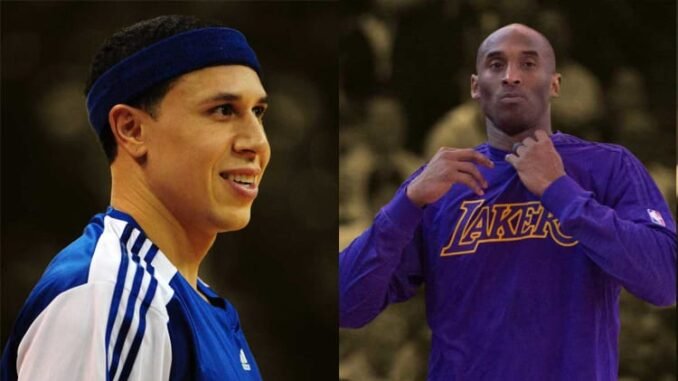
The Rivalry That Couldn’t Be Broken: Mike Bibby Reveals the Failed Deal to Team Up with Kobe Bryant
The history between Mike Bibby and Kobe Bryant is defined by one of the most intense and controversial playoff rivalries in modern NBA history: the epic clashes between the Sacramento Kings and the Los Angeles Lakers in the early 2000s. Yet, behind the public antagonism and the lingering bitterness over the 2002 Western Conference Finals, there was a deep, personal friendship and mutual respect between the two stars.
That respect nearly paved the way for one of the most stunning and impactful mid-season trades of the post-dynasty era. As Bibby recently revealed, the dream of joining forces with his fiercest rival in the purple and gold was tantalizingly close to becoming a reality, only to be vetoed by the unbreakable bond of the Kings-Lakers rivalry.
I. A Friendship Forged in Rivalry
The narrative of Mike Bibby and Kobe Bryant begins long before their iconic on-court battles. They were friends since childhood, as their fathers had played in the NBA concurrently. This relationship evolved as they both became stars, culminating in sharing the floor at the prestigious 1996 McDonald’s All-American Game.
This personal history allowed their intense rivalry to exist within a framework of professional respect.
The 2002 Crucible
Bibby’s time in Sacramento is inseparable from the 2002 Western Conference Finals, a seven-game war that many Kings fans believe was unjustly swayed by questionable officiating in the Lakers’ favor. Bibby was phenomenal in that series, averaging $22.7$ points per game and providing the offensive engine that pushed the Lakers’ dynasty to its absolute limit.
The animosity was palpable:
-
The Rivalry’s Peak: Sacramento’s belief that they were “robbed” cemented the Kings-Lakers rivalry as pure hatred for the fanbase. Bibby was the perfect on-court antagonist to Kobe, matching his ferocity with his own clutch shot-making.
-
The Aftermath: Even after the series, the images of Bibby and Kobe battling, including a famous moment where Kobe’s elbow struck Bibby’s face (resulting in a controversial foul call on Bibby), defined their competitive relationship.
Yet, this very rivalry—which made them enemies on the court—also showcased their similar competitive makeup, making the idea of them finally teaming up years later so appealing to both players.
II. The Secret Pursuit: “We Were Trying to Get It Done”
The trade scenario unfolded in 2007-2008, several years after the peak of the Kings’ contention. By this time, the Sacramento Kings were in the midst of a clear rebuilding effort, and the nearly 30-year-old Bibby was not aligned with their new direction. Trade rumors swirled, with the Cleveland Cavaliers and LeBron James being the primary rumored destination.
However, beneath the noise, a quieter, more personal dialogue was taking place.
The Phone Call to Kobe
According to Bibby’s own recollection, the Lakers entered the picture suddenly as the trade deadline approached. Bibby, eager to join a championship contender, took direct action, reaching out to his friend.
Mike Bibby recounted: “At first, it was supposed to be the Lakers. I called and talked to Kobe, and we were trying to get it done.”
This simple quote reveals a profound level of player agency and mutual desire. Bibby and Bryant, two generational talents who spent years trying to destroy each other’s championship dreams, were actively collaborating on a move to bring them together.
The Perfect Fit for Mamba
The Lakers in 2007 were a team built around a frustrated Kobe Bryant, who was demanding a trade himself before the eventual acquisition of Pau Gasol. At the time of the Bibby rumors, the Lakers desperately lacked a reliable, veteran point guard to take pressure off Bryant as the primary playmaker.
-
A Second Star: Bibby, a proven clutch performer and three-point threat, would have been the perfect backcourt partner for Bryant. He could handle the primary ball-handling duties, allowing Kobe to maximize his scoring off the ball, or act as a high-level spot-up shooter in the final minutes.
-
The Championship Push: A Lakers lineup featuring Kobe Bryant and Mike Bibby would have immediately been a significant threat in the Western Conference, perhaps even accelerating their return to the Finals before the Pau Gasol trade cemented their dynasty.
III. The Rivalry’s Veto: The Maloof’s Final Say
Despite the clear competitive logic and the desires of the two stars, the trade ultimately fell apart after only one day of serious discussion. The reason was entirely based on the raw, lingering bitterness of the 2002 rivalry.
Protecting the Brand
The Sacramento Kings’ ownership at the time, the Maloof family, simply could not stomach the idea of sending their franchise cornerstone directly to their most hated rival.
Bibby explained the deal’s collapse: “But I don’t think the Maloofs wanted to send me to the Lakers. So that fell through.”
The power of the rivalry, which was arguably the most intense in the NBA at the time, was stronger than the pragmatic business interests of the Sacramento organization. To trade Bibby to the Lakers would have been viewed as a betrayal by a Kings fanbase still reeling from the perceived injustice of 2002. The owners chose to prioritize protecting their franchise’s emotional relationship with its fanbase over maximizing their trade return from a willing—and desperate—buyer.
The Immediate Aftermath
Instead of heading to the bright lights of Los Angeles to team up with his friend, Bibby was traded a day later to the Atlanta Hawks. He went from a potential championship contender to a young, rebuilding team in the Eastern Conference.
While Bibby eventually found success in Atlanta, helping them reach the Eastern Conference Semifinals, and later made an NBA Finals appearance with LeBron James and the Miami Heat (falling to the Dallas Mavericks in 2011), the opportunity to play alongside Kobe Bryant and potentially win a title in 2008 or 2009 was permanently lost.
IV. The Lingering “What If”
The failed Mike Bibby trade remains one of the more tantalizing “what-ifs” in Lakers and Kings history.
-
Lakers History: Could a Kobe-Bibby duo have won the 2008 Finals against the Celtics, potentially changing the arc of that rivalry? Would the Lakers have still traded for Pau Gasol?
-
Bibby’s Legacy: For a player who came agonizingly close to a title in 2002, joining the Lakers could have provided the championship ring that ultimately eluded him.
Leave a Reply