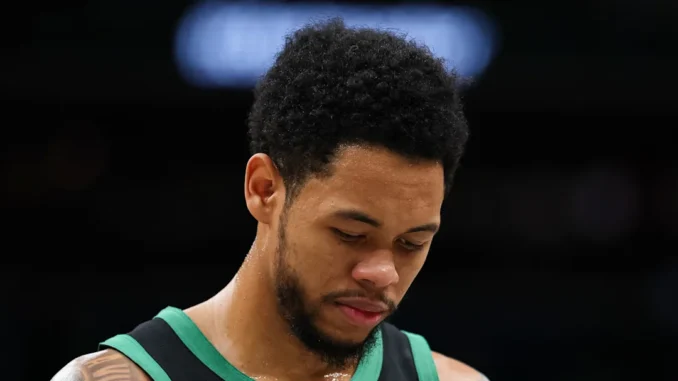
The Expiring Asset: Why Trading Anfernee Simons is the Celtics’ Only Move
The Boston Celtics, even while navigating a complicated season with Jayson Tatum sidelined, have established themselves as a legitimate contender in the Eastern Conference, driven by the emergence of players like Derrick White and the consistent defense of their remaining core. However, the elephant in their opulent locker room is the presence of Anfernee Simons, the high-scoring combo guard acquired from the Portland Trail Blazers in the offseason swap involving Jrue Holiday.
Simons is a talented scorer—a fact undisputed across the league—but he is also an ill-fitting veteran on an expiring contract worth approximately $27.6 million.1 The convergence of his salary, his poor defensive fit in Coach Joe Mazzulla’s system, and the Celtics’ desperate need for a frontcourt upgrade makes the decision crystal clear: It is finally time for Brad Stevens to convert the Anfernee Simons trade chip into a piece that moves the needle for a championship run.
The December 15th trade eligibility date has passed, officially opening the window for the Celtics to make their move. The clock is ticking, and holding onto Simons past the trade deadline would be a disastrous failure of asset management, risking his departure in the offseason for nothing.
📉 The “Ill-Fitting” Diagnosis: Why Simons Doesn’t Work in Boston
The Celtics acquired Simons primarily for financial reasons, converting Jrue Holiday’s long-term, expensive contract into Simons’ massive, but expiring, salary.2 The hope was that Simons could provide a dynamic scoring punch off the bench. While his individual scoring numbers are respectable (3$13.1$ points in 4$23.7$ minutes per game), his overall fit has been problematic for a team prioritizing defense and ball movement.5
1. Defensive Liability in a Defensive System
The identity of the current Celtics is built on versatility and defense. The team sacrifices offense for the ability to switch almost everything and pressure the ball. Simons, at $6’3”$ and lacking the defensive instincts of a player like Derrick White, is a significant weak link.
-
Negative Defensive Impact: Simons’ presence often disrupts the continuity of the Celtics’ defense, forcing teammates to cover for him and creating mismatches that opponents successfully exploit. His defensive rating is among the lowest of the team’s rotation players.
-
Mazzulla’s Style: Coach Mazzulla’s system is less about having a designated “bucket-getter” off the bench and more about having players who can shoot, pass, and defend at a high level. Simons’ score-first, combo-guard mentality often forces a regression to isolation play that the Celtics have successfully moved past.
2. Redundant Skills and Diminished Role
With Derrick White thriving in an expanded role and Payton Pritchard serving as a reliable backup guard, the Celtics simply do not need Anfernee Simons’ skill set.
-
Pritchard’s Reliability: Pritchard provides a more cost-effective, team-first, and energetic presence in the backcourt rotation.
-
A Costly Bench Scorer: Paying $27.6 million for a $6^{th}$ man who averages barely over 20 minutes and is a defensive liability is an untenable proposition for a team facing major luxury tax concerns and potentially repeater tax penalties in the near future.
🔨 The Celtics’ Singular Need: The Frontcourt Anchor
The decision to trade Simons is not about hating his talent; it is about addressing the Celtics’ most glaring flaw: center depth and defensive anchoring.
The offseason departures of Kristaps Porziņģis, Al Horford, and Luke Kornet created a massive hole. While Neemias Queta has performed admirably, averaging career highs and showing flashes of potential, the Celtics cannot reasonably rely on him as the full-time, starting-caliber anchor for a championship team. Stevens’ primary objective must be to leverage Simons’ value to acquire a reliable, rim-protecting big man.
Ideal Trade Targets for Simons’ Expiring Contract
Simons’ expiring contract is his greatest asset—it’s a massive salary slot that allows a trading partner to either balance a high-value acquisition or to shed long-term money and gain immediate cap flexibility.6
| Target Center | Team | Why the Celtics Need Him | Potential Package Anchor | Status/Latest Rumor |
| Nic Claxton | Brooklyn Nets | Elite rim protector and lob threat. Perfect fit for the White/Brown/Tatum drive-and-kick game. | Simons + 2027 1st Round Pick | Nets and Celtics have reportedly held exploratory talks involving Simons. |
| Ivica Zubac | L.A. Clippers | All-Defensive level big man on a team-friendly, long-term deal. A true defensive anchor. | Simons + Multiple 1st Round Picks | Reportedly “not available,” but Simons’ expiring deal was the key to a proposed L.A. package. |
| Day’Ron Sharpe | Brooklyn Nets | Cost-controlled, young center with upside. A more affordable option than Claxton. | Simons for two Nets salary-fillers (Sharpe, Cam Thomas) and draft compensation. | The Celtics coveted Sharpe this past summer. |
The key takeaway is that the Celtics have already engaged in exploratory conversations with teams like the Nets, specifically using Simons’ contract as the centerpiece for a frontcourt upgrade.7
🛑 The Urgent Deadline and Financial Mandate
Stevens cannot afford to wait. The primary motivating factors for moving Simons intensify with every passing week:
-
Avoiding the Tax Line: Trading Simons for two or more lower-salaried players (a scenario often discussed in relation to the Nets) would be the cleanest way for the Celtics to duck below the luxury tax apron. This financial maneuver would reset the franchise’s repeater tax penalties, saving ownership tens of millions in future tax bills—a strategic priority.
-
RFA Risk: If the Celtics were to keep Simons, he would walk into unrestricted free agency this summer. Given his scoring talent, another team will offer him a significant long-term deal—a price the Celtics are unwilling to match. Allowing a $27.6 million trade chip to leave for no compensation is front-office malpractice.
-
The Title Window: With Jayson Tatum out, the current team is performing admirably, but they are not the finished product. To truly compete with the top tier of the East, they need a robust, reliable center. Stevens has a rare opportunity to acquire a needle-mover by trading an ill-fitting asset
Leave a Reply