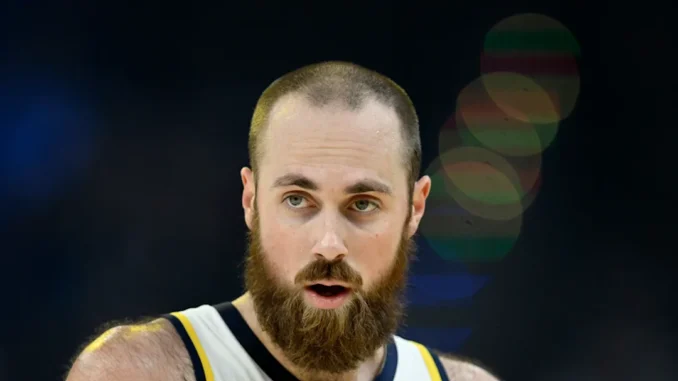
Jay Huff: The Seven-Foot Answer Staring the Pacers in the Face
Jay Huff: The Seven-Foot Answer Staring the Pacers in the Face
The loss of Myles Turner in free agency to the Milwaukee Bucks left a gaping, seven-foot hole in the Indiana Pacers’ long-term plan. For nearly a decade, Turner was the franchise’s cornerstone big man—a unique, two-way center who could space the floor with a reliable three-point shot and serve as a premier rim protector. His departure, regardless of its ultimate value to the team’s payroll flexibility, necessitated an immediate, aggressive search for the “center of the future” to pair with star point guard Tyrese Haliburton.
While much of the media and front office discussion has centered on external trade targets like Ivica Zubac, Daniel Gafford, or even potential draft prospects, the Pacers’ most promising, cost-controlled, and system-perfect center is already in the building: Jay Huff.
In a league that prioritizes continuity, chemistry, and value, Huff, through a combination of timely development and sheer production, has transformed from a fringe roster acquisition to the undeniable center of the future. The data, the on-court fit, and the recent eye test all point to one conclusion: the search is over, and the Pacers can now dedicate their valuable draft capital and salary cap space to fortifying other areas of the roster.
The Statistical Revelation: Huff’s Elite Two-Way Surge
The “staring them in the face” argument for Jay Huff is built on his recent, sensational performance, particularly in a starting role following the trade of Turner. Huff has emerged as one of the NBA’s most surprising and efficient two-way bigs, replicating, and in some areas surpassing, the exact functions the Pacers required from Turner.
🛡️ The Defensive Anchor
The primary concern following Turner’s exit was maintaining elite rim protection, a non-negotiable requirement for a Rick Carlisle system that encourages aggressive perimeter defense. Huff has not just filled that void; he has temporarily become one of the league’s most prolific shot-blockers.
-
Blocks Leaderboard: In a recent 15-day stretch, where Huff has solidified his role as the starting center, he has led the entire NBA in blocks per game, averaging a staggering $3.7$ rejections.
-
The Vertical Threat: At $7’1”$ with a massive wingspan and exceptional vertical leap, Huff is a genuine deterrent. His quick-jumping ability allows him to recover and contest shots at the rim with force, altering driving lanes for opposing offenses. This ability to protect the paint is the engine of the Pacers’ defense and is an essential component for any center playing alongside the up-tempo Haliburton.
🎯 The Stretch-Five Success
The other non-negotiable component for a Haliburton-led offense is floor spacing. The center must be able to pull the opposing team’s biggest defender out of the paint, creating driving lanes for Haliburton and slashing wings like Bennedict Mathurin. Huff has proven he is a genuinely valuable stretch-five, not just a theoretical one.
-
Three-Point Efficiency: Over his recent surge, Huff has consistently shot near 40% from three-point range on reasonable volume. His ability to knock down the corner and top-of-the-key three is crucial.
-
Pick-and-Pop Synergy: Huff’s high-volume, high-efficiency pick-and-pop game with Haliburton has been devastating. Defenses must respect his pop to the arc, which forces the opposing big man to move with him, fundamentally opening up the entire court for Haliburton to attack or distribute.
Huff’s recent stats—averaging roughly 10 points, 5 rebounds, and 3 blocks while shooting over 50% from the field and nearly 40% from deep—are not merely good; they are statistics that mirror those of his predecessor, Myles Turner, proving the Pacers did not suffer a major decline at the position, but simply substituted one unique big for another at a fraction of the cost.
The Irrefutable Fit: Unleashing Haliburton and Siakam
Beyond the raw statistics, Huff’s presence has a tangible, positive effect on the Pacers’ core talent, making the entire team’s offensive and defensive identity more cohesive.
Tyrese Haliburton’s Best Friend
Haliburton’s game is maximized when he has space. A center who clogs the paint, struggles to run the floor, or cannot shoot forces Haliburton into tougher pull-up jumpers or complex passes. Huff’s combination of skills is tailor-made for the Pacers’ superstar:
-
Rim-Running for Transition Buckets: Huff is surprisingly agile and runs the floor extremely well, which is vital for the league’s fastest-paced team. This allows Haliburton to reward him with easy transition alley-oops, immediately putting pressure on the defense.
-
Unclogged Driving Lanes: When Huff sets a screen and pops, the paint is completely cleared. Haliburton can walk into a floater, force a switch, or hit a driving Mathurin or a cutting Pascal Siakam.
The Siakam-Huff Net Rating
The synergy with the team’s other high-value acquisition, Pascal Siakam, provides the most compelling evidence for Huff’s future role. Siakam, who thrives on driving, post-ups, and mid-range jumpers, needs space to operate in the middle of the court.
-
Elite Net Rating: Data shows that when Siakam and Huff share the court, the Pacers’ net rating jumps significantly—from a negative team average to a positive number, often reaching $+3.7$ or higher. This dramatic improvement is a clear indicator that Huff’s specific skill set is the missing piece that unlocks the maximum potential of the Haliburton-Siakam pairing. Huff’s floor spacing gives Siakam the isolation room he requires, and Huff provides the necessary backline defense for Siakam to take chances on the perimeter.
The Financial and Developmental Wisdom
In today’s NBA, where teams are constantly battling the salary cap and the luxury tax, finding elite production at a bargain price is the difference between contention and stagnation.
💰 Cost-Controlled Certainty
Jay Huff’s contract is perhaps the most compelling argument for his permanent ascension. He is signed to a multi-year, team-friendly deal at a fraction of the cost of a max-level or even mid-tier starting center.
-
The Bargain Price: With a cap hit under $6 million over the next two seasons, Huff offers a starting center’s production for the price of a high-end backup.
-
The Cap Space Windfall: This financial efficiency is a monumental win for the Pacers, who face upcoming financial decisions regarding extensions for players like Mathurin. By securing their starting center for cheap, the team preserves its salary cap space and valuable draft picks, which can now be used to acquire a much-needed backup point guard, a high-end wing defender, or simply be used to avoid the luxury tax—a known priority for the organization.
📈 Development Over Trade
While the Pacers have been linked to big-name trade targets, pursuing them would be counterproductive:
-
Trading Assets: Acquiring a center like Ivica Zubac or Daniel Gafford would necessitate trading valuable draft picks or young players like Jarace Walker or Isaiah Jackson. Huff’s emergence means the Pacers don’t have to part with those assets, allowing them to keep their developmental pipeline full and their trade chest ready for a different, more impactful acquisition down the line.
-
The Jay Huff Bet Paid Off: The Pacers, when they signed Huff, made a low-risk, high-reward bet on his potential. That bet has paid off handsomely. To abandon him now for an expensive alternative would negate their own successful player evaluation and development work.
Conclusion: The Era of Jay Huff Begins
The narrative surrounding the Pacers’ center spot has been one of perpetual search. After Myles Turner’s departure, the team faced a dilemma: swing a blockbuster trade for a proven commodity, or take a chance on internal development.
Jay Huff has forcefully resolved that debate. He is not merely a stop-gap; he is a perfectly calibrated solution for the modern, high-speed, space-and-pace offense that Tyrese Haliburton pilots. He provides the elite shot-blocking to anchor the defense and the deep shooting threat to unlock the offense’s full geometry. By trusting the data and the on-court fit, the Pacers have found their center of the future. The time for seeking costly, external options is over. The time for Jay Huff is now.
Leave a Reply