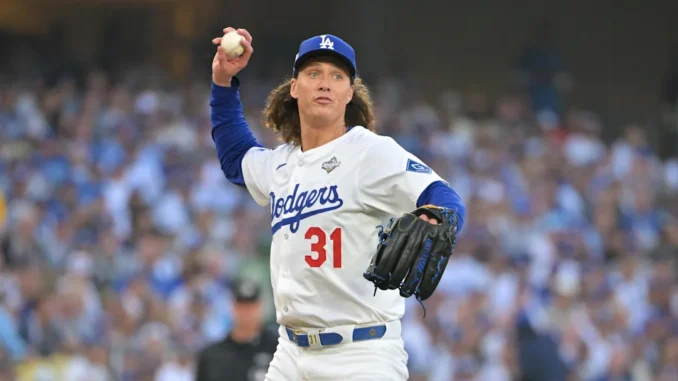
The Ultimate Asset Flip: Why Trading Tyler Glasnow for Tarik Skubal is the Dodgers’ Final Power Move
The Los Angeles Dodgers already shocked the baseball world by acquiring Tyler Glasnow from the Tampa Bay Rays prior to the 2025 season and immediately signing him to a five-year, $136.5 million extension. Glasnow served as the high-upside, high-risk ace the rotation desperately needed, and he paid dividends, culminating in a dominant 2025 postseason showing.
However, the Dodgers’ ambition operates on a different plane. With the opportunity to acquire two-time Cy Young winner Tarik Skubal from the Detroit Tigers, Glasnow has instantly become the key to unlocking the ultimate upgrade. A “sneaky” trade involving Glasnow is not about salary relief or marginal returns; it is the perfect asset flip that exchanges a high-risk, high-AAV pitcher for the best controllable ace in baseball.
Multiple top MLB insiders, including former GM Jim Bowden, have laid out the framework for this blockbuster: trading Glasnow to the Tigers as the primary piece for Skubal. Here is why this trade makes undeniable sense for the Dodgers:
1. The Upgrade from High-Risk to Top-of-the-Line Guarantee
The rationale for trading Glasnow, even after his strong season and dominant 2025 playoff run (1.69 ERA in six appearances), boils down to managing risk versus acquiring certainty.
-
Glasnow’s Risk Profile: Despite his elite stuff (3rd in K/9 over the last five seasons), Glasnow has never been an innings eater. His career high for innings pitched is just 134 in 2024. He has a history of major injuries, including Tommy John surgery and various oblique/knee issues. The Dodgers were willing to gamble $27.3 million AAV on him, but they know he cannot be relied upon for 180+ innings.
-
Skubal’s Certainty: Tarik Skubal, in contrast, is the reigning two-time American League Cy Young winner and has proven himself to be a high-volume, dominant left-handed ace. While his contract is only through the 2026 season (which is why the Tigers are trading him), the trade is entirely contingent on the Dodgers securing him with a long-term contract extension, which is rumored to be in the $400 million range. The cost is astronomical, but the Dodgers are one of the few teams that will pay it.
-
The Exchange: The trade moves the Dodgers from a great pitcher with high injury risk and innings limitations (Glasnow) to arguably the most dominant, long-term controllable ace in the game (Skubal).
2. The Relief of Rotation Congestion
The Dodgers are approaching an embarrassment of riches in their starting rotation—a key reason Glasnow can be deemed “expendable” for the right price.
-
The Post-Glasnow Rotation: Even if Glasnow is traded, the Dodgers’ starting five/six rotation for 2026 still features:
-
Tarik Skubal (The New Ace)
-
Yoshinobu Yamamoto (Elite Righty)
-
Shohei Ohtani (Returning from injury, limited innings)
-
Blake Snell (If re-signed/acquired)
-
Emmet Sheehan (Proven young starter)
-
Walker Buehler (Returning from injury, managing innings)
-
-
Creating Space for Young Talent: The Dodgers have a stable of young, controllable pitching that needs innings, including Emmet Sheehan (who excelled in 2025) and top prospects like River Ryan and Gavin Stone. Trading Glasnow for Skubal while including Sheehan in the deal for Detroit (as the proposed trade package suggests) allows the Dodgers to consolidate their talent at the top while protecting their overall depth.
3. The Unbeatable Trade Package for Detroit
The “sneaky” aspect is how perfectly a Glasnow-centric package meets the Tigers’ highly specific needs, making the Dodgers the preferred trade partner despite the astronomical price tag on Skubal.
The rumored package is as follows: Dodgers send Tyler Glasnow, Emmet Sheehan, and OF prospect Zyhir Hope to Detroit for Tarik Skubal.
| What the Tigers Gain | Why It Works for Detroit |
| Tyler Glasnow (Through 2027) | Proven Ace, More Control: Glasnow provides the Tigers with a dominant, true ace to lead their rotation for two full seasons (2026-2027), which is one more year of team control than they have left with Skubal. This maintains the competitiveness of the team while they seek to develop more cost-controlled talent. |
| Emmet Sheehan (Through 2029) | Controllable Rotation Depth: Sheehan is a young, controllable starter (through 2029) who slots directly into the rotation. He is precisely the kind of low-cost, high-upside pitching asset the cost-conscious Tigers seek. |
| Zyhir Hope (Top Prospect) | Future Outfield Cornerstone: Hope, a highly-rated outfield prospect, addresses a major organizational need. He can pair with Riley Greene and Max Clark to form a dynamic, young outfield trio for the long term. |
For the Tigers, this deal allows them to move their expiring, highly expensive asset (Skubal is projected to command $400M in free agency) at his absolute peak value, while simultaneously getting two MLB-ready pitchers who can help them now and a top prospect who can help them later. It is the ultimate asset maximization move.
For the Dodgers, trading Glasnow is the final piece of transactional wizardry required to put them in pole position to secure the best pitcher in baseball for the next seven years. It is a necessary, calculated risk to cement their dynasty.
Leave a Reply