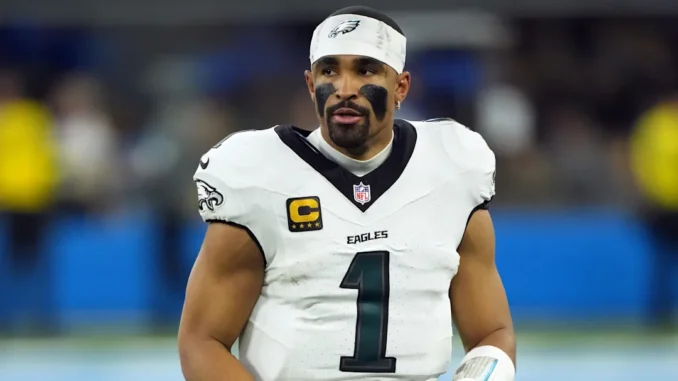
The Unraveling: Jalen Hurts, Not the System, Was the Undeniable Catalyst for the Eagles’ Deflating Loss
The Philadelphia Eagles’ three-game losing streak, culminating in a soul-crushing 22-19 overtime defeat to the Los Angeles Chargers, has thrown the entire season into crisis. While the finger of blame has often been pointed at offensive coordinator Kevin Patullo following the departure of Kellen Moore, the stark reality of Monday Night Football was undeniable: Jalen Hurts was the biggest problem.
The reigning Super Bowl MVP, a player whose entire career has been defined by his composure and ability to overcome adversity, turned in a performance that was historically bad—a complete anomaly for a quarterback of his stature, yet frighteningly indicative of the team’s spiraling control.
A Statistical Debacle: The Five Turnovers
Hurts’ night was characterized by a chaotic cascade of giveaways: four interceptions and one lost fumble. These five turnovers not only sabotaged drive after drive but also negated an otherwise efficient offensive effort that included 122 rushing yards from Saquon Barkley.
| Hurts’ Passing Stats vs. Chargers | Value | Notes |
| Completions / Attempts | 21 / 40 (52.5%) | Failed to complete half his passes. |
| Passing Yards | 240 | Modest production on high volume. |
| Touchdowns / Interceptions | 0 / 4 | Triple his season interception total in one game. |
| Lost Fumbles | 1 | Total of five drive-killing turnovers. |
| Passer Rating | 31.3 | A quarterback spiking the ball on every play would have a higher rating ($39.6$). |
The 31.3 passer rating is a damning indictment, a number usually reserved for backup quarterbacks in mop-up duty, not a $255 million franchise cornerstone.
The Unwanted History Lesson
The most painful part of the night was the bizarre sequence in the second quarter where Hurts created an NFL first—or last, depending on the perspective.
-
He threw an interception (Turnover 1).
-
An Eagles teammate forced a fumble on the return, which Hurts recovered.
-
Hurts was immediately hit and fumbled the ball away (Turnover 2).
According to the Elias Sports Bureau, Hurts became the only player since at least 1978 to be charged with two turnovers on the same play. This single, chaotic event perfectly symbolized the Eagles’ self-inflicted wounds, with the quarterback being the sole agent of their destruction.
The Root Cause: Decision-Making, Not Play-Calling
For weeks, the Eagles faithful have demanded the firing of Kevin Patullo, citing stale, predictable, or overly complex play-calling. While the overall offensive scheme has certainly regressed from their peak, Monday night was an irrefutable case of quarterback execution.
Ignoring Open Check-Downs
Numerous analysts highlighted Hurts’ tendency to bypass easily available check-down options in favor of forcing the ball downfield into tight coverage. This isn’t a problem of Patullo calling a bad play; it’s the quarterback failing to take what the defense is giving him.
-
The interception thrown to a dropping defensive lineman, Da’Shawn Hand, was a terrible throw on third down that should have either been thrown away or dumped off short.
-
The Eagles had success running the ball with Saquon Barkley (122 yards). The fundamental responsibility of a quarterback in a high-leverage situation is to protect the football and ensure the team gets points, even if they are only field goals. Hurts failed that responsibility repeatedly, turning potential scoring drives into empty possessions.
The Game-Ending Mistake
The final interception in overtime was the ultimate nail in the coffin, placing the blame squarely on the quarterback’s shoulders.
The Eagles, tied in a critical overtime period, marched into the Chargers’ red zone. On 1st-and-10 from the 17-yard line, Hurts opted for a deep shot to Jahan Dotson in double coverage in the end zone. The pass was tipped and intercepted by safety Tony Jefferson at the 1-yard line, ending the game on the spot.
A field goal attempt, even if missed, leaves the door open. A short run or a conservative pass gets the offense a few yards closer for a game-tying field goal. Going for the hero shot on 1st-and-10 in overtime, when a tie is still possible, demonstrates a severe lapse in situational awareness and poor risk assessment—errors an elite quarterback simply cannot make.
The Worrying Trend: Regression on the Heels of the MVP Season
The most alarming aspect of the five-turnover game is that it feels like a culmination of smaller, more subtle struggles that have plagued Hurts all season.
-
Turnover Spike: Hurts had only two interceptions on the season entering the game, meaning he quadrupled his total in one night. This sudden surge in recklessness is a fundamental break from the ultra-conservative, mistake-free football the Eagles relied on in their peak seasons. Hurts has now thrown five interceptions in the past two games.
-
Declining Efficiency: Hurts’ reliance on his rushing ability has not been as potent this year. With an offensive line that has struggled with injuries and a run game that has been inconsistent (despite Barkley’s strong Monday night), the onus has shifted more onto Hurts’ passing. When forced to be a traditional pocket passer, his accuracy and decision-making have regressed significantly.
-
The Weight of the Contract: The Eagles committed $255 million to Hurts, largely based on his ability to elevate the players around him and lead a championship-level offense. A quarterback of that caliber must be able to overcome adversity, such as a struggling coordinator or a missing offensive tackle. Instead, Hurts’ performance has amplified the existing offensive issues, proving that he is currently not the system-proof difference-maker he was paid to be.
Conclusion: The Path to Redemption Starts with Ball Security
The Eagles’ three-game slide has cost them the top seed in the NFC and brought the Dallas Cowboys roaring back into the NFC East race. With a forgiving schedule ahead—games against the Raiders and Commanders (twice)—the Eagles control their destiny, but only if the quarterback can put this performance behind him.
Hurts’ honest post-game assessment—”It starts with me, how I play, how I lead”—was the first step. The next, and most crucial, step is to internalize the lessons from this catastrophic loss. For the Eagles to stop their slide and reclaim their status as an NFC contender, Jalen Hurts must return to the foundational principle of championship football: protect the ball above all else. Until he does, the Eagles will remain a team that beats itself.
Leave a Reply