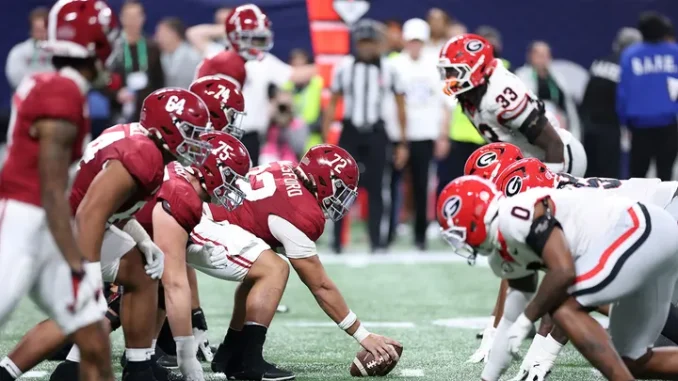
The Blueprint of Dominance: Why Georgia’s Rout of Alabama in the SEC Championship Solidifies Their Claim to the College Football Playoff First-Round Bye
Shifting the Narrative of Power
The College Football Playoff (CFP) era has been defined by the rivalry and competitive parity between the Georgia Bulldogs and the Alabama Crimson Tide. While Alabama often held the psychological edge in the SEC Championship, the recent contest—a dominant Georgia victory—did more than just award the conference trophy. It fundamentally reshaped the narrative of college football dominance and, more immediately, solidified the Georgia Bulldogs’ untouchable position in the final four. In the context of the imminent 12-team CFP expansion, this victory served as the most powerful statement possible: Georgia is not just a playoff contender; they are the standard, and they earned the critical first-round bye that dictates the easiest path to the national championship.
This analysis argues that Georgia’s rout of Alabama was a strategic masterpiece that accomplished five key goals: it secured the highest level of institutional prestige (the No. 1 ranking and the bye), validated their defense as the most dominant unit in the country, exposed the limits of Alabama’s sustained physical superiority, created invaluable psychological momentum, and provided the perfect blueprint for success in the grueling 12-team playoff format. This performance ensures that the road to the national title must now run directly through Athens.
Securing the Apex: The Unassailable Argument for the No. 1 Seed
In the final four-team playoff format, or under the expanded 12-team structure where the top four conference champions receive a bye, the No. 1 seed is the ultimate prize. It offers the easiest route to the championship game by requiring one fewer game and offering crucial weeks of rest and preparation.
Georgia’s victory over Alabama provides an unassailable argument for this top spot, combining resume quality with a defining eye-test performance:
-
Marquee Victory: Defeating Alabama, a consensus top-four program and a primary rival, in the conference championship game immediately vaults Georgia’s resume past any other potential No. 1 candidate (such as an undefeated team from a lesser conference or a team with a weaker strength of schedule). This victory is the ultimate ‘Quad 1’ metric.
-
The “How” Matters: The manner of the victory—a decisive rout rather than a narrow escape—convinced the voters and analysts that Georgia was not just better, but substantially better than their closest rival. This visual dominance is often the final piece of evidence required by the Committee to assign the top rank.
-
Complete Resume: By adding the SEC Championship to an already flawless season defined by multiple dominant wins over ranked opponents, Georgia’s body of work is unmatched. They proved they can win against various styles, sustain excellence over a long season, and perform flawlessly under the immense pressure of the conference final.
Securing the No. 1 seed and the subsequent first-round bye in the expanded format means Georgia immediately gains a competitive edge that could decide the national title. They avoid the potential pitfalls of an upset in the first round and gain valuable time for player recovery and advanced scouting.
Validation of the Defense: The Unwavering Foundation
The Georgia defense has been the program’s foundation, and the SEC Championship served as its definitive, most comprehensive validation. Alabama’s offense, even when challenged, is rarely shut down completely, yet Georgia’s defense dictated every possession, proving they are the most formidable unit in the nation.
The defensive performance was a mastery of execution, built on two core principles:
-
Relentless Interior Pressure: Georgia’s defensive front consistently generated pressure against Alabama’s offensive line without resorting to exotic blitz schemes. This allowed them to pressure the quarterback into mistakes while committing seven defenders to coverage, minimizing the risk of the big play. This four-man pressure is the gold standard for championship defense.
-
Secondary Execution and Discipline: The defensive backs played with elite discipline, preventing Alabama’s talented receivers from winning single coverage matchups and avoiding the miscommunication errors that lead to easy scores. Their ability to cover for extended periods while the defensive line worked was crucial.
This defensive dominance is the single greatest indicator of long-term success in the postseason. History shows that elite defense travels, translates against any opponent, and remains reliable when the pressure is highest. The defensive blueprint laid out against Alabama proves that Georgia is fundamentally built to win championship football, where offensive output can be volatile but defensive execution is constant.
Exposing the Limits: The End of Alabama’s Physical Hegemony
For years, the SEC Championship served as the final examination of college football physics, with Alabama often demonstrating a physical superiority that broke opponents mentally and physically. Georgia’s victory decisively turned the tables.
The rout signaled the temporary, if not permanent, end of Alabama’s assumed physical hegemony. Georgia matched and surpassed the Crimson Tide in every facet of trench warfare:
-
Offensive Line Dominance: Georgia’s offensive line controlled the line of scrimmage, allowing them to establish a consistent, physical running game and protect their quarterback. This sustained control of possession wore down Alabama’s defense and kept Georgia’s high-powered defense fresh.
-
Physicality at the Point of Attack: Every collision favored Georgia. Whether it was the defensive line stuffing the run or the linebackers meeting running backs in the hole, Georgia played with a violence that Alabama could not consistently match. This is a massive psychological win, suggesting that the era of Georgia recruiting and development has fully caught up to, and perhaps surpassed, the standard set by the Tide.
This shift in physical power is the most crucial long-term takeaway. It allows Georgia to now own the narrative of toughness and grit, which is essential for recruiting and for managing the mental game against future opponents in the playoff.
The Psychological Momentum and Roster Stability
The confidence gained from dominating a rival like Alabama cannot be overstated. It provides a massive psychological momentum boost heading into the layoff period before the playoff.
-
Confidence and Focus: The team enters the playoff feeling truly unbeatable, not just because of their record, but because they conquered the single greatest hurdle in their path. This confidence helps maintain focus and prevents complacency during the weeks of preparation.
-
Roster Retention (Portal Deterrent): In the modern transfer portal era, a loss in a game of this magnitude can lead to mass defections. The dominant win, however, reinforces commitment. Players see a clear path to the national championship and believe implicitly in the program’s ability to win it all, acting as a powerful deterrent against high-profile opt-outs or transfers.
-
Recruiting Edge: The victory provides instant, tangible recruiting fodder. Coaches can point to the film and tell recruits that Georgia is the place to come if they want to dominate the trenches and win championships now.
The sheer momentum generated by this decisive victory is a competitive advantage, ensuring Georgia’s emotional and psychological readiness for the ultimate challenge.
The 12-Team Playoff Blueprint
Looking ahead to the expanded 12-team CFP, the performance against Alabama provides Georgia with the perfect strategic blueprint for future success.
The 12-team playoff will be a six-week, seven-game grind for teams that don’t secure the bye. Georgia’s ability to dominate early and rest late becomes the crucial differentiator:
-
The Power of the Bye: The first-round bye, secured by the No. 1 ranking, gives Georgia an extra week of rest, rehabilitation, and scouting time. This is invaluable in the modern, physically demanding era of college football. While other contenders are playing a taxing extra game against a motivated opponent, Georgia is healing and perfecting their game plan.
-
Avoiding the Early Upset: The early rounds of the expanded playoff will be ripe for upsets, as lower seeds (like a dominant Group of 5 champion) will be highly motivated. Georgia avoids this landmine entirely.
-
The Depth Demonstration: The ability to dominate Alabama proves that Georgia’s depth is exceptional. In the expanded playoff, where sustained injuries are inevitable, having a deep roster of SEC-caliber talent is non-negotiable. Georgia showcased that they possess not just elite starters, but the reliable backups needed to win multiple games deep into January.
Georgia’s strategic domination of Alabama ensures they get to implement the best possible strategy in the new format: Minimize games played and maximize recovery time.
Conclusion: The New Reign
Georgia’s comprehensive victory over the Alabama Crimson Tide in the SEC Championship was far more than a conference title win; it was a statement of intent that finalized their claim to the College Football Playoff’s highest honor: the No. 1 seed and the critical first-round bye.
The performance validated their foundational dominance—the unbreakable defense and the newly established physical supremacy in the trenches. By crushing their greatest rival, Georgia erased any lingering doubts about their championship readiness, built invaluable psychological momentum, and secured the most advantageous path to the national title in both the current and expanded playoff formats. The message is clear: the balance of power in college football has shifted, and the Georgia Bulldogs are now unequivocally the team to beat.
Your article helped me a lot, is there any more related content? Thanks!