Introduction: The Unsettled Throne of College Hoops
The weekly release of the Associated Press (AP) Top 25 poll in men’s college basketball is rarely a rubber-stamped affair, but the current season has elevated volatility to an art form. The latest rankings serve as a stark reminder that the traditional hierarchy of the sport is fluid, characterized by parity, early-season upsets, and the inherent difficulty of consistent excellence in a high-turnover, pressure-filled environment. The most recent poll delivered a significant jolt: the once-stable Purdue Boilermakers have slipped outside the Top 5, and yet another team has ascended to claim the coveted, yet seemingly cursed, No. 1 spot in a tightly packed field.
This shift is more than just a numerical adjustment; it is symptomatic of a fundamental unpredictability that defines the 2024-2025 season. No team has established the kind of iron grip on the top spot that has characterized dominant seasons of the past. Instead, the current landscape is a chaotic, week-to-week audition where every major conference title contender faces relentless scrutiny and the imminent threat of an unranked opponent eager to make a statement. The movement at the top signifies that there is no singular, consensus national title favorite, making this season a thrilling, yet dizzying, race to the finish line where the true measure of a team’s worth will only be revealed in March.
The New Apex: Analyzing the Ascent to No. 1
The ascension of a new team to the No. 1 ranking is always the headline, and in this crowded field, the honor reflects not just their recent performances but their ability to navigate early non-conference challenges with greater success than their peers. Whether it is a defensively suffocating team like the Houston Cougars, a high-powered offensive juggernaut like the Arizona Wildcats, or a resurgent blue-blood like the Kansas Jayhawks (depending on the specific week), the new top team’s resume always reveals a commitment to consistency, especially in high-leverage games.
The new No. 1 has managed to compile a near-perfect or perfect record by passing crucial early-season litmus tests. This often includes securing a signature non-conference victory over a Top 10 opponent, demonstrating an ability to win on the road or in neutral site environments, and avoiding the dreaded “bad loss” that has plagued so many other contenders. The criteria for No. 1 in this volatile season is less about sheer dominance and more about prudence—taking care of business against inferior opponents while proving mettle against the elite. Their position is a temporary reflection of being the cleanest shirt in the messy laundry basket of college basketball, but the target now squarely on their back ensures their tenure will be brief unless they can achieve something their predecessors could not: sustained perfection. Their success is built on the back of exceptional guard play, often featuring a senior or upperclassman leader who dictates the pace and tempo, minimizing turnovers and maximizing shot quality—the essential ingredients for stability at the highest level.
The Purdue Paradox: From Stability to Scrutiny
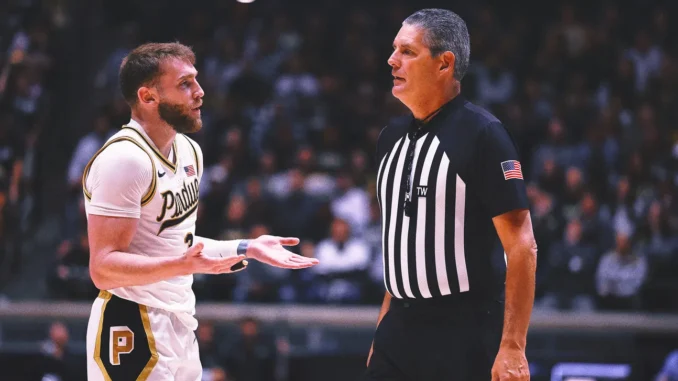
The most surprising development of the week is the plunge of the Purdue Boilermakers outside the Top 5. For a program anchored by a generational talent like their All-American center and guided by the consistently disciplined Matt Painter, a drop of this magnitude signals a deeper concern than a simple ranking adjustment.
Purdue’s strength has always been its clear identity: massive interior presence, elite free-throw shooting, and suffocating half-court defense. Their early-season success was a testament to this formula. The dip, however, is almost universally traceable to a loss, often an early conference matchup or a high-profile neutral site game where their weaknesses were exposed.
The primary flaw often identified is perimeter defense and three-point shooting consistency. While their star center dominates the paint, the team’s reliance on his gravity occasionally masks struggles in guarding the perimeter, especially against smaller, quicker guards who can pull their center away from the basket. Furthermore, when opposing teams successfully pack the paint, Purdue relies heavily on inconsistent outside shooting. When the three-pointers fall, they are unbeatable; when they don’t, the offense stagnates and becomes predictable.
The fall outside the Top 5 forces a necessary reassessment of Purdue’s national title readiness. Is this simply a temporary blip—a necessary, humbling loss that will refocus the team ahead of the conference tournament—or does it expose a fatal flaw that will be relentlessly attacked in March? Coach Painter now faces the challenge of adapting his scheme, particularly on defense, to prevent the same quick guards and outside shooters from consistently exploiting their vulnerabilities. For the Boilermakers, the drop in the rankings is less about punishment and more about a warning: adapt or face the same outcome against tournament competition.
The Crowded Middle: Chaos in the 5-15 Tier
The true madness and competitive depth of this season reside in the teams ranked from No. 5 to No. 15. This tier represents a veritable free-for-all, with teams trading places weekly based on marginal wins and losses. Unlike previous years where the Top 4 or 5 separated themselves, the current 5-15 grouping is separated by razor-thin margins, demonstrating the immense parity across the major conferences.
Teams in this section—including the likes of UCLA, Duke, UConn, and Gonzaga (or their equivalents in this week’s poll)—are all elite on paper, but each possesses a debilitating flaw. One team might have a phenomenal offense but consistently struggles to defend the pick-and-roll; another might feature a lottery-pick freshman class but lack the senior leadership necessary to close out tight road games. The movement within this tier is dictated by three factors:
-
Marquee Matchups: Victories in specific, high-profile games are golden tickets out of this tier, while a single loss can drop a team five or six spots, reflecting the Committee’s desire to punish inconsistency.
-
Road Performance: Success on the road is highly weighted. Winning away from home against a difficult opponent, even if unranked, signifies the maturity and composure necessary for NCAA Tournament success.
-
Net Ranking Dependence: Teams are subtly boosted or penalized by the NET rankings—the metric used to evaluate team sheets—which relies heavily on quality of wins and location. A team that wins consistently but lacks elite non-conference wins often finds itself stuck near the bottom of this grouping.
The 5-15 tier is the engine of ranking volatility. Any one of these teams is fully capable of making a Final Four run, but their inability to string together more than a few weeks of flawless basketball keeps the ranking picture murky. This depth ensures that every week is fraught with peril for even the most talented programs.
The Conference Impact: Shifts in Power Dynamics
The current AP Top 25 reflects significant power shifts across college basketball’s dominant conferences. The rankings are not merely about individual teams, but about the collective strength that defines the conference landscape.
The Big Ten Conundrum
The Big Ten, often perceived as a powerhouse, finds itself in an unusual position. While highly competitive, its reliance on specific styles of play (like Purdue’s post dominance or Michigan State’s reliance on disciplined guard play) means that conference success doesn’t always translate to non-conference stability. Purdue’s dip highlights a potential weakness across the league: a collective inability to consistently win against the athletic, up-tempo teams from the SEC or Big 12. The conference’s strength may be its internal cannibalism, where teams beat each other up, leaving the victor worn down rather than strengthened for the national stage.
The SEC’s Ascendancy
The Southeastern Conference (SEC) continues to flex its recruiting muscles, often placing multiple teams in the Top 25. The SEC’s identity is built on elite athleticism, size, and NBA-level talent, making their best teams highly versatile and difficult to prepare for. Their success reflects a modern shift in college basketball strategy: prioritizing long, agile athletes who can switch on defense and attack in transition. The SEC teams in the Top 10 are generally characterized by high-scoring efficiency and depth, enabling them to weather the injury and fatigue typical of conference play.
The Big 12’s Unrelenting Quality
The Big 12 remains the most challenging league from top to bottom. Even the “bottom” teams in the Big 12 possess the quality and coaching acumen to defeat Top 15 opponents, leading to the conference’s notoriously high strength of schedule ratings. The Big 12 teams that survive the gauntlet and remain ranked in the Top 15 are often the most battle-tested and physically prepared for the NCAA Tournament’s grueling structure. Their ranking stability, even if they hover outside the absolute Top 5, reflects the intrinsic, sustained difficulty of their schedule.
Looking Ahead: The Road to Selection Sunday
The volatility of the current AP Top 25 sets the stage for a dramatic and unpredictable second half of the season. The primary implication of this wide-open field is that the journey to the NCAA Tournament will be fraught with more peril than in recent memory, requiring sustained excellence rather than simply a few signature wins.
The Importance of Conference Tournaments
With so many teams clustered together, the Conference Tournaments in March will hold unprecedented weight. A top team could lose its No. 1 or No. 2 seed status with a single early tournament loss, while a team currently ranked No. 12 could secure a crucial Top 4 seed by running the table. The Committee will be forced to scrutinize head-to-head conference play and tournament performance with painstaking detail, as the separation between the fifth and twelfth-best team is minuscule.
The Search for Consistency
Ultimately, the team that separates itself from the chaos and claims a No. 1 seed in the NCAA Tournament will be the one that finds consistency. This means minimizing turnovers, excelling in free-throw percentage, and demonstrating discipline on defense—the bedrock principles that transcend talent. The current rankings suggest that many talented teams are sacrificing these fundamentals in pursuit of spectacular, yet unsustainable, play.
The race is now on for a team to establish itself as the most reliable rather than simply the most talented. If Purdue, or any other Top 10 team, can iron out its flaws and string together ten consecutive weeks of disciplined basketball, they will likely be the ones cutting down the nets in April.
The Thrill of the Unknown
The latest AP Top 25 poll, marked by Purdue’s dip and the crowning of a new No. 1, perfectly encapsulates the wild, unpredictable nature of the current men’s college basketball season. The rankings reflect not a fixed hierarchy, but a constant state of flux, where excellence is fleeting and competitive depth is paramount.
For fans, this volatility is the ultimate reward—it ensures that nearly every high-profile game carries the weight of national relevance. For the teams, it serves as a stern warning: the path to the Final Four is long, unforgiving, and demands a level of consistency that has yet to be seen from any program. The throne remains unsettled, and the race to claim it definitively promises a thrilling and chaotic journey toward Selection Sunday.
Leave a Reply