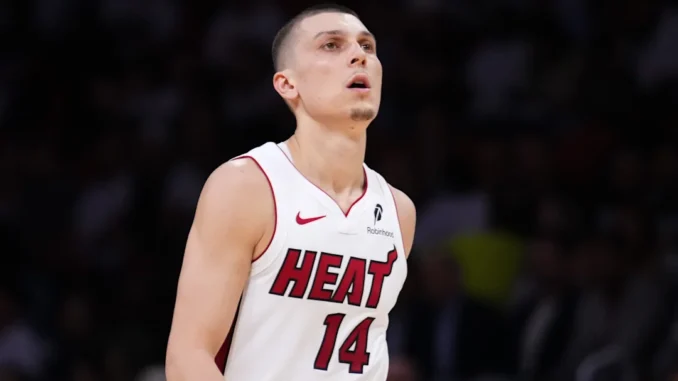
An Ill-Fitting Piece: Why Tyler Herro’s Style Clashes with the New Miami Heat Identity
The Miami Heat are undergoing a fundamental philosophical change. They have jettisoned their historically slow, half-court-grinding offense in favor of a new, high-paced, free-flowing, and versatile attack under Erik Spoelstra. They are now ranked among the fastest teams in the league, prioritizing early offense, ball movement, and the empowerment of multiple playmakers.
In this exciting new system, one glaring inconsistency has emerged: Tyler Herro no longer fits on the Miami Heat, and it couldn’t be more obvious.
While Herro remains an undeniably talented, All-Star caliber scorer—returning from injury with elite shooting splits and scoring over 24 points per game—his ball-dominant, score-first style of play is fundamentally at odds with the team’s new, egalitarian, and frantic offensive identity. This is not a knock on Herro’s skill, but a statement on the team’s evolving strategic needs. The Heat have outgrown their need for a high-usage guard who relies heavily on isolation and dribble-dribble-shoot tendencies.
The Pace Paradox: An Engine Built for Half-Court
The most striking change in Miami is the shift in pace. For years, the Heat were among the league’s slowest teams. Now, they are the fastest, spearheaded by the playmaking of Davion Mitchell and the aggressive downhill driving of Norman Powell and Andrew Wiggins.
Herro, however, is a classic half-court scorer. His best work comes from the methodical breakdown of defenses: high pick-and-rolls, deep pull-up jumpers, and contested floaters.
-
Slowing the Flow: Despite the team’s strong record since his return (3-1 in his first four games), there is an underlying sense that Herro’s presence—when inserted as the primary creator—inherently slows down the offense. The moment the ball hits his hands, the aggressive, attacking rhythm established by the starting unit often stalls.
-
The Drop in Playmaking: The statistics clearly show this shift in usage. Herro’s assist average has plummeted from his career-high of $5.5$ assists per game last season to just $2.8$ assists since his return this season. This is a direct consequence of the new system which places a premium on immediate passes and rapid decisions, not individual ball-pounding. Herro is still capable of generating offense, but he’s not generating it in the way the new Heat offense demands.
In this new Heat system, the best offense is a quick offense. Herro’s individual brilliance is forced to yield to the collective pace, minimizing his greatest strength: self-creation.
The Defensive Drag: A Permanent System Flaw
The biggest and most enduring issue with Herro’s fit is, and has always been, his defense. The Heat’s success is ultimately built on their defense, which is anchored by Bam Adebayo. While the new-look Heat offense is explosive, the team’s ability to win playoff series will depend on their defensive ability to execute precise schemes and switch seamlessly.
-
Targeted Liability: Herro remains a constant target for opposing offenses, as seen in the recent loss to the Pistons where he was reportedly “picked on defensively” in switches. In a playoff setting, opponents will run their entire offense through Herro, forcing Adebayo or another big to constantly rotate, exhausting the defense and creating mismatches.
-
The Alternative: The Heat’s newer rotation players—like Davion Mitchell and Jaime Jaquez Jr.—are superior, high-motor defenders who fit the “Heat Culture” identity perfectly. Mitchell is an elite point-of-attack defender, and Jaquez Jr. is an intelligent, versatile wing who can switch across three positions. When the Heat prioritize these players for defensive integrity, Herro’s minutes or role are inevitably compromised in high-leverage situations.
For a championship contender, having an elite offensive player whose presence inherently lowers the team’s defensive ceiling is a structural handicap that Erik Spoelstra cannot solve, only manage.
The Financial and Trade Reality: A Valuable, Expendable Asset
While Herro’s on-court fit is questionable, his value to the Heat organization is, paradoxically, at an all-time high. This fact seals his destiny as the team’s most necessary trade asset.
Herro is a 25-year-old All-Star (2025) under contract for two more seasons at $31 million and $33 million, respectively. He represents a massive salary slot and a desirable talent package for any team seeking a primary scorer.
The Giannis Antetokounmpo Conundrum
The most pressing trade scenario revolves around Giannis Antetokounmpo. For the Heat to win the bidding war against the Thunder and the Spurs for a generational star, they must offer a package of value that trumps pure draft capital. That package starts and ends with Herro, a Wisconsin native and proven All-Star who offers the Bucks an established star for their inevitable rebuild.
-
Salary Matching: Herro’s contract is essential for matching Giannis’s massive salary, as virtually no other combination of non-untouchables ($30M+) works efficiently.
-
Asset Appeal: He provides the Bucks with an immediate, high-volume scorer and a hometown narrative, which is far more appealing to a rebuilding team than relying purely on future draft picks.
Pat Riley is facing the classic dilemma: Is a great individual scorer who doesn’t fit the system more valuable as a trade chip than as a core player? The answer is unequivocally yes. Moving Herro allows the Heat to achieve three crucial objectives:
-
Acquire the Superstar: Land Giannis, turning the team into an instant title favorite.
-
Clean the Roster: Remove the biggest defensive liability and the friction in the offensive system.
-
Validate the New System: Fully commit to the high-pace, versatile offense that has shown early success.
Leave a Reply