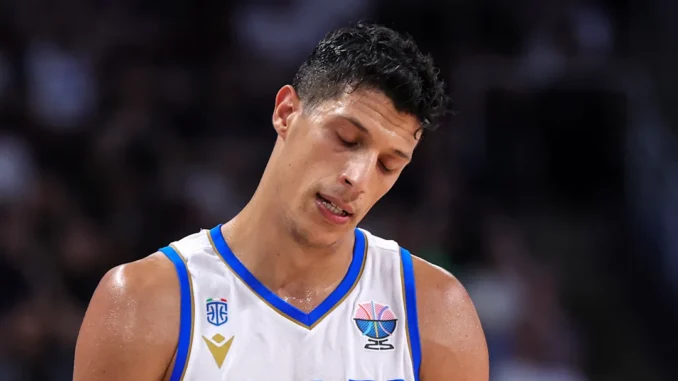
The Contender’s Caveat: Why the Heat’s Simone Fontecchio Realization is Detroit’s Old News
The Miami Heat, under the unwavering banner of “Heat Culture,” believed they had identified a perfect addition to their rotation: a versatile 6’7″ shooter, a 3-and-D wing in the mold that every contender craves. That player was Simone Fontecchio, acquired from the Detroit Pistons in the 2025 offseason.
Fontecchio arrived in South Beach fresh off a successful stint with the Pistons, where he’d averaged a career-high 15.4 points per game while shooting 42.6% from three in his initial 16 games following the 2024 trade deadline. The Heat saw those numbers, saw the European pedigree, and saw a solution to their perimeter scoring woes.
But as the 2025-26 season progresses, the Heat organization is making a painful, sobering realization—a truth that the Pistons already knew and priced into the final trade: Simone Fontecchio is a good player whose specific skills and weaknesses are violently incompatible with the demands of a championship contender.
The Heat have discovered that the dynamic, free-flowing scorer nurtured in Detroit is simply not the disciplined, switchable, and consistent piece required to win in the Eastern Conference playoffs, turning an offseason victory into a mid-season disappointment.
The Pistons’ Paradox: Why Success Led to Trade
To understand the Heat’s current dilemma, one must look at the foundation of the Pistons’ decision-making. Detroit traded for Fontecchio in February 2024 and subsequently signed him to a manageable two-year, $16 million contract in July 2024. For Detroit, Fontecchio was an absolute success story, but his ceiling and timeline were the problem.
The Good: Usage and Opportunity
In Detroit, Fontecchio was given a significant green light and increased usage. On a rebuilding team focused on developing Cade Cunningham and Jalen Duren, Fontecchio thrived on the open looks and offensive freedom afforded to him. He was able to attack closeouts, put the ball on the floor, and operate as a primary scoring option in certain bench units—a role that allowed his confidence to soar.
Pistons fans praised his grit and his occasional bursts of high-level scoring, recognizing that the team had successfully converted a former Jazz reserve into a valuable, tradable asset.
The Realization: Timeline and Ceiling
The Pistons’ front office, however, understood two crucial limitations:
-
The Defensive Ceiling: Despite his willingness, Fontecchio lacks the elite foot speed and strength to consistently guard top-tier wings and forwards in the NBA. On a bad defensive team, this weakness was masked by the overall chaos. The Pistons knew that if he were ever put in a high-leverage defensive situation, he would be exploited relentlessly.
-
The Contender’s Fit: The Pistons’ success with Fontecchio was predicated on high usage and offensive freedom. They realized that when forced back into a strictly catch-and-shoot role alongside ball-dominant stars, his streaky shooting, poor shot selection, and high turnover rate (as noted by Pistons fan commentary) resurfaced. For Detroit, a successful $8 million player was excellent. For a contender, he would be a liability at that price point.
The Pistons made a shrewd, cold-blooded decision: sell high on a player whose value was inflated by his role on a losing team, converting him into a piece that better served their long-term rebuild (i.e., trading him to the Heat as part of the Duncan Robinson sign-and-trade to acquire more assets or cap relief).
The Heat’s Miscalculation: Trading for a Stat-Line, Not a Role
The Miami Heat, famous for their ability to maximize talent, viewed the Pistons’ willingness to trade Fontecchio not as a warning, but as an opportunity. They believed Erik Spoelstra’s system and “Heat Culture” could sanitize his weaknesses and extract his best qualities—his size and shooting.
The Unmet Expectations: Defense and Consistency
The Heat expected Fontecchio to seamlessly replace the minutes and shooting of a player like Duncan Robinson (who was sent to Detroit in the trade) while offering superior positional size and a better defensive base.
The painful realization for the Heat is hitting hard in the mid-season:
-
Defensive Exposure: In Spoelstra’s switch-heavy, high-IQ defensive scheme, there are no places to hide. Fontecchio is frequently targeted and exploited by elite wings. His rotational struggles and lack of lateral quickness have led to numerous breakdowns, frustrating the otherwise meticulous Heat defense. This is the exact deficiency the Pistons realized would be catastrophic in the playoffs.
-
The Usage Drop: His offensive usage has plummeted from the 15.4 PPG he achieved in Detroit to just over 10 points per game in Miami, on slightly reduced efficiency (38.1% from three, according to the current 2025-26 stat lines). On the Heat, he is a spot-up shooter, and when his shot is not falling, he offers almost nothing else, often resorting to bad shots or turnovers when forced to initiate. The streaky nature of his shot, a weakness noted even by his European profile, is magnified on a team that needs consistency.
-
Financial Rigidity: The $8.3 million he is owed this season on a contract that expires in 2026 makes him an awkward, expiring contract. He is now too expensive to be a pure end-of-bench specialist, yet too flawed to be a reliable starter or core rotation player in the playoffs.
The realization is that Fontecchio’s success in Detroit was dependent on high volume and a low-pressure environment. He flourished when he could make mistakes and shoot through slumps. On the Heat, every mistake is costly, and every shot is under the intense pressure of championship expectation.
The Contender’s Caveat: Why Good Players Fail on Great Teams
The core difference between the Pistons’ perspective and the Heat’s current situation is the fundamental criteria for success.
-
For the Pistons: A player who can provide 15 points and shoot 42% from three for 16 games while maintaining a good attitude is a valuable asset. He served his purpose: increasing trade value and providing excitement during a tough season.
-
For the Heat: A player must provide specialized, reliable, and high-level complementary skills. If the primary skill (shooting) is streaky, and the secondary skill (defense) is a negative, the player becomes unplayable when the games truly matter.
The Miami Heat are currently facing the consequences of prioritizing a player’s uncontextualized statistics over a nuanced understanding of their role and limitations within a winning system—a costly mistake that Pat Riley rarely makes. The Pistons, in their rebuilding clarity, understood the player’s true ceiling and sold at the perfect time. The Heat, in their championship pursuit, are learning the hard way that one team’s success story can be another team’s costly lesson.
The challenge now falls to Erik Spoelstra to either miraculously fix Fontecchio’s defensive shortcomings or cut his minutes entirely, accepting that the promising offseason signing is likely a rental for salary matching purposes and not the rotational piece they desperately needed.
Leave a Reply