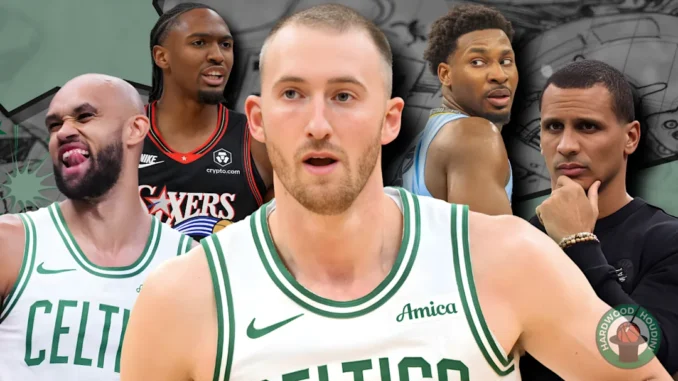
The Hauser Revelation: Sam Hauser’s Defensive Emergence as the Celtics’ Desperate, Unexpected Need
The Boston Celtics, a franchise defined by its defensive pedigree, have stumbled upon one of the season’s most unexpected revelations: the defensive transformation of Sam Hauser. Once viewed almost exclusively as a floor-spacing specialist—a sharpshooter whose primary job was to stand in the corner and sink timely threes—Hauser has quietly morphed into one of the team’s most reliable, high-IQ defenders. This realization, though subtle, fulfills a desperate underlying need that plagued the Celtics: finding a cost-controlled, scalable wing defender who could consistently execute the team’s complex switching schemes without sacrificing elite offensive gravity.
For years, the Celtics’ construction under various management regimes prioritized interchangeable wing defenders who were also high-usage offensive players (Jayson Tatum, Jaylen Brown, Marcus Smart). When they needed depth, they sought defense first. Hauser, however, was originally a bet on offense. His defensive emergence now offers the team an invaluable two-way stabilizing force that dramatically improves their flexibility and personnel choices, solving a desperate need for efficient depth that even large salaries couldn’t guarantee.
The Pre-Hauser Defensive Dilemma (The Desperate Need)
Before Sam Hauser’s defensive leap, the Celtics faced a structural problem common to elite, top-heavy rosters: the scaling of complementary talent.
1. The Financial Pinch
The Celtics are deeply invested in their core stars (Tatum, Brown) and key role players (Jrue Holiday, Kristaps Porziņģis, Derrick White). This reality creates immense pressure to find high-impact, low-cost depth players capable of playing heavy minutes, particularly off the bench. When budget players struggle defensively, they become massive liabilities that erode the overall defensive rating. The Celtics desperately needed a minimum-salary player who could hold his own and not force the coaches to compromise their defensive strategy.
2. The Defensive Gravity Trade-Off
The Celtics’ defense is based on switchability and length. Every player on the floor must be able to hold their ground, at least temporarily, against multiple positions. Historically, purely offensive specialists (often referred to as “shooters”) struggle here, forcing coaches to play them sparingly or to substitute them out in critical defensive moments. This creates predictability and makes the offense less lethal.
The desperate need was a player who:
-
Could shoot over 40% from three (Hauser’s established value).
-
Was structurally sound enough defensively to stay on the court in the fourth quarter.
Hauser initially fulfilled only the first point, meaning the team was desperately searching for a defender who wouldn’t compromise the offense when the stars rested.
The Revelation: Hauser’s Defensive Transformation
The “realization” that Sam Hauser is one of Boston’s best defenders isn’t rooted in him becoming a lockdown isolation specialist; rather, it’s his mastery of the systemic, high-IQ defense that Head Coach Joe Mazzulla and his staff demand.
1. System Execution and Positioning
Hauser’s primary defensive jump is attributed to flawless execution within the Celtics’ complex scheme. He is rarely caught out of position, excels at tagging and recovering on rotations, and effectively executes the team’s switch assignments.
-
Rotational Discipline: He anticipates where help defense is needed, often sliding into the paint or closing out on the weak side to deter passes or take charges. This discipline, though less flashy than a block or a steal, is the lifeblood of an elite NBA defense.
-
Fouling: His fouling rate is extremely low, a critical metric for a successful defender. He uses his length (6’8″ with a good wingspan) effectively to contest shots without lunging or fouling unnecessarily, conserving possessions and minimizing easy points for the opponent.
2. Contesting and Defending the Shot
Hauser’s length and quick close-outs have proven highly effective against perimeter shooters. When matched up on a wing or a guard, he relies on his wingspan and correct positioning to force tough attempts. The statistics bear this out: the opposition’s field goal percentage when defended by Hauser often drops below their season average, a testament to his consistent effort and spatial awareness.
3. Versatility and Scalability
Perhaps the most crucial aspect of the “realization” is his scalability. Hauser is demonstrating the ability to play heavy minutes alongside all combinations of Boston’s stars, particularly the high-usage offensive players. Because his defense is reliable and his shooting requires constant attention from the opponent, he is not a liability that the opponent can easily target or isolate. This allows the Celtics to deploy their best lineups for longer, making their overall ceiling higher.
The Impact of the Hauser Realization
The successful defensive integration of Sam Hauser is arguably as important as any major off-season trade, purely because of the financial and tactical freedom it provides.
1. Financial Flexibility
Hauser’s contract is an absolute steal for a player providing elite shooting and reliable defense. This minimal cap hit allows the front office to allocate their massive budget toward their core players and fill niche needs, rather than having to overpay for a rotation player who could provide similar minutes. He has become the definition of positive value in the salary cap era.
2. Lineup Optimization
The defensive trust earned by Hauser unlocks new lineup possibilities for Mazzulla.
-
Bench Stability: Hauser provides a stable defensive anchor for bench units, ensuring the defense doesn’t completely collapse when Tatum or Brown sit.
-
Dual-Threat Alignment: When playing alongside the starters, his defensive competence means the Celtics don’t have to choose between their best floor-spacer and their best perimeter defender. They get both, pushing the team’s offensive rating (due to his shooting gravity) and defensive rating (due to his high-IQ play) higher simultaneously.
3. Culture Reinforcement
Hauser’s transformation reinforces the culture that the Celtics staff seeks to instill: collective sacrifice and improvement. A player who was pigeonholed as a shooter took the initiative to become a complete player. This sets a powerful example for other young players and non-stars on the roster, confirming that defensive effort and learning the system are non-negotiable paths to earning consistent minutes on a championship-contending team.
The Celtics didn’t trade for a solution, nor did they sign a high-priced free agent. They developed a solution internally. Sam Hauser’s defensive realization has turned a desperate need for efficient, two-way depth into a tangible, high-value asset, proving that sometimes the best “secret weapon” is simply finding the hidden potential in the players you already have.
Leave a Reply