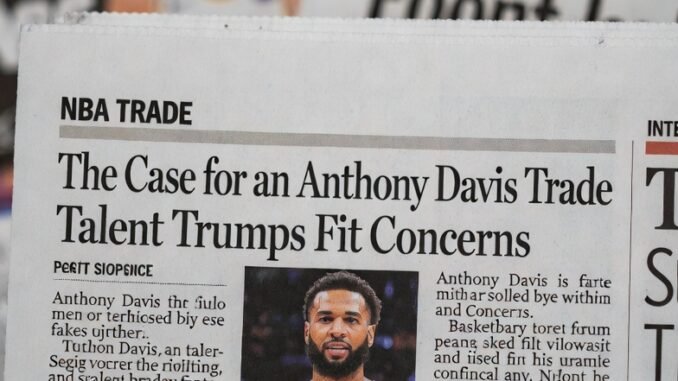
The Case for an Anthony Davis Trade: Talent Trumps Fit Concerns
Pat Riley and the Heat organization have an established history of aggressively pursuing superstars when the opportunity arises. The chance to acquire a perennial All-Star and former champion like Anthony Davis, even with his noted injury history and unique contract situation, is a scenario the Heat must explore.
1. The Defensive Ceiling: A Historic Frontcourt Duo
The most compelling argument for the trade is the immediate, game-breaking defensive potential of a Bam Adebayo and Anthony Davis frontcourt.
- Elite Rim Protection: Davis is a five-time All-Defensive First Team selection. Pairing his elite shot-blocking and paint deterrence with Adebayo’s incredible versatility and switchability would instantly create arguably the most fearsome defensive tandem in modern NBA history.
- Defensive Versatility: In the current hyper-spaced NBA, having two big men capable of guarding the perimeter and protecting the rim is the ultimate competitive advantage. This duo would allow the Heat to deploy a virtually impenetrable, switch-everything scheme, effectively eliminating opponents’ pick-and-roll attacks and forcing low-percentage shots. This fits perfectly with the “Heat Culture” emphasis on elite, championship-level defense.
2. The Talent Upgrade and Playoff Pedigree
While the Heat’s current core, led by Jimmy Butler, has proven its ability to make deep playoff runs, adding a talent of Davis’s caliber provides the necessary edge to transcend from a contender to a definitive favorite.
- True Co-Star: Davis offers a legitimate co-star presence that the Heat have consistently pursued. He can seamlessly function as the team’s primary scorer on any given night, taking pressure off Butler and providing an interior scoring threat that the Heat’s offense currently lacks.
- Championship Experience: Davis’s role in winning the 2020 NBA Championship provides the invaluable, proven playoff pedigree that Pat Riley covets. He knows what it takes to win at the highest level.
🚧 The Critical Obstacles: Cost, Injury, and Fit
Despite the tantalizing potential, the move for Anthony Davis carries significant risks related to cost, availability, and offensive fit.
1. The Trade Cost: Preserving Future Assets
The primary hurdle for the Heat is formulating a trade package that satisfies the Mavericks without completely liquidating Miami’s future.
- The Mavs’ Rebuild Price: Following the firing of their GM, the Mavericks’ asking price for Davis is likely to pivot toward young talent and draft picks to kickstart a rebuild around their remaining core.
- The Heat’s Trade Chips: Miami’s most attractive pieces for a rebuilding team are Tyler Herro, Jaime Jaquez Jr., and Kel’el Ware, along with tradable draft capital. The Heat should draw a hard line at including both Jaquez Jr. and Ware, who are seen as integral parts of the team’s long-term future and fit the culture perfectly. A potential package would likely center around Tyler Herro, Andrew Wiggins, and draft picks, which may not be enough for Dallas.
- The Contract: Davis’s max contract, while justifiable for his talent, puts a tremendous financial strain on the Heat, who are currently trying to remain competitive while navigating the luxury tax and the NBA’s second apron rules.
2. Injury and Availability Concerns
Davis has a history of high-profile injuries, which is the single biggest question mark hanging over any trade.
- Recent Trends: The Mavericks’ experience with him this season highlights the concern, as he has played in only 16 of a possible 43 games due to a calf strain, detached retina, and adductor strain.
- Risk vs. Reward: The Heat would be trading a significant portion of their depth and future assets for a player whose annual availability is consistently in question. This is a massive gamble, especially for a franchise that thrives on consistency and hard-wearing players.
3. Offensive Fit and Pace
The proposed Davis/Adebayo frontcourt, while defensively dominant, raises valid concerns about the offensive spacing and flow, particularly in light of Miami’s current offensive identity.
- Spacing: While Davis is an improved mid-range shooter, neither he nor Bam Adebayo are high-volume three-point threats. The lack of three-point shooting from the starting frontcourt could clog the paint for Butler’s drives, requiring the Heat’s perimeter players (Norman Powell, Andrew Wiggins, etc.) to be absolutely lights-out from beyond the arc.
- Pace: The Heat have been playing at a much faster pace this season, a style that benefits their younger, athletic wings. Davis’s game is often played at a more deliberate pace. Erik Spoelstra would need to masterfully blend his current fast-paced offense with a more structured, post-up-heavy game for Davis.
Final Verdict and Trade Strategy
The Miami Heat must pursue Anthony Davis, but with a clearly defined cap on the assets they are willing to surrender.
The Decision Point: The Heat’s most logical trade is to offer a package anchored by Tyler Herro and potentially Andrew Wiggins (who has been playing well) and draft picks. The line in the sand should be protecting Jaime Jaquez Jr., who embodies the future of “Heat Culture.”
Pat Riley’s Mandate: The time is now. Jimmy Butler is in the final years of his prime, and the franchise must maximize its championship window. Anthony Davis is one of the few players available who could realistically swing the championship pendulum in the Eastern Conference. The risk is immense, but the reward—a top-two defensive unit in NBA history and a legitimate title favorite—is worth the gamble for a franchise whose identity is built on chasing rings.
They should push hard for a trade, banking on their training and medical staff to manage Davis’s health, and on Erik Spoelstra to solve the dual-center offensive conundrum. The ultimate goal is to put a third star next to Butler and Adebayo; Davis is the most realistic 10-time All-Star opportunity on the market.
Leave a Reply