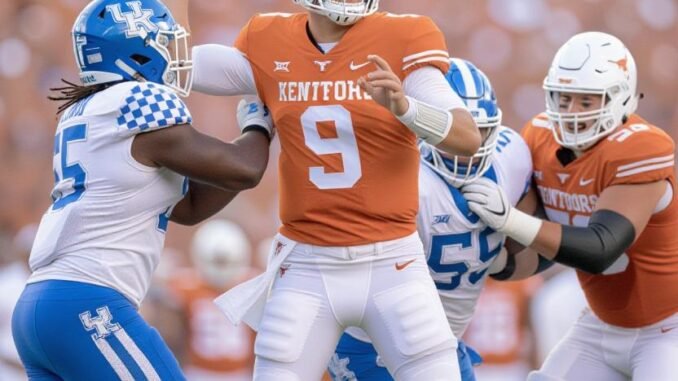
The Alarming Anomaly: How Steve Sarkisian’s Offense Hit Two New Lows in the Longhorns’ Win Over Kentucky
A victory is a victory, and ultimately, that is all that matters for a national championship contender. Yet, the Texas Longhorns’ grinding, 13-10 win over the Kentucky Wildcats was less a showcase of offensive dominance and more a neon warning sign blinking over the program’s most trusted unit: Steve Sarkisian’s offense. While the defense and special teams (specifically Mason Shipley) secured the result, the Longhorns’ attack hit two unprecedented lows that raise serious questions about the team’s ability to compete with the elite defenses left on the schedule.
The two most damning metrics were not total yardage or time of possession, but specific, fundamental failures in efficiency and execution: Red Zone conversion failure (forcing a reliance on field goals) and an alarming drop in explosive play rate. For an offense built on surgical execution and field-stretching capability, these twin lows suggest that opposing defensive coordinators have finally found the blueprint to neutralize Sarkisian’s sophisticated scheme.
Low No. 1: The Red Zone Conversion Crisis
The primary job of an elite offense is not merely to move the ball, but to turn drives into touchdowns once they cross the 20-yard line. Against Kentucky, Texas failed this core mission repeatedly, exposing a profound lack of punch near the goal line.
The Stalling Engine
Texas’s offense managed to move the ball with difficulty against a rugged Kentucky defense, but the moment they hit the red zone, the engine sputtered into neutral. For a game that ended 13-10, this is the most critical area of failure. Instead of finding ways to score seven points, Texas was repeatedly forced into the following sequence:
- First Down: A short run or an incomplete pass.
- Second Down: A play-action pass that goes nowhere, often resulting in a scramble or a check-down that leaves them well short of the goal line.
- Third Down: An attempted conversion pass (often a fade or a route across the middle) that is broken up or simply results in no gain, forcing the field goal unit onto the field.
The Longhorns were unable to execute the concise, high-percentage, scheme-specific plays that are the hallmarks of Sarkisian’s genius. The failure was not one-dimensional; it was a crisis of both play-calling and execution.
The Goal-Line Gap
The inability to punch the ball into the end zone, even after having driven over 60 or 70 yards, forced Mason Shipley to be the difference-maker. Shipley’s brilliance covered up the fact that Texas settled for three field goals on drives that should have, by all metrics of an elite offense, resulted in touchdowns. Had Shipley missed even one of those attempts, Texas would have lost the game.
The red zone struggle reveals that when the field shrinks, and the defense knows the threats are constrained, the Longhorns lack the necessary physicality or complexity to create immediate separation. This low conversion rate against a high-quality defense is a dangerous precursor to matchups against the best defensive units in the conference and in the College Football Playoff hunt. Championship teams score touchdowns in the red zone; Texas settled for draws.
Low No. 2: The Alarming Drop in Explosive Play Rate
Steve Sarkisian’s offensive philosophy is predicated on generating explosive plays—runs of 10+ yards and passes of 20+ yards. These plays flip field position, put defenses on their heels, and ultimately define an offense’s efficiency. Against Kentucky, the Texas explosive play rate plunged to a new low for the season, essentially paralyzing the offense.
Defensive Neutralization
Kentucky’s defensive coordinator executed a brilliant game plan, focusing almost entirely on preventing the Longhorns from stretching the field vertically. They utilized two-high safety shells to limit the deep passing game, forcing the Texas quarterback to settle for short, underneath throws.
In the past, when defenses dared Texas to run, they punished them. When they dared Texas to throw short, they turned short gains into long runs after the catch. Against Kentucky, however, the defense successfully compressed the field and eliminated the space necessary for the Longhorns’ elite receivers to generate their usual yards after the catch (YAC).
- Vertical Stagnation: The deep shots that are characteristic of the Texas offense were either tightly covered or resulted in incompletions. This forced the offense into long, drawn-out, high-risk drives that required perfect execution over 10 to 12 plays.
- Yards After Catch (YAC) Failure: The speed and athleticism of Kentucky’s linebackers and secondary prevented the Longhorns receivers from breaking tackles and turning five-yard routes into 15-yard gains, an absolute staple of the Texas attack.
The Problem of Predictability
When the explosive plays vanish, an offense loses its greatest weapon: the threat of the big play. Without that fear factor, the opposing defense can play more aggressively against the run and dedicate more resources to stopping the short passing game.
The low explosive play rate suggests that Sarkisian’s signature play-calling sequences—the use of play-action after a run, or the quick vertical shot after several short passes—were anticipated and neutralized. This is the ultimate insult to a play-caller of Sarkisian’s reputation. The Longhorns are supposed to be unpredictable, yet against Kentucky, they were rendered surprisingly linear and controllable.
The Root Cause: Execution and Trust
The two statistical lows are symptoms of deeper issues within the Longhorns offensive ecosystem.
Questionable Quarterback Play
While the entire offense struggled, a significant portion of the blame must fall on the quarterback. Sarkisian’s offense demands perfection in the pre-snap process and decisive reads post-snap.
In a tough, defensive game, there were likely several instances where the quarterback either missed open receivers downfield due to pressure or failed to pull the trigger on a tight-window throw that was necessary to convert a third down or secure a red zone touchdown. The conservative nature of the offense in the second half suggests a lack of trust in the quarterback’s ability to consistently execute complex, high-risk, high-reward plays necessary to break open the game.
Offensive Line Struggles in Short Yardage
The failure to convert in the red zone directly points to struggles along the offensive line, particularly in short-yardage and goal-line situations. For an offense that prides itself on imposing its will, the inability to consistently generate three yards of push when needed to score a touchdown is alarming.
This forces the play-calling to become overly reliant on perimeter speed or pass concepts, abandoning the physical mandate required to dominate close-quarters battles. An elite offensive line creates space; against Kentucky, the line allowed the defense to collapse that space too easily.
The Path Forward: Avoiding a Relapse
The good news is that Texas won, and the problems are fixable. The bad news is that they were exposed in a manner that will give every future opponent a comprehensive defensive blueprint.
1. Re-establishing the Vertical Threat
Sarkisian must prioritize plays that successfully break the two-high safety shell. This might involve using tight end movements to create 1-on-1 matchups, or incorporating more run-pass options (RPOs) that freeze the second level of the defense long enough for receivers to get vertical separation. The offense must force defenses to pay a severe price for playing conservatively.
2. Simplifying the Red Zone Attack
The Longhorns need to find two or three “can’t-miss” goal-line concepts that rely on pure execution rather than complexity. This could involve more power running formations with two tight ends, or simplifying the pass routes to basic slants and flat routes that guarantee positive yardage and force the defense to choose between covering the flat and defending the middle. The goal is to maximize the first two downs to set up a manageable third-down scenario.
3. Trusting the Playmakers
The offense needs to find ways to get the ball into the hands of its elite receivers in space. If YAC is being neutralized by tight coverage, Sarkisian must scheme ways to achieve that separation pre-snap. More jet sweeps, quick screens, and pre-designed misdirection plays are necessary to force the defense to account for the speed threat horizontally before they can worry about it vertically.
The victory over Kentucky was a testament to the Longhorns’ defense and special teams tenacity. However, the two new offensive lows revealed a critical vulnerability. If the Longhorns want to transition from a good team to a championship team, they must solve the mystery of their stalled offense before a similarly rugged defense turns a 13-10 win into a devastating 13-10 loss.
Leave a Reply