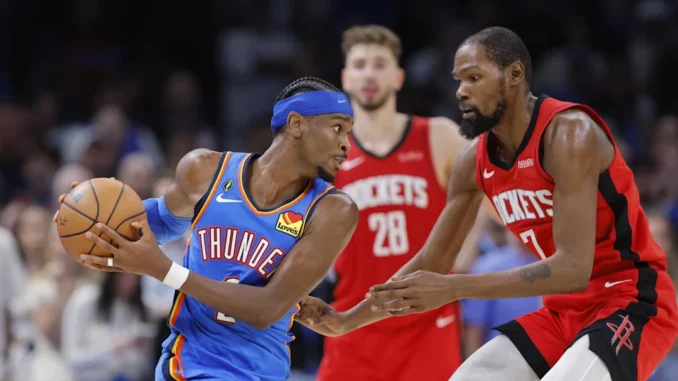
The Asset Revolution: Why Thunder and Rockets Have a Championship Blueprint the Heat Can Only Dream Of
The NBA season opener is always a promise—a lightning strike of action reminding fans that the long wait is over. This year, perhaps more than any other, that first night offered a powerful microcosm of the league’s shifting landscape. We saw classic, gritty, veteran-led battles, but the real narrative was being written by the Oklahoma City Thunder and the Houston Rockets, two franchises that have methodically armed themselves with a generational collection of assets.
While a “Game One classic” might be determined by a buzzer-beater, a championship blueprint is built on structural integrity and optionality. In this context, the Thunder and Rockets are miles ahead of the ever-competitive, yet structurally constrained, Miami Heat. The Heat have defined the 2020s by making deep playoff runs through sheer will, organizational “Culture,” and veteran star power, but their path to a true title requires a perilous, high-stakes trade that might never materialize. The Thunder and Rockets, conversely, have already secured their future with unprecedented draft capital, young stars on controlled contracts, and financial flexibility that Miami sacrificed long ago. Their blueprints don’t just aspire to a title; they are designed to command one.
The Oklahoma City Thunder: Architects of Optionality
The Oklahoma City Thunder’s front office, led by General Manager Sam Presti, executed what will go down in NBA history as the single most successful asset accumulation strategy of the modern era. The strategy was simple: trade every available veteran for draft picks, prioritize high-ceiling talent over immediate wins, and wait for the mathematical probability of a superstar to pay off. What they created wasn’t just a rebuild; it was a self-sustaining asset factory.
The Crown Jewel: Shai Gilgeous-Alexander
The foundation of the Thunder’s present success and future ceiling is Shai Gilgeous-Alexander (SGA). Acquired in the trade that sent Paul George to the Los Angeles Clippers, SGA transformed from a promising young guard into a perennial All-NBA First Team selection. This level of organic, internal development is the holy grail of any blueprint, as it means the team found its cornerstone without sacrificing all of its assets. SGA’s rise—a guard who can get to the rim at will, hit tough mid-range shots, and function as the team’s primary creator—gave immediate, concrete meaning to the abstract value of their draft capital.
SGA’s contract status is a crucial part of the blueprint. He is signed through his prime, allowing the Thunder to maximize their competitive window without the immediate pressure of an expiring deal. This contrasts sharply with Miami’s constant, expensive need to retain or acquire top-tier veteran talent. OKC’s superstar is home-grown, cheap relative to his value, and locked in.
The Asset Reservoir: Draft Pick Wealth
The true genius of the OKC plan lies in the unprecedented cache of future draft picks. At one point, the Thunder possessed over 30 draft picks through the next seven years, including a slew of valuable first-rounders from Denver, Houston, the Clippers, and Utah. This asset pool does three things for the Thunder that the Heat cannot replicate:
- Unlimited Flexibility: If a top-five player suddenly becomes available via trade—a hypothetical LeBron, or a disgruntled superstar—the Thunder can outbid any team in the league. They can offer combinations of guaranteed first-round picks, high-ceiling young players, and pick swaps that are simply non-replicable. Miami, by contrast, often finds itself restricted to offering two future first-rounders and a mid-level young player, a package that is increasingly uncompetitive in the trade market.
- Trade Protection: Their pick stockpile acts as an insurance policy. If a future pick fails to land a star, they simply use another one. They can afford to be aggressive and take chances without fearing a complete collapse of their future viability, a luxury only available to a team with so many resources.
- Developmental Buffer: It allows them to develop young talent without rushing. Players like Chet Holmgren (the defensive anchor and stretch big) and Jalen Williams (the two-way secondary playmaker) were high draft picks who are thriving precisely because the organization is not reliant on their immediate superstar performance. They are allowed to grow into their roles, a process that is often accelerated—and sometimes destroyed—by the win-now pressure of a team like the Heat.
The Thunder’s blueprint is a mathematical advantage realized in basketball form. It is a slow, patient, and precise accumulation of resources that guarantees they will have the tools to acquire the final piece when the window truly opens.
The Houston Rockets: Aggressive Acceleration
The Houston Rockets took a different, but equally powerful, route to structural advantage. After the disastrous James Harden trade fallout, Houston bottomed out, accumulating a high-ceiling young core of Jalen Green, Amen Thompson, Jabari Smith Jr., and Alperen Şengün. However, the Rockets realized that youth, by itself, is often disorganized and inefficient. Their blueprint transition was one of aggressive acceleration.
From Tanking to Targeted Spending
The key pivot for Houston was their willingness to weaponize their cap space this past summer. Cap space is often viewed as a passive asset, but the Rockets treated it as currency, quickly transforming their balance sheet into stability and leadership.
They signed veteran point guard Fred VanVleet to a lucrative, high-dollar contract. While some criticized the dollar amount, the strategic value was undeniable: VanVleet immediately gave the young team a bona fide, champion-caliber floor general, someone who understands time, score, and NBA defense. He took the playmaking burden off Jalen Green, allowing him to focus on becoming an elite scorer.
Next, they acquired defensive-minded, high-motor wing Dillon Brooks. Love him or hate him, Brooks provides a defensive identity and intensity that was completely absent from the Rockets’ roster during their tanking years.
The Ime Udoka Factor
The hiring of Ime Udoka was the necessary cultural counter-balance to Miami’s “Culture.” Instead of relying on an established, internal ethos, the Rockets imported a modern, disciplined, and defensively focused head coach known for demanding accountability. Udoka’s job is to impose structure and professionalism on the young talent, turning raw potential into winning habits—the fast track to organizational discipline.
Houston’s blueprint works because they used their asset advantage—massive cap space—to buy the maturity and culture that OKC is waiting to develop and that Miami is constantly trying to maintain. They shortened the timeline significantly.
The Rockets now boast a roster with:
- A high-ceiling core (Şengün’s playmaking, Green’s scoring, Smith Jr.’s defense/shooting, Thompson’s athleticism).
- Veteran leadership (VanVleet, Brooks) signed with the money the team generated through tanking.
- An established, defensive-minded coach.
Their path is clear: let the veterans mentor and lead while the young players mature into a cohesive unit. If the team stalls, they still have flexibility to trade the large, expiring contracts they created, converting the money back into future assets or another established star. The Rockets bought their way out of the NBA’s developmental wilderness and now stand firmly on a path built on financial leverage and tactical urgency.
The Miami Heat Paradox: The Culture Ceiling
The Miami Heat are arguably the best-run organization of the last decade, but their championship blueprint is a high-wire act—a perpetual trade-off between today and tomorrow. This is where their success becomes their greatest structural liability.
The Cost of Consistency
The Heat’s success is rooted in the legendary “Heat Culture”—an ethos of accountability, conditioning, and unwavering competitive spirit championed by President Pat Riley and implemented by Coach Erik Spoelstra. This culture has allowed the team to consistently outperform its perceived talent level, resulting in Finals appearances in 2020 and 2023.
However, Culture does not generate draft picks, nor does it create cap space.
The Heat’s primary mode of acquiring star talent has been two-fold:
- Veteran Attraction: Relying on the reputation of the organization to attract established veterans (like Jimmy Butler).
- Trading Away Futures: Consistently trading future draft capital and young talent to acquire immediate upgrades or to shed salary for pursuit of the next star (e.g., their pursuit of Bradley Beal or Damian Lillard).
This approach has led to a structural deficit:
- Scarcity of Assets: The Heat’s draft capital is severely limited. They often lack the tradable first-round picks to make a compelling offer for the elite star needed to push them over the top. When star-hunting, they are forced to include their few remaining young players (like a Tyler Herro or Duncan Robinson) in trade packages simply to match salary or add marginal value, constantly depleting the pipeline.
- Cap Constriction: Unlike the Thunder and Rockets, the Heat are typically cap-strapped, forced to operate using exceptions or relying on minimum contracts to fill out the roster around their highly paid core (Jimmy Butler, Bam Adebayo). This leaves little margin for error in building depth.
- The Aging Star Problem: While Jimmy Butler is a playoff warrior, he is also aging and his contract demands are significant. The Heat are locked into winning now, as their window is dictated by Butler’s remaining elite years. There is no fallback plan, no reservoir of picks to accelerate a new rebuild if Butler declines or gets injured.
The Heat are perpetually stuck in the mid-contention zone, where a title is possible only if they land an unquestionably elite top-five player, often via a demanding trade market where OKC and Houston hold all the leverage. Their reliance on veteran ambition means they are always sacrificing the future for a chance at the present, a strategy that is inherently precarious in the modern NBA, which rewards teams that control their own destiny.
The West’s Youthful Surge vs. Miami’s Grind
The difference in blueprints is also a difference in style and sustainability. The Heat play a physically demanding, often grueling, defensive style, perfectly suited for the Eastern Conference grinder. But the West is now defined by youthful dynamism.
- The Thunder’s offense, centered on SGA’s isolation mastery and Holmgren’s spacing, is built on modern efficiency and fluidity.
- The Rockets are combining athletic aggression with veteran organization.
Both Western teams have futures that are entirely within their control. They can choose to trade for the final piece, sign it in free agency (Houston), or wait for their young players to develop organically (OKC). Miami, by contrast, is standing in line, hoping a star forces their way to South Beach.
Game One: A Harbinger of the Future
Imagine that “Game One classic” of the season. Let’s say it was the Thunder vs. the Lakers—a high-stakes, competitive environment.
The Thunder lost nothing in that hypothetical loss; they gained experience for their young core. Every clutch possession defended by Holmgren, every mid-range shot made by Jalen Williams, is a developmental win. They exit the game knowing they are on the right track, with nine first-round picks still in the holster for a rainy day.
Now imagine a similar close, grinding loss for the Heat. A loss for Miami costs them something vital: another game in an aging Jimmy Butler’s prime, another minute of high-leverage wear and tear, and perhaps most importantly, another data point confirming they are still one superstar short. They exit the game facing a harsh reality: they have almost no draft capital left to acquire that missing piece, and the clock is ticking faster than their young player development can keep up.
This is the crux of the comparison: The OKC and Houston blueprints are about building equity, whereas the Miami blueprint is about spending equity.
The structural advantage of the Thunder and Rockets is too profound to ignore. OKC has the flexibility to buy any stock on the market; Houston bought the necessary management to run the new factory; Miami is trading vintage items and hoping the market doesn’t crash.
Leave a Reply